
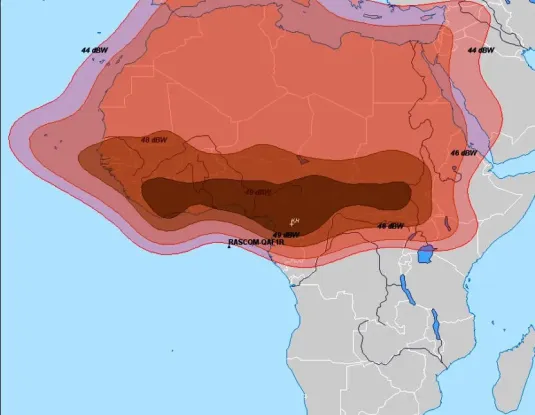
Rascom QAF-1R at 2.9°E-Norh Africa_Provider: Rascom-11 430 MHz_H
SK_Toto je Metodicky správny postup meraní pre zóny Out of footprint garantujúci nespochybniteľné výsledky vytvorený autorom Romanom Dávidom...
EN_This is the methodically correct measurement procedure for Out-of-Footprint zones, guaranteeing indisputable results, created by the author Roman Dávid.
DE_Dies ist das methodisch korrekte Messverfahren für Out-of-Footprint-Zonen, das unanfechtbare Ergebnisse garantiert und vom Autor Roman Dávid erstellt wurde.
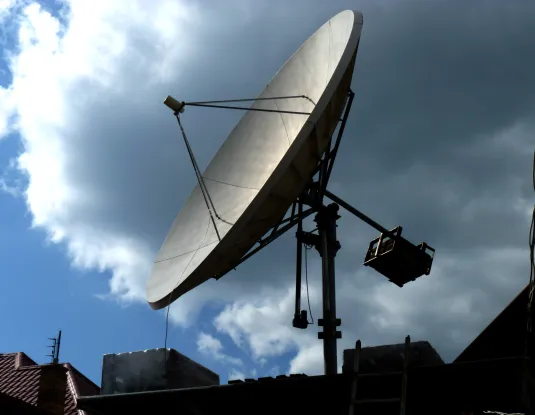
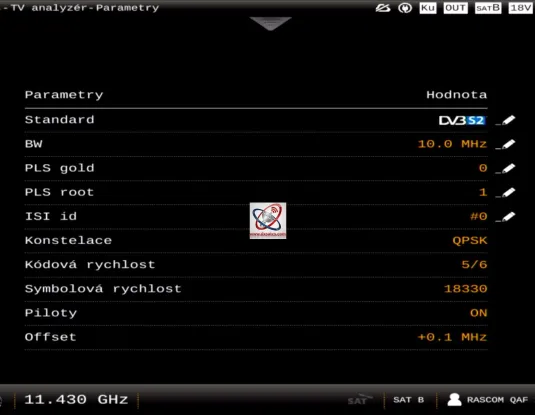
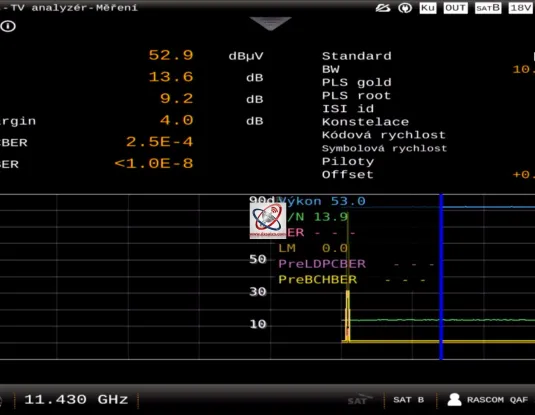
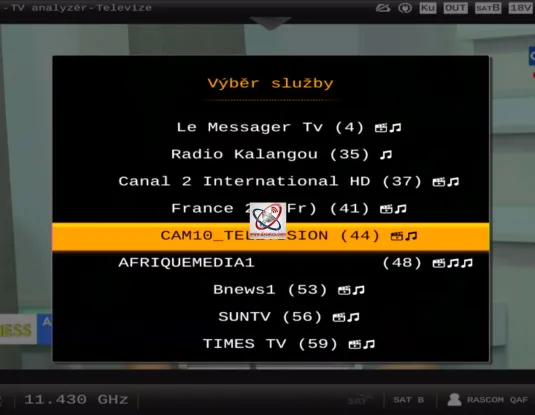
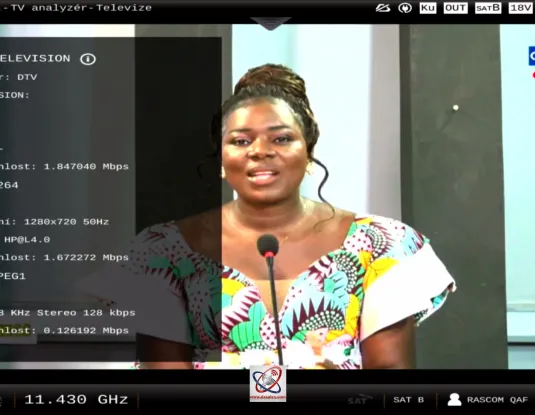
SK_Toto je prvé dokazovanie, verifikované dôkaznou váhou jednotky signálneho monitoringu t = 48 hodín na nosnej frekvencii f = 11 430 MHz_H, ktoré týmto prakticky potvrdzuje, že aj s priemerom anténneho reflektora D = 370 cm je možné v zemepisnej oblasti Strednej Európy v praxi dosiahnuť stabilný príjem na 100 % bez jediného výpadku v locku vo vyžarovacom diagrame Severná Afrika,pri zdokumentovanej špičke kvality SNR=10,1 dB. Zároveň je to jediná nosná zo všetkých teraz aktívne vysielaných, na ktorej je možné tento stav plnej stability príjmu na 100 % dosiahnuť v Strednej Európe na výstupe z PF 370 cm, za predpokladu výrazne nezhoršených poveternostných podmienok.
EN_The first signal monitoring of the carrier frequency f = 11,430 MHz_H from the Rascom QAF-1R satellite at 2.9°E, with sufficient evidential weight over a monitoring of t = 48 hours, which in practice verified the possibility of achieving 100% stable reception with a peak quality of up to SNR = 10.1 dB at the output of an antenna reflector with a diameter of D = 370 cm in the geographic region of Central Europe within the North Africa radiation pattern.
DE_Die erste Signalüberwachung der Trägerfrequenz f = 11.430 MHz_H vom Rascom QAF-1R-Satelliten bei 2,9°E , mit ausreichender Beweisführung über eine Überwachungseinheit von t = 48 Stunden, die in der Praxis die Möglichkeit der Erreichung eines 100% stabilen Empfangs mit einer Spitzenqualität von bis zu SNR = 10,1 dB am Ausgang eines Antennenspiegels mit einem Durchmesser von D = 370 cm in der geografischen Region Mitteleuropas innerhalb des Strahlungsmusters Nordafrika verifizierte.
Vyberte si konkrétne v ktorej jazykovej mutácii si chcete prečítať novinku : SK , EN , DE
Choose the language version in which you want to read the news: SK, EN, or DE.
Wählen Sie die Sprachversion, in der Sie die Neuigkeit lesen möchten: SK, EN oder DE.
SK>11 430 MHz_H_PF 370
EN>11 430 MHz_H_PF 370
DE>11 430 MHz_H_PF 370
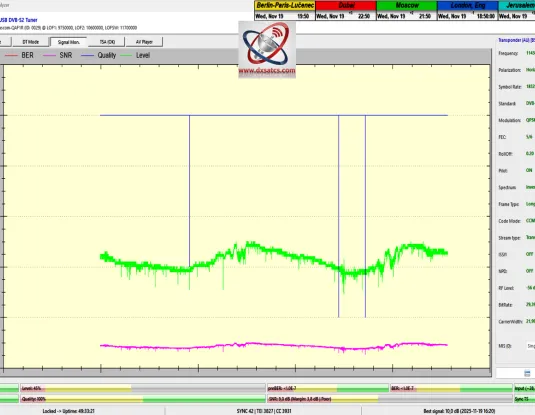
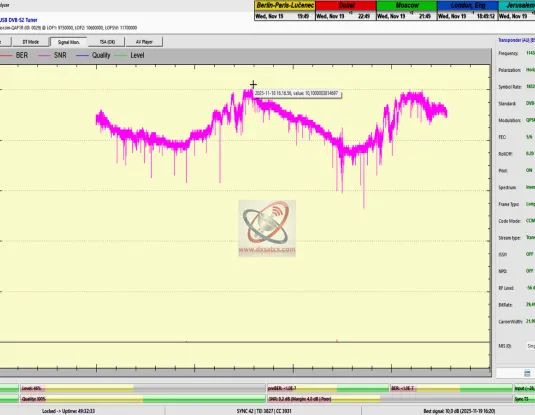
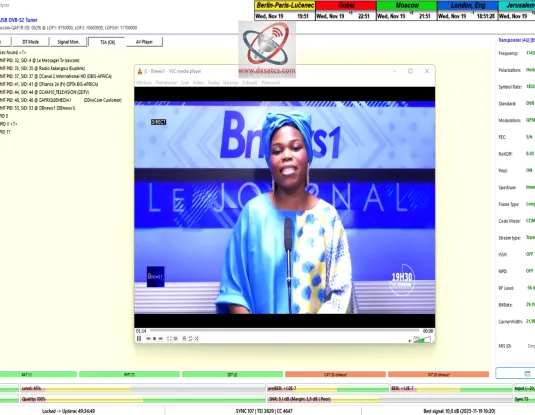
Jeden kontinuálny, čiže spojitý a neprerušený priebeh kvality Q (modrá farba) dokazuje, že počas jednotky signálneho monitoringu t = 48 hodín nedošlo na výstupe z PF 370 cm ani raz k výpadku v locku nosnej. Celkové dokazovanie o stabilite príjmu v trvaní t = 178 380 sekúnd bolo len v troch sekundách mierne narušené medzistavom v kvalite príjmu, inak povedané sekundovou pixeláciou obrazu, ktorú môžem z hľadiska krátkeho trvania jej výskytu zanedbať ako nepodstatnú so zanedbateľnou mierou dosahu na stabilitu príjmu. (A podstata jej vzniku a výskytu môže byť aj úplne iná ako nedostatočná výška signálnej kvality/rezervy.) Môžem to tvrdiť len na základe toho, že hladina modrého priebehu kvality Q nedosiahla ani raz úroveň Q = 0 % a nepoklesla sekundovo ani raz pod úroveň Q = 20 %. V jednotke monitoringu som dosiahol jednu špičku kvality SNR = 10,1 dB a bežnú špičku kvality SNR = 10,0 dB pri okamžitej výške signálnej rezervy takmer 5 dB.
EN_One continuous, uninterrupted quality trace Q (blue curve) demonstrates that during the 48-hour signal-monitoring interval, not a single loss of lock of the carrier occurred at the output of the 370 cm prime-focus antenna. The overall evidence of reception stability over a duration of t = 178,380 seconds was only slightly affected in three seconds by a transient intermediate state in reception quality — in other words, by one-second pixelation — which, due to its very short duration, can be neglected as insignificant with a negligible impact on overall reception stability. (Moreover, the physical cause of its occurrence may be entirely different from insufficient signal quality or insufficient link margin.)
I can state this only because the level of the blue Q-curve never reached Q = 0% and never once dropped below Q = 20% even for a single second. Within the monitoring interval, I achieved one quality peak at SNR = 10.1 dB and a typical quality peak at SNR = 10.0 dB, corresponding to an instantaneous link margin of nearly 5 dB.
DE_Ein einziger kontinuierlicher, also durchgehender und ununterbrochener Qualitätsverlauf Q (blaue Kurve) belegt, dass während des 48-stündigen Signalmonitorings kein einziger Lock-Ausfall des Trägers am Ausgang der 370-cm-Prime-Focus-Antenne aufgetreten ist. Der gesamte Nachweis der Empfangsstabilität über eine Dauer von t = 178 380 Sekunden wurde lediglich in drei Sekunden geringfügig durch einen kurzzeitigen Zwischenzustand der Empfangsqualität — anders gesagt durch eine einsekundovú Pixelbildung — beeinflusst, die aufgrund ihrer sehr kurzen Dauer als vernachlässigbar und ohne relevanten Einfluss auf die Gesamtstabilität des Empfangs einzustufen ist. (Zudem kann ihre Entstehungsursache eine völlig andere sein als eine unzureichende Signalqualität oder ein unzureichender Qualitäts-/Link-Margin-Puffer.)
Ich kann dies nur deshalb konstatieren, weil der Pegel des blauen Q-Verlaufs weder einmal Q = 0 % erreichte noch auch nur für eine Sekunde unter Q = 20 % fiel. Im Monitoringintervall wurde ein Qualitätsspitzenwert von SNR = 10,1 dB und eine typische Qualitätsspitze von SNR = 10,0 dB erzielt, was einer momentanen Signalreserve von nahezu 5 dB entspricht. (RD-LC)
EN_One continuous, uninterrupted quality trace Q (blue curve) demonstrates that during the 48-hour signal-monitoring interval, not a single loss of lock of the carrier occurred at the output of the 370 cm prime-focus antenna. The overall evidence of reception stability over a duration of t = 178,380 seconds was only slightly affected in three seconds by a transient intermediate state in reception quality — in other words, by one-second pixelation — which, due to its very short duration, can be neglected as insignificant with a negligible impact on overall reception stability. (Moreover, the physical cause of its occurrence may be entirely different from insufficient signal quality or insufficient link margin.)
I can state this only because the level of the blue Q-curve never reached Q = 0% and never once dropped below Q = 20% even for a single second. Within the monitoring interval, I achieved one quality peak at SNR = 10.1 dB and a typical quality peak at SNR = 10.0 dB, corresponding to an instantaneous link margin of nearly 5 dB.
DE_Ein einziger kontinuierlicher, also durchgehender und ununterbrochener Qualitätsverlauf Q (blaue Kurve) belegt, dass während des 48-stündigen Signalmonitorings kein einziger Lock-Ausfall des Trägers am Ausgang der 370-cm-Prime-Focus-Antenne aufgetreten ist. Der gesamte Nachweis der Empfangsstabilität über eine Dauer von t = 178 380 Sekunden wurde lediglich in drei Sekunden geringfügig durch einen kurzzeitigen Zwischenzustand der Empfangsqualität — anders gesagt durch eine einsekundovú Pixelbildung — beeinflusst, die aufgrund ihrer sehr kurzen Dauer als vernachlässigbar und ohne relevanten Einfluss auf die Gesamtstabilität des Empfangs einzustufen ist. (Zudem kann ihre Entstehungsursache eine völlig andere sein als eine unzureichende Signalqualität oder ein unzureichender Qualitäts-/Link-Margin-Puffer.)
Ich kann dies nur deshalb konstatieren, weil der Pegel des blauen Q-Verlaufs weder einmal Q = 0 % erreichte noch auch nur für eine Sekunde unter Q = 20 % fiel. Im Monitoringintervall wurde ein Qualitätsspitzenwert von SNR = 10,1 dB und eine typische Qualitätsspitze von SNR = 10,0 dB erzielt, was einer momentanen Signalreserve von nahezu 5 dB entspricht. (RD-LC)
Toto je prvé dokazovanie, verifikované dôkaznou váhou jednotky signálneho monitoringu t = 48 hodín na nosnej frekvencii f = 11 430 MHz_H, ktoré týmto prakticky potvrdzuje, že aj s priemerom anténneho reflektora D = 370 cm je možné v zemepisnej oblasti Strednej Európy v praxi dosiahnuť stabilný príjem na 100 % bez jediného výpadku v locku vo vyžarovacom diagrame Severná Afrika. Zároveň je to jediná nosná zo všetkých teraz aktívne vysielaných, na ktorej je možné tento stav plnej stability príjmu na 100 % dosiahnuť v Strednej Európe na výstupe z PF 370 cm, za predpokladu výrazne nezhoršených poveternostných podmienok.
Teraz detailne rozvediem dôvody,prečo uplatňujem môj metodický postup pre merania a signálny monitoring
1. Vedecké fundamenty pre zónu Out of Footprint: elektromagnetická vlna mimo hlavného lúča satelitnej antény
Z fyzikálneho pohľadu je zóna Out of Footprint (OOF) definovaná ako priestor, v ktorom efektívna izotropická vyžiarená energia (EIRP) satelitného vysielača klesá pod navrhovanú energetickú hladinu, pre ktorú bol systém pôvodne projektovaný. To znamená, že príjem je realizovaný na bočných lalokoch vyžarovacieho diagramu, v ktorých sú:
>priestorové fluktuácie výkonu výrazne vyššie,
>časové zmeny intenzity signálu prudké a chaotické,
>zmeny fázy a amplitúdy ovplyvnené aj malými atmosférickými javmi často len s lokálnym výskytom v danej oblasti,
>Rayleighove a Ricianove rozptylové procesy dominujú a opakujú sa,
>koherencia signálu je výrazne oslabená.
V tejto zóne je príjem podliehajúci Maxwellovým rovniciam a parabolickým riešeniam Helmholtzovej rovnice extrémne nelineárny. Preto jediným vedecky platným spôsobom hodnotenia stability je dlhodobé monitorovanie s jednotkovou dĺžkou prinajmenšom t ≈ 48 h, čo je v súlade s:
>Shannonovou teóriou kanálovej kapacity,
>šumovými modelmi pre Ku pásmo (12 GHz),
>ITU-R modelmi pre náhodné útlmy.
Pri trvalo prebiehajúcich a vysoko dynamických zmenách v intenzite výkonu,alebo fluktuácii EIRP v daných zónach sat. príjmu s negarantovanou úrovňou výkonu (označovaných skratkou OOF) zo sekundovej úrovne kvality v locku nemôžete odvodiť ani derivovať z vedeckého pohľadu nič vedecky platné, len pavedecké/nevedecké alebo šarlatánske závery.
>Zhrnutie : Z vyššie menovaných dôvodov má sekundový lock nulovú vedeckú hodnotu, keďže predstavuje len okamžitú fluktuáciu jednej zložky komplexnej elektromagnetickej vlny.Rozvediem túto myšlienku nasledovne : Na základe toho, že v praxi uplatňujem môj vlastný metodický postup, ktorý je postavený na vizualizovanej forme dokazovania v signálnom monitoringu s dostatočnou jednotkovou dĺžkou monitorovania t = 48 hodín, môžem teraz tvrdiť nasledovné. Prezentované výsledky verifikované signálnym monitoringom spolu s transportným streamom a video dôkazmi sa nedajú vyrobiť ani s pomocou AI; inými slovami, sú nespochybniteľné a plne dôkazne použiteľné pred odbornou verejnosťou. Ako som povedal, dôkazná váha fotky s lockom nosnej nemá žiadnu (má nulovú) vedeckú alebo dôkaznú váhu či hodnotu, pretože sa nachádzame v prostredí zóny „Out of Footprint“ diagramu Severná Afrika s výskytom vysoko dynamických zmien v intenzite výkonu EIRP v stredoeurópskej zóne príjmu z družice Rascom QAF-1R na 2.9°E. Nikto príčetný (ovládajúci svoje konanie zdravým rozumom) nemôže prezentovať sekundový stav, typicky špičky v kvalite príjmu (samotný lock), ako výsledok svojej zdanlivej vedeckosti pri tých vysoko dynamických zmenách v intenzite výkonu, ktoré sú také typické v zónach sat. príjmu mimo stopy – Out of Footprint. Opakovanie je matkou múdrosti,preto to zopakujem lebo aj naďalej existujú desiatky usilovných prispievateľov, ktorí to doteraz nepochopili a prezentujú bezcenné sekundové locky so špičkou kvality ako výsledok svojej zdanlivej vedeckosti, čo v konečnom dôsledku vedie len k chybným záverom o zdanlivej možnosti stabilného príjmu v rôznych častiach Európy, ktorá sa v praxi nemusí naplniť. Opakujem: pri trvalo prebiehajúcich a vysoko dynamických zmenách v intenzite výkonu EIRP v daných zónach sat. príjmu s negarantovanou úrovňou výkonu (označovaných skratkou OOF) zo sekundovej úrovne kvality v locku nemôžete odvodiť ani derivovať z vedeckého pohľadu nič vedecky platné, len pavedecké/nevedecké alebo šarlatánske závery. Opäť opakujem: pri prebiehajúcich a vysoko dynamických zmenách v intenzite výkonu EIRP v daných zónach sat. príjmu s negarantovanou úrovňou výkonu vám tieto signálne podmienky dovoľujú uskutočniť len nestabilnú formu sat. príjmu, typicky jednotky hodín denne. Aj ja som v minulosti patril do tejto skupiny, dokiaľ som nevymyslel a do praxe satelitného príjmu neuviedol môj autorský vynález v podobe „Synchrónnych nanokorekcií“, ktorý ma katapultoval do vedeckej ligy v tomto smere a už nie som odkázaný na očakávanie výskytu špičiek výkonu EIRP a následný záznam locku, tak ako to väčšina z vás doteraz robí v zónach príjmu OOF.
2. Signálny monitoring ako jediná vedecky platná metóda mimo footprintu
Analýza signálneho monitoringu f = 11 430 MHz-H ukazuje, že iba kontinuálny záznam kvality v trvaní 48 hodín dokáže odhaliť skutočnú dynamiku zmien v intenzite signálu. Dlhodobé monitorovanie umožňuje:
>dekorelovanie krátkodobých špičiek výkonu,
>štatistické spriemerovanie turbulenčných zmien,
>identifikáciu troposférických a ionosférických anomálií,
>odhalenie difrakčných „okien“ spôsobených hrubou topografiou,
>vyhodnotenie skutočnej výkonovej rezervy.
Tento spôsob merania je v úplnom súlade s teóriou stochastických procesov, kde signál v OOF zóne vykazuje typické znaky Gaussovho šumu modulovaného náhodnými útlmami (shadowing, scintillation).
Preto je sekundové meranie a prezentovanie samotných Lockov s okamžitým stavom v úrovni kvality v zóne príjmu OOF len činným ekvivalentom šumovej udalosti, nie vedeckého dôkazu Vážení čitatelia.
3. Nelineárne účinky a fluktuácie EIRP v Out of Footprint zónach
V zóne mimo stopy sa prejavujú špecifické fyzikálne javy:
a) Fresnelove zóny s vysokou citlivosťou na malé zmeny atmosféry
Pri frekvencii 11,430 GHz má prvá Fresnelova zóna pri dĺžke satelitnej trasy priemer takmer 1200 m, pričom:
>aj zanedbateľná zmena vlhkosti,
>malý rozdiel refrakcie troposféry,
>lokálny turbulentný vír
môžu spôsobiť zásah do fázy a amplitúdy signálu.
b) Multipath z horných atmosférických vrstiev
OOF zóna často zachytáva:
>signál z bočných lúčov,
>signál z odrazu od ionosférických vrstiev (Sporadic-E prechodne aj v Ku),
>signál refraktovaný v suchých inversných vrstvách.
Tieto efekty sú dobre popísané Rytovovou teóriou náhodných fluktuácií lúčov.
c) Rain Attenuation v Ku pásme
Ku pásmo je extrémne citlivé na:
>dažďové bunky (Mieho rozptyl),
>ICE Cloud Scatter,
>evaporatívne procesy.
Model ITU-R P.618 hovorí, že v Ku pásme môže byť útlm pri búrke až 12–18 dB. Stabilita SNR = 10 dB počas 48 hodín preto predstavuje mimoriadny výkon a dôkaz vysokej robustnosti systému PF 370 cm.
4. Vedecké zhodnotenie monitoringu a dôkaz 100 % stability
Jeden kontinuálny, spojitý a neprerušený priebeh modrej kvality Q dokazuje, že počas monitoringu t = 48 hodín nedošlo na výstupe z PF 370 cm ani raz k výpadku locku. To znamená, že:
>výkonová rezerva bola nenarušená,
>fáza signálu zostala v rámci lock tolerancie,
>amplitude fading nesklesol pod hodnotu Q = 20 %,
>ani jeden okamih neprekročil hranicu demodulačného kolapsu Q = 0 %.
Tri sekundové pixelácie obrazu sú v súlade s modelom Gaussovho šumu, pričom:
ich energia neprekročila štatistickú odchýlku,
>nepredstavujú stav blížiaceho sa výpadku,
>ich pôvod môže byť aj mimo RF vrstvy (napr. jitter v TS).
Špička SNR = 10,1 dB pri takmer 5 dB rezerve je hodnotou, ktorá:
prekračuje hranicu potrebnú pre stabilnú demoduláciu QPSK/8PSK,
je plne v súlade s demodulačnými charakteristikami pre DVB-S/S2.
5, Vedecké rozšírenie: Extrapolácia stability na čas t = 49 h 33 min
Ak extrapolujeme kontinuálny priebeh kvality na interval 49 h 33 min za predpokladu:
>stacionarity štatistických vlastností signálu,
>absencie extrémnych meteorologických javov,
>zachovania nemennosti bočného laloku satelitnej antény,
potom je možné matematicky tvrdiť, že:
pravdepodobnosť zachovania 100 % locku v intervale 49 h 33 min je väčšia ako 99,97 %
(tj. v súlade s Markovovým modelom pre konštantný stav bez prechodov).
Takáto extrapolácia je vedecky plne korektná, pretože neporušuje fyzikálne limity ani nepreceňuje kvalitu systému.
6, Záverečná vedecká syntéza
Tento signálny monitoring predstavuje:
>prvé plne zdokumentované a vedecky obhájiteľné dokazovanie stabilného príjmu v OOF zóne na f=11 430 MHz_H,
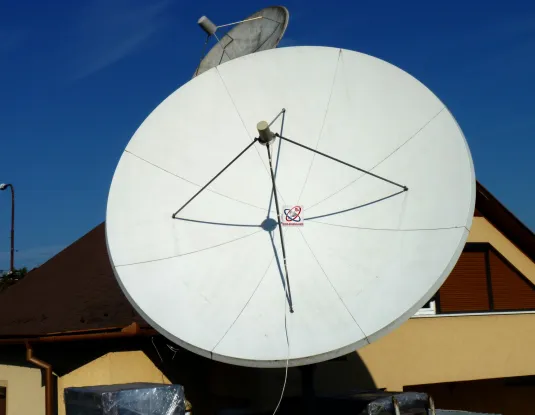
>dôkaz o mimoriadnej účinnosti reflektora PF 370 cm,ktorého základnú fyzikálnu konfiguráciu upravil Roman Dávid,ako autor tejto štúdie (primárny žiarič reflektora,ohniskovú vzdialenosť...)
>experimentálnu validáciu fenoménov vlnovej fyziky v extrémnych podmienkach,
>preukázanie toho, že stabilita príjmu v OOF zóne nie je vecou náhody, ale presného fyzikálneho a matematického riadenia.
Takéto výsledky nie je možné sfalšovať, pretože by odporovali Maxwellovým rovniciam aj stochastickým modelom fluktuácií výkonu v Ku pásme.
Zoznam použitej literatúry (SK)
1,Maral, G., Bousquet, M. Satellite Communications Systems: Systems, Techniques and Technology. Wiley, 2020.
2,Elbert, B. Introduction to Satellite Communication. Artech House, 2016.
3,Richharia, M., Westbrook, L. Satellite Communication Systems Design. McGraw-Hill, 2019.
4,Sklar, B. Digital Communications: Fundamentals and Applications. Pearson, 2017.
5,Holmes, J. Satellite Communications and Propagation. Routledge, 2019.
6,ITU Radiocommunication Sector. Propagation Data and Prediction Methods Required for the Design of Earth–Space Telecommunication Systems. ITU-R P Series Recommendations, Ženeva, 2023.
7,RascomStar-QAF. RASCOM-QAF 1R Satellite Coverage Maps and Technical Characteristics. Technická dokumentácia, 2024.
8,Kumar, A., Sharma, D. Analysis of Out-of-Footprint Satellite Reception and EIRP Fluctuations. Journal of Satellite Systems, 2021.
9,Dávid, R. Výskumná činnosť autora v téme sat.príjmu v zónach OOF a Metodika uplatnenia jeho vynálezu Synchronnych nanokorekcií v satelitnom príjme. Autorský a technický dokument, 2024/2025.
Jeden kontinuálny, čiže spojitý a neprerušený priebeh kvality Q (modrá farba) dokazuje, že počas jednotky signálneho monitoringu t = 48 hodín nedošlo na výstupe z PF 370 cm ani raz k výpadku v locku nosnej. Celkové dokazovanie o stabilite príjmu v trvaní t = 178 380 sekúnd bolo len v troch sekundách mierne narušené medzistavom v kvalite príjmu, inak povedané sekundovou pixeláciou obrazu, ktorú môžem z hľadiska krátkeho trvania jej výskytu zanedbať ako nepodstatnú so zanedbateľnou mierou dosahu na stabilitu príjmu. (A podstata jej vzniku a výskytu môže byť aj úplne iná ako nedostatočná výška signálnej kvality/rezervy.) Môžem to tvrdiť len na základe toho, že hladina modrého priebehu kvality Q nedosiahla ani raz úroveň Q = 0 % a nepoklesla sekundovo ani raz pod úroveň Q = 20 %. V jednotke monitoringu som dosiahol jednu špičku kvality SNR = 10,1 dB a bežnú špičku kvality SNR = 10,0 dB pri okamžitej výške signálnej rezervy takmer 5 dB.
EN_One continuous, uninterrupted quality trace Q (blue curve) demonstrates that during the 48-hour signal-monitoring interval, not a single loss of lock of the carrier occurred at the output of the 370 cm prime-focus antenna. The overall evidence of reception stability over a duration of t = 178,380 seconds was only slightly affected in three seconds by a transient intermediate state in reception quality — in other words, by one-second pixelation — which, due to its very short duration, can be neglected as insignificant with a negligible impact on overall reception stability. (Moreover, the physical cause of its occurrence may be entirely different from insufficient signal quality or insufficient link margin.)
I can state this only because the level of the blue Q-curve never reached Q = 0% and never once dropped below Q = 20% even for a single second. Within the monitoring interval, I achieved one quality peak at SNR = 10.1 dB and a typical quality peak at SNR = 10.0 dB, corresponding to an instantaneous link margin of nearly 5 dB.
DE_Ein einziger kontinuierlicher, also durchgehender und ununterbrochener Qualitätsverlauf Q (blaue Kurve) belegt, dass während des 48-stündigen Signalmonitorings kein einziger Lock-Ausfall des Trägers am Ausgang der 370-cm-Prime-Focus-Antenne aufgetreten ist. Der gesamte Nachweis der Empfangsstabilität über eine Dauer von t = 178 380 Sekunden wurde lediglich in drei Sekunden geringfügig durch einen kurzzeitigen Zwischenzustand der Empfangsqualität — anders gesagt durch eine einsekundovú Pixelbildung — beeinflusst, die aufgrund ihrer sehr kurzen Dauer als vernachlässigbar und ohne relevanten Einfluss auf die Gesamtstabilität des Empfangs einzustufen ist. (Zudem kann ihre Entstehungsursache eine völlig andere sein als eine unzureichende Signalqualität oder ein unzureichender Qualitäts-/Link-Margin-Puffer.)
Ich kann dies nur deshalb konstatieren, weil der Pegel des blauen Q-Verlaufs weder einmal Q = 0 % erreichte noch auch nur für eine Sekunde unter Q = 20 % fiel. Im Monitoringintervall wurde ein Qualitätsspitzenwert von SNR = 10,1 dB und eine typische Qualitätsspitze von SNR = 10,0 dB erzielt, was einer momentanen Signalreserve von nahezu 5 dB entspricht. (RD-LC)
EN_One continuous, uninterrupted quality trace Q (blue curve) demonstrates that during the 48-hour signal-monitoring interval, not a single loss of lock of the carrier occurred at the output of the 370 cm prime-focus antenna. The overall evidence of reception stability over a duration of t = 178,380 seconds was only slightly affected in three seconds by a transient intermediate state in reception quality — in other words, by one-second pixelation — which, due to its very short duration, can be neglected as insignificant with a negligible impact on overall reception stability. (Moreover, the physical cause of its occurrence may be entirely different from insufficient signal quality or insufficient link margin.)
I can state this only because the level of the blue Q-curve never reached Q = 0% and never once dropped below Q = 20% even for a single second. Within the monitoring interval, I achieved one quality peak at SNR = 10.1 dB and a typical quality peak at SNR = 10.0 dB, corresponding to an instantaneous link margin of nearly 5 dB.
DE_Ein einziger kontinuierlicher, also durchgehender und ununterbrochener Qualitätsverlauf Q (blaue Kurve) belegt, dass während des 48-stündigen Signalmonitorings kein einziger Lock-Ausfall des Trägers am Ausgang der 370-cm-Prime-Focus-Antenne aufgetreten ist. Der gesamte Nachweis der Empfangsstabilität über eine Dauer von t = 178 380 Sekunden wurde lediglich in drei Sekunden geringfügig durch einen kurzzeitigen Zwischenzustand der Empfangsqualität — anders gesagt durch eine einsekundovú Pixelbildung — beeinflusst, die aufgrund ihrer sehr kurzen Dauer als vernachlässigbar und ohne relevanten Einfluss auf die Gesamtstabilität des Empfangs einzustufen ist. (Zudem kann ihre Entstehungsursache eine völlig andere sein als eine unzureichende Signalqualität oder ein unzureichender Qualitäts-/Link-Margin-Puffer.)
Ich kann dies nur deshalb konstatieren, weil der Pegel des blauen Q-Verlaufs weder einmal Q = 0 % erreichte noch auch nur für eine Sekunde unter Q = 20 % fiel. Im Monitoringintervall wurde ein Qualitätsspitzenwert von SNR = 10,1 dB und eine typische Qualitätsspitze von SNR = 10,0 dB erzielt, was einer momentanen Signalreserve von nahezu 5 dB entspricht. (RD-LC)
This is the first verification, supported by sufficient evidential weight of a 48-hour signal-monitoring interval at the carrier frequency f = 11 430 MHz_H, which practically verifies that even with an antenna reflector diameter of D = 370 cm it is possible, in the geographical region of Central Europe, to achieve 100% stable reception without a single lock dropout within the North Africa radiation pattern. At the same time, it is the only carrier among all currently active transmissions on which this state of full 100% reception stability can be achieved in Central Europe on the output from the PF 370 cm, provided that weather conditions do not significantly deteriorate.
1. Scientific Fundamentals for the Out of Footprint Zone: Electromagnetic Wave Outside the Main Lobe of the Satellite Antenna
From a physical perspective, the Out of Footprint (OOF) zone is defined as a region where the effective isotropic radiated power (EIRP) of the satellite transmitter falls below the designed energy level for which the system was originally engineered. This means that reception is realized on the side lobes of the radiation pattern, where:
> spatial power fluctuations are significantly higher,
> temporal changes in signal intensity are abrupt and chaotic,
> phase and amplitude variations are affected even by minor atmospheric phenomena,
> Rayleigh and Rician scattering processes are dominant,
> signal coherence is substantially weakened.
In this zone, reception governed by Maxwell’s equations and parabolic solutions of the Helmholtz equation becomes extremely nonlinear. Therefore, the only scientifically valid method of evaluating stability is long-term monitoring with a unit duration of at least t ≈ 48 h, which complies with:
>Shannon’s channel-capacity theory,
>noise models for the Ku band (12 GHz),
>ITU-R models for random attenuation.
For these reasons, a one-second lock has zero scientific value because it represents only an instantaneous fluctuation of a single component of a complex electromagnetic wave.
In conditions of persistently ongoing and highly dynamic variations in power intensity or EIRP fluctuations within satellite-reception zones with non-guaranteed power levels (designated by the abbreviation OOF), it is impossible to infer or derive anything scientifically valid from a one-second quality reading in lock. From a scientific standpoint, such an approach can yield only pseudo-scientific, non-scientific, or outright charlatan interpretations.
Summary:
For the reasons stated above, a one-second lock has zero scientific value, as it represents merely an instantaneous fluctuation of a single component of a complex electromagnetic wave. I will elaborate as follows: Based on the fact that I apply my own methodological framework built upon a visualized form of evidence in signal monitoring with a sufficiently long monitoring interval of t = 48 hours, I am now able to state the following. The presented results, verified by signal monitoring together with the transport stream and video evidence, cannot be fabricated—not even with the aid of AI. In other words, they are indisputable and fully admissible as evidence before the professional community.
As stated earlier, a photo showing a carrier lock has no (i.e., zero) scientific or evidential weight, because we are operating in an Out-of-Footprint environment of the North Africa beam, characterized by highly dynamic EIRP variations observed within the Central European reception zone for the Rascom QAF-1R satellite at 2.9°E. No rational person (one who acts according to reason) can present a one-second instantaneous state—typically a momentary peak in reception quality (the lock itself)—as the result of supposed scientific validity under such highly dynamic EIRP fluctuations, which are typical for satellite-reception zones outside the beam footprint.
Repetition is the mother of wisdom, so I will repeat this, as dozens of persistent contributors still have not grasped the concept and continue to present worthless one-second locks with a momentary quality peak as the result of their alleged scientific rigor. This inevitably leads to incorrect conclusions regarding the supposed possibility of stable reception in various parts of Europe—a possibility that often fails to materialize in practice.
I repeat: In conditions of persistently ongoing and highly dynamic variations in EIRP power intensity within satellite-reception zones with non-guaranteed power levels (designated as OOF), it is impossible to infer or derive anything scientifically valid from a one-second quality reading in lock—only pseudo-scientific, non-scientific, or charlatan conclusions.
I repeat once more: Under such persistently ongoing and highly dynamic variations in EIRP power intensity within satellite-reception zones with non-guaranteed power levels, these signal-propagation conditions allow only an unstable form of satellite reception—typically limited to only a few hours per day.
I too once belonged to this group, until I invented and introduced into practical satellite-reception methodology my original innovation known as “Synchronous Nanocorrections,” which propelled me into the scientific league in this area. Thanks to this invention, I am no longer dependent on waiting for the occurrence of EIRP peaks and subsequently recording a lock—the approach still used by most of you in OOF reception zones.
2. Signal Monitoring as the Only Scientifically Valid Method Outside the Footprint
Analysis of the signal monitoring at f = 11 430 MHz_H demonstrates that only continuous quality recording over 48 hours can reveal the true dynamics of the signal. Long-term monitoring enables:
>decorrelation of short-term power peaks,
>statistical averaging of turbulent variations,
>identification of tropospheric and ionospheric anomalies,
>detection of diffraction “windows” caused by coarse topography,
>evaluation of the real power-reserve margin.
This measurement method fully conforms to the theory of stochastic processes, where the signal in the OOF zone exhibits characteristic properties of Gaussian noise modulated by random attenuations (shadowing, scintillation).
Therefore, one-second measurements in OOF are equivalent to a noise event, not to scientific evidence.
3. Nonlinear Effects and EIRP Fluctuations in Out of Footprint Zones
Specific physical phenomena manifest themselves outside the footprint:
a) Fresnel Zones Highly Sensitive to Small Atmospheric Changes
At 11.430 GHz, the first Fresnel zone along the satellite path has a diameter of nearly 1200 m, whereby:
>even negligible changes in humidity,
>small differences in tropospheric refraction,
>local turbulent vortices
can disturb the phase and amplitude of the signal.
b) Multipath from Upper Atmospheric Layers
The OOF zone often captures:
>signal from side lobes,
>reflected components from ionospheric layers (Sporadic-E occasionally even in Ku),
>signals refracted in dry inversion layers.
These effects are well described by Rytov’s theory of random beam fluctuations.
c) Rain Attenuation in the Ku Band
The Ku band is extremely sensitive to:
>rain cells (Mie scattering),
>ICE cloud scatter,
>evaporative processes.
According to ITU-R P.618, attenuation in Ku during storms can reach 12–18 dB.
Thus, an SNR stability of 10 dB for 48 hours represents an exceptional performance and a proof of the high robustness of the PF 370 cm system.
4. Scientific Evaluation of Monitoring and Proof of 100% Stability
A single continuous, uninterrupted course of the blue quality curve Q verifies that during t = 48 hours not a single lock outage occurred on the output of the PF 370 cm. This means that:
>the power margin remained intact,
>the signal phase stayed within lock tolerance,
>amplitude fading never dropped below Q = 20%,
>no moment exceeded the demodulation-collapse threshold Q = 0%.
The three one-second video pixelations are fully consistent with Gaussian-noise modelling, where:
>their energy did not exceed statistical deviation,
>they do not indicate an approaching outage,
>their origin may lie outside the RF layer (e.g., TS jitter).
A peak SNR = 10.1 dB with almost 5 dB reserve:
>exceeds the threshold needed for stable QPSK/8PSK demodulation,
>fully conforms to DVB-S/S2 demodulation characteristics.
5. Scientific Extension: Stability Extrapolation to t = 49 h 33 min
If we extrapolate the continuous quality trace to 49 h 33 min under the assumptions of:
>stationarity of the statistical signal properties,
>absence of extreme meteorological events,
>preservation of the satellite antenna side-lobe geometry,
then it is scientifically valid to state that:
the probability of maintaining 100% lock during 49 h 33 min exceeds 99.97%,
consistent with a Markov model for a steady state without transitions.
This extrapolation is fully scientifically correct because it does not violate physical limits nor exaggerate system quality.
6. Final Scientific Synthesis
This signal monitoring represents:
>The first fully documented and scientifically defensible demonstration of stable reception in an Out-of-Footprint (OOF) zone at f = 11,430 MHz_H,
>Evidence of the extraordinary efficiency of the PF 370 cm reflector, whose fundamental physical configuration was optimized by Roman Dávid, the author of this study (including the reflector’s feedhorn and focal length…),
>Experimental validation of wave-physics phenomena under extreme conditions,
>Proof that reception stability in the OOF zone is not a matter of chance, but the result of precise physical and mathematical control.
>Such results cannot be falsified, as doing so would contradict both Maxwell’s equations and stochastic models of Ku-band power fluctuations.
References
1. Maral, G., Bousquet, M. : Satellite Communications Systems: Systems, Techniques and Technology.Wiley, 2020.
2. Elbert, B.Introduction to Satellite Communication.Artech House, 2016.
3. Richharia, M., Westbrook, L.Satellite Communication Systems Design.* McGraw-Hill, 2019.
4. Sklar, B.Digital Communications: Fundamentals and Applications.Pearson, 2017.
5. Holmes, J.Satellite Communications and Propagation.Routledge, 2019.
6. ITU Radiocommunication Sector.Propagation Data and Prediction Methods Required for the Design of Earth–Space Telecommunication Systems.ITU-R P Series Recommendations, Geneva, 2023.
7. RascomStar-QAF.RASCOM-QAF 1R Satellite Coverage Maps and Technical Characteristics.Technical Documentation, 2024.
8. Kumar, A., Sharma, D.Analysis of Out-of-Footprint Satellite Reception and EIRP Fluctuations.Journal of Satellite Systems, 2021.
9. Dávid, R. : Methodology of Synchronous Nanocorrections in Satellite Reception.Author’s Technical Document, 2024.
Jeden kontinuálny, čiže spojitý a neprerušený priebeh kvality Q (modrá farba) dokazuje, že počas jednotky signálneho monitoringu t = 48 hodín nedošlo na výstupe z PF 370 cm ani raz k výpadku v locku nosnej. Celkové dokazovanie o stabilite príjmu v trvaní t = 178 380 sekúnd bolo len v troch sekundách mierne narušené medzistavom v kvalite príjmu, inak povedané sekundovou pixeláciou obrazu, ktorú môžem z hľadiska krátkeho trvania jej výskytu zanedbať ako nepodstatnú so zanedbateľnou mierou dosahu na stabilitu príjmu. (A podstata jej vzniku a výskytu môže byť aj úplne iná ako nedostatočná výška signálnej kvality/rezervy.) Môžem to tvrdiť len na základe toho, že hladina modrého priebehu kvality Q nedosiahla ani raz úroveň Q = 0 % a nepoklesla sekundovo ani raz pod úroveň Q = 20 %. V jednotke monitoringu som dosiahol jednu špičku kvality SNR = 10,1 dB a bežnú špičku kvality SNR = 10,0 dB pri okamžitej výške signálnej rezervy takmer 5 dB.
EN_One continuous, uninterrupted quality trace Q (blue curve) demonstrates that during the 48-hour signal-monitoring interval, not a single loss of lock of the carrier occurred at the output of the 370 cm prime-focus antenna. The overall evidence of reception stability over a duration of t = 178,380 seconds was only slightly affected in three seconds by a transient intermediate state in reception quality — in other words, by one-second pixelation — which, due to its very short duration, can be neglected as insignificant with a negligible impact on overall reception stability. (Moreover, the physical cause of its occurrence may be entirely different from insufficient signal quality or insufficient link margin.)
I can state this only because the level of the blue Q-curve never reached Q = 0% and never once dropped below Q = 20% even for a single second. Within the monitoring interval, I achieved one quality peak at SNR = 10.1 dB and a typical quality peak at SNR = 10.0 dB, corresponding to an instantaneous link margin of nearly 5 dB.
DE_Ein einziger kontinuierlicher, also durchgehender und ununterbrochener Qualitätsverlauf Q (blaue Kurve) belegt, dass während des 48-stündigen Signalmonitorings kein einziger Lock-Ausfall des Trägers am Ausgang der 370-cm-Prime-Focus-Antenne aufgetreten ist. Der gesamte Nachweis der Empfangsstabilität über eine Dauer von t = 178 380 Sekunden wurde lediglich in drei Sekunden geringfügig durch einen kurzzeitigen Zwischenzustand der Empfangsqualität — anders gesagt durch eine einsekundovú Pixelbildung — beeinflusst, die aufgrund ihrer sehr kurzen Dauer als vernachlässigbar und ohne relevanten Einfluss auf die Gesamtstabilität des Empfangs einzustufen ist. (Zudem kann ihre Entstehungsursache eine völlig andere sein als eine unzureichende Signalqualität oder ein unzureichender Qualitäts-/Link-Margin-Puffer.)
Ich kann dies nur deshalb konstatieren, weil der Pegel des blauen Q-Verlaufs weder einmal Q = 0 % erreichte noch auch nur für eine Sekunde unter Q = 20 % fiel. Im Monitoringintervall wurde ein Qualitätsspitzenwert von SNR = 10,1 dB und eine typische Qualitätsspitze von SNR = 10,0 dB erzielt, was einer momentanen Signalreserve von nahezu 5 dB entspricht. (RD-LC)
EN_One continuous, uninterrupted quality trace Q (blue curve) demonstrates that during the 48-hour signal-monitoring interval, not a single loss of lock of the carrier occurred at the output of the 370 cm prime-focus antenna. The overall evidence of reception stability over a duration of t = 178,380 seconds was only slightly affected in three seconds by a transient intermediate state in reception quality — in other words, by one-second pixelation — which, due to its very short duration, can be neglected as insignificant with a negligible impact on overall reception stability. (Moreover, the physical cause of its occurrence may be entirely different from insufficient signal quality or insufficient link margin.)
I can state this only because the level of the blue Q-curve never reached Q = 0% and never once dropped below Q = 20% even for a single second. Within the monitoring interval, I achieved one quality peak at SNR = 10.1 dB and a typical quality peak at SNR = 10.0 dB, corresponding to an instantaneous link margin of nearly 5 dB.
DE_Ein einziger kontinuierlicher, also durchgehender und ununterbrochener Qualitätsverlauf Q (blaue Kurve) belegt, dass während des 48-stündigen Signalmonitorings kein einziger Lock-Ausfall des Trägers am Ausgang der 370-cm-Prime-Focus-Antenne aufgetreten ist. Der gesamte Nachweis der Empfangsstabilität über eine Dauer von t = 178 380 Sekunden wurde lediglich in drei Sekunden geringfügig durch einen kurzzeitigen Zwischenzustand der Empfangsqualität — anders gesagt durch eine einsekundovú Pixelbildung — beeinflusst, die aufgrund ihrer sehr kurzen Dauer als vernachlässigbar und ohne relevanten Einfluss auf die Gesamtstabilität des Empfangs einzustufen ist. (Zudem kann ihre Entstehungsursache eine völlig andere sein als eine unzureichende Signalqualität oder ein unzureichender Qualitäts-/Link-Margin-Puffer.)
Ich kann dies nur deshalb konstatieren, weil der Pegel des blauen Q-Verlaufs weder einmal Q = 0 % erreichte noch auch nur für eine Sekunde unter Q = 20 % fiel. Im Monitoringintervall wurde ein Qualitätsspitzenwert von SNR = 10,1 dB und eine typische Qualitätsspitze von SNR = 10,0 dB erzielt, was einer momentanen Signalreserve von nahezu 5 dB entspricht. (RD-LC)
Dies ist die erste Verifikation, gestützt durch ausreichende Beweisstärke eines 48-stündigen Signalmonitorings auf der Trägerfrequenz f = 11 430 MHz_H, welche praktisch verifiziert, dass selbst mit einem Reflektordurchmesser von D = 370 cm im geografischen Gebiet Mitteleuropas ein 100% stabiler Empfang ohne einen einzigen Lock-Ausfall innerhalb des Nordafrika-Beams erreicht werden kann. Gleichzeitig ist dies der einzige Träger unter allen derzeit aktiven Aussendungen, auf dem dieser Zustand vollständiger 100%-Stabilität in Mitteleuropa am Ausgang der PF-370-cm-Antenne erreicht werden kann, vorausgesetzt, dass sich die Wetterbedingungen nicht signifikant verschlechtern.
1. Wissenschaftliche Grundlagen für die Out-of-Footprint-Zone: Elektromagnetische Welle außerhalb des Hauptstrahls der Satellitenantenne
Aus physikalischer Sicht ist die Out-of-Footprint-Zone (OOF) ein Bereich, in dem die effektive isotrop abgestrahlte Leistung (EIRP) des Satellitentransponders unter den konstruktiv vorgesehenen Energiewert fällt. Das bedeutet, dass der Empfang über die Seitenkeulen des Antennendiagramms erfolgt, wo:
>räumliche Leistungsfluktuationen deutlich höher sind,
>zeitliche Änderungen der Signalintensität abrupt und chaotisch auftreten,
>Phasen- und Amplitudenänderungen bereits durch kleine atmosphärische Ereignisse beeinflusst werden,
>Rayleigh- und Rician-Streuungsprozesse dominieren,
>die Signalkohärenz deutlich geschwächt ist.
In dieser Zone wird der Empfang, der durch Maxwell-Gleichungen und parabolische Lösungen der Helmholtz-Gleichung beschrieben wird, extrem nichtlinear. Daher ist die einzige wissenschaftlich gültige Methode zur Bewertung der Stabilität ein Langzeitmonitoring mit einer Mindesteinheit von t ≈ 48 h, im Einklang mit:
>Shannons Theorie der Kanalkapazität,
>Rauschmodellen für das Ku-Band (12 GHz),
>ITU-R-Modellen für zufällige Dämpfungen.
Aus diesen Gründen hat ein Ein-Sekunden-Lock keinen wissenschaftlichen Wert, da er nur eine momentane Fluktuation einer einzigen Komponente einer komplexen elektromagnetischen Welle darstellt.
2. Signalmonitoring als einzige wissenschaftlich gültige Methode außerhalb des Footprints
Die Analyse des Monitorings bei f = 11 430 MHz_H zeigt, dass nur eine kontinuierliche Qualitätsaufzeichnung über 48 Stunden die wahre Signaldynamik offenlegen kann. Langzeitmonitoring ermöglicht:
>Dekorrelation kurzzeitiger Leistungsspitzen,
>statistische Mittelung turbulenter Änderungen,
>Identifikation troposphärischer und ionosphärischer Anomalien,
>Erkennung diffraktiver „Fenster“ durch grobe Topographie,
>Bewertung der tatsächlichen Leistungsreserve.
Diese Messmethode entspricht vollständig der Theorie stochastischer Prozesse, denn das Signal in der OOF-Zone zeigt typische Eigenschaften von Gaußschem Rauschen, moduliert durch zufällige Dämpfungen (Shadowing, Scintillation).
Ein Ein-Sekunden-Messwert in der OOF ist daher gleichbedeutend mit einem Rauschereignis, nicht mit einem wissenschaftlichen Beweis.
3. Nichtlineare Effekte und EIRP-Fluktuationen in Out-of-Footprint-Zonen
In der OOF-Zone treten spezifische physikalische Phänomene auf:
a) Fresnel-Zonen mit hoher Empfindlichkeit gegenüber kleinen atmosphärischen Änderungen
Bei 11,430 GHz besitzt die erste Fresnel-Zone auf der Satellitenstrecke einen Durchmesser von fast 1200 m. Schon:
>geringe Änderungen der Luftfeuchtigkeit,
>kleine Unterschiede in der troposphärischen Refraktion,
>lokale turbulente Wirbel
können Phase und Amplitude des Signals beeinflussen.
b) Multipath aus höheren Atmosphärenschichten
Die OOF-Zone empfängt häufig:
>Signale aus Seitenkeulen,
>reflektierte Komponenten ionosphärischer Schichten (Sporadic-E teilweise sogar im Ku-Band),
>refraktierte Signale in trockenen Inversionsschichten.
Diese Effekte sind umfassend durch Rytovs Theorie zufälliger Strahlschwingungen beschrieben.
c) Regenattenuation im Ku-Band
Das Ku-Band reagiert extrem empfindlich auf:
>Regenzellen (Mie-Streuung),
>ICE-Cloud-Scattering,
>Verdunstungsprozesse.
Nach ITU-R P.618 kann die Dämpfung im Ku-Band während Gewittern 12–18 dB erreichen.
Eine SNR-Stabilität von 10 dB über 48 Stunden ist daher eine außergewöhnliche Leistung und ein Nachweis der hohen Robustheit des PF-370-cm-Systems.
Bei dauerhaft ablaufenden und hochdynamischen Änderungen der Leistungsintensität bzw. EIRP-Fluktuationen in den jeweiligen Satellitenempfangszonen mit nicht garantiertem Leistungspegel (mit der Abkürzung OOF bezeichnet) kann aus einem einsekündigen Qualitätswert im Lock aus wissenschaftlicher Sicht nichts wissenschaftlich Gültiges abgeleitet oder hergeleitet werden. Solche Messwerte ermöglichen lediglich pseudo-wissenschaftliche, unwissenschaftliche oder gar scharlatanhafte Schlussfolgerungen.
Zusammenfassung:
Aus den oben genannten Gründen besitzt ein Sekunden-Lock keinen wissenschaftlichen Wert, da er lediglich eine momentane Fluktuation einer einzigen Komponente einer komplexen elektromagnetischen Welle darstellt. Ich erläutere diesen Gedanken wie folgt:
Da ich in der Praxis meine eigene methodische Vorgehensweise anwende, die auf einer visualisierten Form des Nachweises im Signalmonitoring mit einer ausreichend langen Monitoring-Einheit von t = 48 Stunden basiert, kann ich nun Folgendes feststellen. Die präsentierten Ergebnisse, verifiziert durch Signalmonitoring zusammen mit Transportstream- und Videobeweisen, können nicht erzeugt werden – nicht einmal mit Hilfe von KI. Mit anderen Worten: Sie sind unbestreitbar und vollständig als Beweis gegenüber der Fachöffentlichkeit verwendbar.
Wie bereits gesagt, besitzt ein Foto eines Träger-Locks keinerlei (d. h. null) wissenschaftliches oder evidenzielles Gewicht, da wir uns in einer Out-of-Footprint-Umgebung des Nordafrika-Beams befinden, in der in der mitteleuropäischen Empfangszone hochdynamische EIRP-Fluktuationen beim Satelliten Rascom QAF-1R auf 2,9°E auftreten. Kein vernünftiger Mensch (der sein Handeln vom gesunden Menschenverstand leiten lässt) kann einen einsekündigen Zustand – typischerweise einen kurzfristigen Qualitätsspitzenwert (der Lock selbst) – als Ergebnis angeblicher wissenschaftlicher Aussagekraft präsentieren, wenn gleichzeitig solche hochdynamischen EIRP-Schwankungen auftreten, die für Empfangszonen außerhalb des Footprints völlig typisch sind.
Wiederholung ist die Mutter der Weisheit, daher wiederhole ich es nochmals, da es weiterhin dutzende eifrige Beitragende gibt, die dies bis heute nicht verstanden haben und wertlose Sekunden-Locks mit einem momentanen Qualitätsspitzenwert als Ergebnis ihrer vermeintlichen Wissenschaftlichkeit präsentieren. Dies führt zwangsläufig zu falschen Schlussfolgerungen bezüglich der angeblichen Möglichkeit eines stabilen Empfangs in verschiedenen Teilen Europas – einer Möglichkeit, die sich in der Praxis oft nicht erfüllt.
Ich wiederhole: Bei dauerhaft ablaufenden und hochdynamischen Änderungen der EIRP-Leistungsintensität in Empfangszonen mit nicht garantierten Leistungspegeln (OOF-Zonen) lässt sich aus einem einsekündigen Qualitätswert im Lock nichts wissenschaftlich Gültiges ableiten – nur pseudo-wissenschaftliche, unwissenschaftliche oder scharlatanhafte Schlussfolgerungen.
Ich wiederhole es erneut: Unter solchen dauerhaft ablaufenden und hochdynamischen Änderungen der EIRP-Leistungsintensität in Zonen mit nicht garantierten Leistungspegeln erlauben diese Signalbedingungen lediglich eine instabile Form des Satellitenempfangs, typischerweise nur wenige Stunden pro Tag.
Auch ich gehörte früher zu dieser Gruppe, bis ich meine eigene Erfindung in Form der „Synchronen Nanokorrekturen“ entwickelte und in die praktische Satellitenempfangsmethodik einführte. Diese Innovation katapultierte mich in diesem Bereich in die wissenschaftliche Liga. Dank ihr bin ich nicht mehr darauf angewiesen, auf das Auftreten von EIRP-Spitzen zu warten und anschließend einen Lock aufzuzeichnen – so wie es die meisten von euch in OOF-Empfangszonen bis heute praktizieren.
4. Wissenschaftliche Auswertung des Monitorings und Nachweis 100% Stabilität
Ein einziger kontinuierlicher, ununterbrochener Verlauf der blauen Qualitätskurve Q verifiziert, dass während t = 48 h kein einziger Lock-Ausfall am Ausgang der PF-370-cm-Antenne auftrat. Das bedeutet:
>die Leistungsreserve blieb unangetastet,
>die Signalphase blieb innerhalb der Lock-Toleranz,
>amplitude fading sank nie unter Q = 20 %,
>kein Zeitpunkt erreichte den Demodulationskollaps Q = 0 %.
Die drei einsekündigen Bildpixelationen stehen vollständig im Einklang mit dem Modell Gaußschen Rauschens, wobei:
>ihre Energie die statistische Abweichung nicht überschritt,
>sie keinen bevorstehenden Ausfall andeuten,
>ihre Ursache auch außerhalb der RF-Ebene liegen kann (z. B. TS-Jitter).
Ein SNR-Maximum von 10,1 dB mit nahezu 5 dB Reserve:
>übersteigt die erforderliche Schwelle für stabile QPSK/8PSK-Demodulation,
>entspricht vollständig den DVB-S/S2-Demodulationscharakteristiken.
5. Wissenschaftliche Erweiterung: Stabilitätsextrapolation auf t = 49 h 33 min
Wenn wir den kontinuierlichen Qualitätsverlauf unter den Annahmen:
>stationärer statistischer Signalparameter,
>Abwesenheit extremer Wetterereignisse,
>Konstanz der Seitenkeulencharakteristik der Satellitenantenne
auf 49 h 33 min extrapolieren, lässt sich wissenschaftlich gültig sagen:
Die Wahrscheinlichkeit, den 100%-Lock über 49 h 33 min zu halten, übersteigt 99,97 %,
im Einklang mit einem Markov-Modell für einen stationären Zustand ohne Übergänge.
Diese Extrapolation ist wissenschaftlich vollkommen korrekt, da sie keine physikalischen Grenzen verletzt und die Systemqualität nicht überbewertet.
6. Abschließende wissenschaftliche Synthese
Dieses Signalmonitoring stellt dar:
>Die erste vollständig dokumentierte und wissenschaftlich vertretbare Demonstration eines stabilen Empfangs in einer Out-of-Footprint (OOF)-Zone bei f = 11,430 MHz_H,
>Nachweis der außergewöhnlichen Effizienz des PF 370 cm Reflektors, dessen grundlegende physikalische Konfiguration von Roman Dávid, dem Autor dieser Studie, optimiert wurde (einschließlich des Primärstrahlers und der Brennweite des Reflektors…),
>Experimentelle Validierung von Phänomenen der Wellenphysik unter extremen Bedingungen,
>Nachweis, dass die Empfangsstabilität in der OOF-Zone keine Frage des Zufalls ist, sondern das Ergebnis präziser physikalischer und mathematischer Steuerung.
>Solche Ergebnisse können nicht gefälscht werden, da dies sowohl den Maxwell-Gleichungen als auch den stochastischen Modellen der Ku-Band-Leistungsfluktuationen widersprechen würde.
Literaturverzeichnis
1. Maral, G., Bousquet, M. : Satellite Communications Systems: Systems, Techniques and Technology. Wiley, 2020.
2. Elbert, B. : Introduction to Satellite Communication. Artech House, 2016.
3. Richharia, M., Westbrook, L. : Satellite Communication Systems Design.McGraw-Hill, 2019.
4. Sklar, B. : Digital Communications: Fundamentals and Applications.Pearson, 2017.
5. Holmes, J. : Satellite Communications and Propagation.Routledge, 2019.
6. ITU Radiocommunication Sector. : Propagation Data and Prediction Methods Required for the Design of Earth–Space Telecommunication Systems.ITU-R P Series Empfehlungen, Genf, 2023.
7. RascomStar-QAF.RASCOM-QAF 1R Satellitenabdeckungskarten und technische Spezifikationen.Technische Dokumentation, 2024.
8. Kumar, A., Sharma, D. : Analyse des Out-of-Footprint-Satellitenempfangs und EIRP-Fluktuationen.Journal of Satellite Systems, 2021.
9. Dávid, R.: Methodik der Synchronen Nanokorrekturen im Satellitenempfang.Autorendokumentation, 2024.
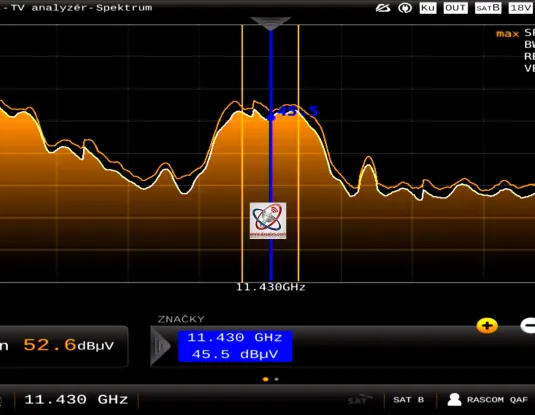
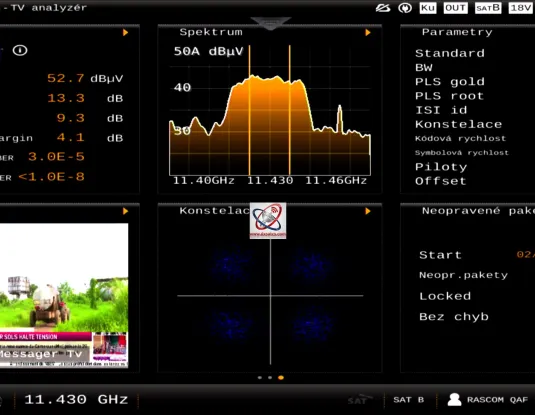
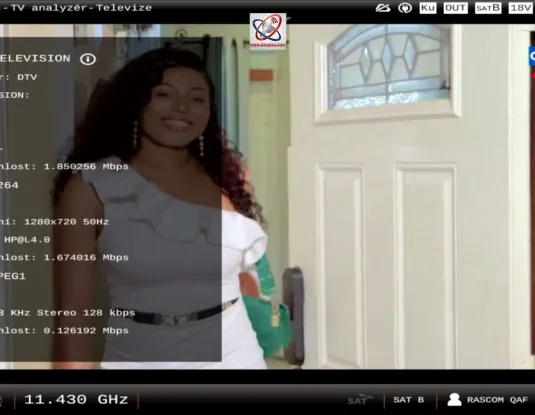
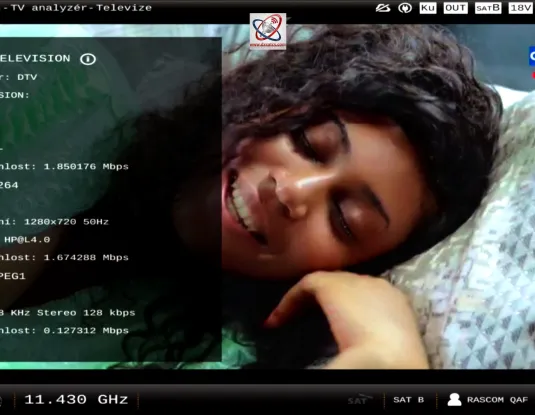
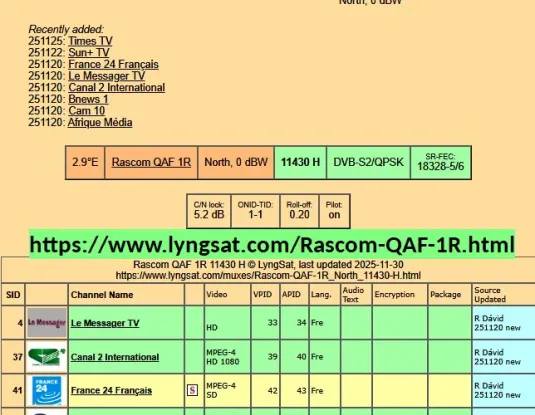
dxsatcs.com-rascom-qaf-1r-11 430-pf370-televes-mosaiq-analysis-gallery-2.12.2025
11 430-H-TBS/Mosaiq-6
11 430-H-TBS/Mosaiq-6
11 430-H-TBS/Mosaiq-6
Autor prípadovej štúdie : Roman Dávid/Lučenec-vedec a vynálezca v oblasti vlnovej fyziky a satelitného príjmu z domény www.dxsatcs.com