
Introduction and Theoretical Framework of the T2-MI/PLP Technological Standard for Satellite Signal Distribution
SK>
EN>
DE>
FR>
RU >
Centralizovaná distribúciu DVB-T2 multiplexov pomocou T2-MI/PLP štandardu
T2-MI SATELLITE DISTRIBUTION ARCHITECTURE 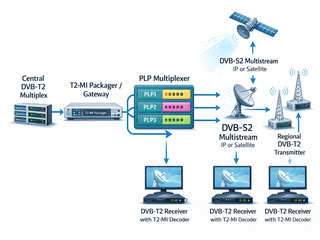
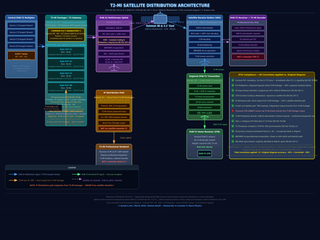
bloková (menej presná)schéma a detailná/presnejšia schéma
Popis blokovej schémy : Schéma znázorňuje centralizovanú distribúciu DVB-T2 multiplexov prostredníctvom štandardu T2-MI/PLP. Centrálny DVB-T2 multiplex je spracovaný blokom T2-MI Packager / Gateway, ktorý prevádza transportný tok na viacero Physical Layer Pipes (PLP), pričom každý PLP je nezávisle konfigurovateľný z hľadiska modulácie, kódovacej rýchlosti a ochrany proti chybám. PLP-y sú kombinované v PLP Multiplexeri a prenášané cez DVB-S2 Multistream alebo IP siete do regionálnych DVB-T2 vysielačov, pričom je zabezpečená presná synchronizácia a robustný prenos. Nakoniec DVB-T2 prijímače s podporou T2-MI dekódovania obnovia jednotlivé PLP a rekonštruujú transportný tok, čím umožňujú príjem SD, HD, UHD a mobilných služieb pri zachovaní vysokej integrity signálu.
Detailný popis schémy v pdf dokumente podľa normy ETSI (SK) : 
Distribučné technológie T2-MI a PLP v kontexte satelitnej distribúcie DVB-T2.
(Technická dokumentácia podľa noriem ETSI)
1. ÚVOD
Táto technická dokumentácia poskytuje komplexný prehľad distribučných technológií T2-MI (T2 Modulator Interface) a PLP (Physical Layer Pipe) v kontexte satelitného šírenia digitálneho terestriálneho televízneho vysielania druhej generácie (DVB-T2). Všetky technické špecifikácie sú v súlade s normami ETSI (European Telecommunications Standards Institute), konkrétne s dokumentmi ETSI TS 102 773 a ETSI EN 302 755.
2. T2-MI (T2 MODULATOR INTERFACE)
2.1 Definícia a účel
T2-MI (T2 Modulator Interface) je štandardizované rozhranie definované v norme ETSI TS 102 773, ktoré slúži na prenos konfiguračných parametrov a dátových tokov medzi T2 Gateway a DVB-T2 modulátormi. Toto rozhranie zabezpečuje, že všetky modulátory v sieti Single Frequency Network (SFN) vytvárajú identický vysielací signál, čo je kritické pre správnu funkciu SFN.
2.2 Technická architektúra
T2-MI implementuje vrstvovú architektúru založenú na nasledujúcich princípoch:
• Enkapsulačný mechanizmus: T2-MI pakety sú enkapsulované do MPEG-2
Transport Stream (TS) paketov pomocou techniky Data Piping v súlade s
normou EN 301 192, klauzula 4
• Transportné protokoly: Podporuje distribúciu cez ASI (Asynchronous Serial
Interface) rozhrania alebo IP siete podľa normy TS 102 034
• Časová synchronizácia: Obsahuje timestamp dáta (nerealizované v over-air
signáli), ktoré definujú presný čas emisie DVB-T2 signálu v modulátore
• Datová štruktúra: T2-MI pakety prenášajú L1 signalizáciu, baseband frame
(BBFrame) dáta, časové pečiatky a konfiguračné parametre pre všetky PLP
2.3 Typy T2-MI paketov
Podľa normy ETSI TS 102 773 existuje niekoľko typov T2-MI paketov, z ktorých
každý plní špecifickú funkciu:
• Typ 00 ₁₆ (Baseband Frame): Nesie BBFrame dáta pre jednotlivé PLP ₁₆
• Typ 10 ₁₆ (L1-Current): Obsahuje aktuálne L1 signalizačné informácie (L1-pre, ₁₆
L1-post configurable a L1-post dynamic)
• Typ 20 ₁₆ (Timestamp): Prenáša synchronizačné časové údaje vo formáte TAI ₁₆
(International Atomic Time) alebo relatívne offsety
• Typ 30 ₁₆ , 31₁₆ , 32₁₆ (FEF): Pakety pre Future Extension Frame dáta
2.4 Satelitná distribúcia T2-MI
V kontexte satelitnej distribúcie sa T2-MI stream prenáša prostredníctvom DVB-S2 modulácie. Tento prístup umožňuje efektívnu distribúciu DVB-T2 obsahu z centrálneho T2 Gateway na viacero vzdialených vysielacích staníc. Transport Stream obsahujúci T2-MI pakety je modulovaný pomocou DVB-S2 (8PSK, 16APSK alebo 32APSK) a vysielaný cez satelit. Na prijímacej strane satelitné prijímače demodulujú DVB-S2 signál a extrahujú T2-MI stream, ktorý je následne dodávaný do DVB-T2 modulátorov.
3. PLP (PHYSICAL LAYER PIPE)
3.1 Koncept a význam
Physical Layer Pipe (PLP) je fundamentálny koncept DVB-T2 systému, definovaný v norme ETSI EN 302 755. PLP predstavuje logický kanál na fyzickej vrstve, ktorý využíva časové delenie (TDM - Time Division Multiplexing) a prenáša sa v špecifikovaných sub-slices rámca T2. Každý PLP môže niesť jednu alebo viacero služieb a má vlastné parametre modulácie, kódovania a ochrany proti chybám.
3.2 Typy PLP
Norma DVB-T2 definuje tri základné typy PLP:
• Common PLP: Má jeden slice na každý T2 frame, vysielaný bezprostredne po
L1 signalizácii. Môže obsahovať dáta spoločné pre všetky služby
• Type 1 PLP: Využíva časové prekladanie (time interleaving) v rámci jedného
T2 frame
• Type 2 PLP: Umožňuje časové prekladanie naprieč viacerými T2 frames, čo
poskytuje vyššiu odolnosť voči chybám
Áko by sme mali chápať anglické slovo slice-plátok/rez v kontexte technológie T2-MI ?
V kontexte technológie T2-MI je slice súvislý, časovo ohraničený blok dátových buniek v rámci jedného T2 framu, ktorý je priradený konkrétnemu PLP (Physical Layer Pipe). Každý PLP — vrátane Common PLP — zaberá v T2 frame práve jeden takýto blok, pričom Common PLP slice je vždy umiestnený ako prvý, bezprostredne za L1 signalizáciou.
V prostredí T2-MI, kde je celý DVB-T2 multiplex zabalený do satelitného nosného signálu DVB-S2 a distribuovaný k pozemným prevádzačom, má presná pozícia a ohraničenie každého slicu kľúčový význam — prijímač na strane prevádzača musí vedieť presne, kde v štruktúre framu jednotlivé slice začínajú a končia, aby mohol správne extrahovať dáta každého PLP a následne ich vyslať do éteru ako pozemný DVB-T2 signál.
Zjednodušene povedané: slice je „adresný priestor" jedného PLP v T2 frame — bez jeho presnej definície by nebolo možné v T2-MI toku rozlíšiť, ktoré dáta patria ktorej službe alebo kanálu v multiplexe.
3.3 Technické parametre PLP
Každý PLP je charakterizovaný súborom konfigurovateľných parametrov:
• PLP_ID: 8-bitový identifikátor jedinečný v rámci T2 systému (identifikovaného
T2_system_id)
• Modulačná schéma: QPSK, 16-QAM, 64-QAM alebo 256-QAM
• Kódovacia frekvencia (Code Rate): 1/2, 3/5, 2/3, 3/4, 4/5 alebo 5/6 pre LDPC
kód
• FEC typ: LDPC (Low-Density Parity-Check) kódy s BCH (Bose-ChaudhuriHocquenghem) vonkajším kódovaním
• Time Interleaving: Konfigurovateľná hĺbka časového prekladania pre
optimalizáciu odolnosti proti impulzným poruchám
3.4 Výhody multi-PLP architektúry
Implementácia viacerých PLP v rámci jedného T2 systému poskytuje nasledujúce výhody:
• Servisne-špecifická robustnosť: Rôzne služby môžu mať rôzne úrovne ochrany proti chybám prispôsobené ich dôležitosti a požiadavkám na kvalitu
• Optimalizácia spektrálnej efektívnosti: HD služby môžu používať vyššie modulačné schémy (256-QAM) zatiaľ čo mobilné služby môžu používať robustnejšie nastavenia (QPSK)
• Flexibilná regionalizácia: Umožňuje PLP substitúciu alebo agregáciu pre lokálny obsah bez nutnosti retransmisie celého multiplexu
• Energetická efektívnosť prijímačov: Prijímače môžu dekódovať len potrebný PLP, čo znižuje spotrebu energie
4. INTEGRÁCIA T2-MI A PLP V DISTRIBUČNOM REŤAZCI
T2-MI a PLP technológie tvoria komplementárny systém v distribučnom reťazci DVBT2. T2 Gateway na centrálnej stanici vykonáva alokáciu služieb do jednotlivých PLP a vytvára kompletný T2-MI stream obsahujúci všetky potrebné dáta a konfiguračné parametre. Tento stream je následne distribuovaný cez satelit (DVB-S2) alebo IP siete do vzdialených vysielacích staníc.
Na vysielacej stanici T2-MI demodulátor extrahuje jednotlivé PLP streamy a dodáva ich spolu s L1 signalizáciou a časovou synchronizáciou do DVB-T2 modulátora. Modulátor potom zostrojí identický on-air signál ako ostatné modulátory v SFN sieti, pričom každý PLP dostane svoje špecifikované pozície v T2 frame štruktúre a vlastné MODCOD (modulation and coding) parametre.
5. PRAKTICKÉ IMPLIKÁCIE PRE SATELITNÝ PRÍJEM
5.1 Požiadavky na profesionálne vybavenie
Pre príjem a analýzu T2-MI distribúcie cez satelit je potrebné špecializované
profesionálne vybavenie:
• DVB-S2 profesionálny prijímač s podporou T2-MI demodulácie (v mojom prípade dxsatcs.com som použil TBS 5927+AltDVB – Version 2.5)
• T2-MI analyzátor pre monitorovanie integrity streamu a verifikáciu parametrov
podľa ETSI TR 101 290
• Schopnosť demodulácie pokročilých DVB-S2 modulácií (16APSK, 32APSK) bežne používaných pre T2-MI distribúciu
• Nástroje pre separáciu a analýzu jednotlivých PLP z T2-MI streamu
5.2 Monitorovanie kvality
Podľa rozšírenia A14-1 normy ETSI TR 101 290 je definovaných 18 špecifických meraní pre monitorovanie T2-MI signálu. Tieto merania zahŕňajú kontrolu integrity L1 signalizácie, verifikáciu časových pečiatok, monitorovanie PLP parametrov a validáciu BBFrame štruktúry. Kontinuálne monitorovanie týchto parametrov je kritické pre zabezpečenie spoľahlivej prevádzky DVB-T2 siete.
6. ZÁVER
Technológie T2-MI a PLP predstavujú sofistikovaný a flexibilný systém pre distribúciu a vysielanie digitálnej terestriálnej televízie druhej generácie. Ich implementácia v súlade s normami ETSI umožňuje vytváranie robustných SFN sietí s optimalizovanou spektrálnou efektívnosťou a servisne-špecifickou ochranou proti chybám. Satelitná distribúcia T2-MI streamov cez DVB-S2 poskytuje efektívny prostriedok pre dodávku obsahu na vzdialené vysielacie stanice, pričom zachováva presnú synchronizáciu potrebnú pre SFN prevádzku.
Pochopenie týchto technológií je fundamentálne pre profesionálov v oblasti satelitného a terestriálneho vysielania, monitorovania signálu a návrhu distribučných sietí
NORMATÍVNE REFERENCIE-zdrojovanie textu podla ETSI...
• ETSI TS 102 773 v1.3.1: Digital Video Broadcasting (DVB); Modulator
Interface (T2-MI) for a second generation digital terrestrial television
broadcasting system (DVB-T2)
• ETSI EN 302 755 v1.4.1: Digital Video Broadcasting (DVB); Frame structure
channel coding and modulation for a second generation digital terrestrial
television broadcasting system (DVB-T2)
• ETSI TS 102 831 v1.2.1: Digital Video Broadcasting (DVB); Implementation
guidelines for a second generation digital terrestrial television broadcasting
system (DVB-T2)
• ETSI EN 301 192: Digital Video Broadcasting (DVB); DVB specification for
data broadcasting
• ETSI TS 102 034: Digital Video Broadcasting (DVB); Transport of MPEG-2 TS
Based DVB Services over IP Based Networks
• ETSI TR 101 290: Digital Video Broadcasting (DVB); Measurement guidelines
for DVB systems (Amendment A14-1 for T2-MI)
• ETSI EN 302 307: Digital Video Broadcasting (DVB); Second generation
framing structure, channel coding and modulation systems for Broadcasting,
Interactive Services, News Gathering and other broadband satellite
applications (DVB-S2)
Centralized Distribution of DVB-T2 Multiplexes via the T2-MI/PLP Standard
T2-MI SATELLITE DISTRIBUTION ARCHITECTURE
Block (less precise) Diagram and Detailed / More Accurate Diagram
Description of the Block Diagram:The diagram illustrates the centralized distribution of DVB-T2 multiplexes via the T2-MI/PLP standard. The central DVB-T2 multiplex is processed by the T2-MI Packager / Gateway, which converts the transport stream into multiple Physical Layer Pipes (PLP), each independently configurable in terms of modulation, coding rate, and error protection. The PLPs are combined in the PLP Multiplexer and transmitted through DVB-S2 Multistream or IP networks to regional DVB-T2 transmitters, ensuring precise synchronization and robust delivery. Finally, DVB-T2 receivers with T2-MI decoding capability recover the individual PLPs and reconstruct the transport stream, allowing reception of SD, HD, UHD, and mobile services while maintaining high signal integrity.
Detailed Description of the Diagram in the PDF Document According to ETSI Standard (EN): 
T2-MI and PLP Distribution Technologies in the Context of DVB-T2 Satellite Distribution
(Technical Documentation in Accordance with ETSI Standards )
1. INTRODUCTION
This technical documentation provides a comprehensive overview of T2-MI (T2 Modulator Interface) and PLP (Physical Layer Pipe) distribution technologies in the context of satellite distribution of second-generation digital terrestrial television broadcasting (DVB-T2). All technical specifications are in accordance with ETSI (European Telecommunications Standards Institute) standards, specifically documents ETSI TS 102 773 and ETSI EN 302 755
2. T2-MI (T2 MODULATOR INTERFACE)
2.1 Definition and Purpose
T2-MI (T2 Modulator Interface) is a standardized interface defined in ETSI TS 102 773, which serves to transmit configuration parameters and data streams between the T2 Gateway and DVB-T2 modulators. This interface ensures that all modulators in a Single Frequency Network (SFN) generate an identical broadcast signal, which is critical for proper SFN operation.
2.2 Technical Architecture
T2-MI implements a layered architecture based on the following principles:
• Encapsulation mechanism: T2-MI packets are encapsulated into MPEG-2 Transport Stream (TS) packets using the Data Piping technique in accordance with standard EN 301 192, clause 4
• Transport protocols: Supports distribution via ASI (Asynchronous Serial Interface) interfaces or IP networks according to standard TS 102 034
• Time synchronization: Contains timestamp data (not realized in the over-air signal) that defines the precise emission time of the DVB-T2 signal in the modulator
• Data structure: T2-MI packets carry L1 signaling, baseband frame (BBFrame) data, timestamps, and configuration parameters for all PLPs
2.3 T2-MI Packet Types
According to ETSI TS 102 773, there are several types of T2-MI packets, each
fulfilling a specific function:
• Type 00₁₆ (Baseband Frame): Carries BBFrame data for individual PLPs ₁₆
• Type 10₁₆ (L1-Current): Contains current L1 signaling information (L1-pre, L1- ₁₆
post configurable, and L1-post dynamic)
• Type 20₁₆ (Timestamp): Transmits synchronization time data in TAI ₁₆
(International Atomic Time) format or relative offsets
• Type 30₁₆ , 31₁₆ , 32₁₆ (FEF): Packets for Future Extension Frame data
2.4 Satellite Distribution of T2-MI
In the context of satellite distribution, the T2-MI stream is transmitted via DVB-S2 modulation. This approach enables efficient distribution of DVB-T2 content from a central T2 Gateway to multiple remote broadcast stations. The Transport Stream containing T2-MI packets is modulated using DVB-S2 (8PSK, 16APSK, or 32APSK) and transmitted via satellite. On the receiving side, satellite receivers demodulate the DVB-S2 signal and extract the T2-MI stream, which is subsequently delivered to DVB-T2 modulators.
3. PLP (PHYSICAL LAYER PIPE)
3.1 Concept and Significance
Physical Layer Pipe (PLP) is a fundamental concept of the DVB-T2 system, defined in standard ETSI EN 302 755. PLP represents a logical channel at the physical layer that utilizes time division multiplexing (TDM) and is transmitted in specified subslices of the T2 frame. Each PLP can carry one or more services and has its own modulation, coding, and error protection parameters.
3.2 PLP Types
The DVB-T2 standard defines three basic types of PLPs:
• Common PLP: Has one slice per T2 frame, transmitted immediately after L1 signaling. May contain data common to all services
• Type 1 PLP: Utilizes time interleaving within a single T2 frame
• Type 2 PLP: Enables time interleaving across multiple T2 frames, providing higher error resilience
3.3 Technical Parameters of PLP
Each PLP is characterized by a set of configurable parameters:
• PLP_ID: 8-bit identifier unique within the T2 system (identified by T2_system_id)
• Modulation scheme: QPSK, 16-QAM, 64-QAM, or 256-QAM
• Code rate: 1/2, 3/5, 2/3, 3/4, 4/5, or 5/6 for LDPC code
• FEC type: LDPC (Low-Density Parity-Check) codes with BCH (BoseChaudhuri-Hocquenghem) outer coding
• Time Interleaving: Configurable time interleaving depth for optimizing resilience against impulse noise
3.4 Advantages of Multi-PLP Architecture
Implementation of multiple PLPs within a single T2 system provides the following
advantages:
• Service-specific robustness: Different services can have different levels of error protection tailored to their importance and quality requirements
• Spectral efficiency optimization: HD services can use higher modulation schemes (256-QAM) while mobile services can use more robust settings (QPSK)
• Flexible regionalization: Enables PLP substitution or aggregation for local content without the need to retransmit the entire multiplex
• Receiver power efficiency: Receivers can decode only the necessary PLP, reducing power consumption
4. INTEGRATION OF T2-MI AND PLP IN THE DISTRIBUTION CHAIN
T2-MI and PLP technologies form a complementary system in the DVB-T2
distribution chain. The T2 Gateway at the central station performs allocation of
services to individual PLPs and creates a complete T2-MI stream containing all
necessary data and configuration parameters. This stream is subsequently
distributed via satellite (DVB-S2) or IP networks to remote broadcast stations.
At the broadcast station, the T2-MI demodulator extracts individual PLP streams and
delivers them together with L1 signaling and time synchronization to the DVB-T2
modulator. The modulator then constructs an identical on-air signal as other
modulators in the SFN network, with each PLP receiving its specified positions in the
T2 frame structure and its own MODCOD (modulation and coding) parameters.
5. PRACTICAL IMPLICATIONS FOR SATELLITE RECEPTION
5.1 Professional Equipment Requirements
Reception and analysis of T2-MI distribution via satellite requires specialized
professional equipment:
• Professional DVB-S2 receiver with T2-MI demodulation support
• T2-MI analyzer for monitoring stream integrity and parameter verification according to ETSI TR 101 290
• Capability to demodulate advanced DVB-S2 modulations (16APSK, 32APSK) commonly used for T2-MI distribution
• Tools for separation and analysis of individual PLPs from the T2-MI stream
5.2 Quality Monitoring
According to Annex A14-1 of standard ETSI TR 101 290, 18 specific measurementsare defined for monitoring the T2-MI signal. These measurements include verification of L1 signaling integrity, timestamp validation, PLP parameter monitoring, and BBFrame structure validation. Continuous monitoring of these parameters is critical for ensuring reliable operation of the DVB-T2 network.
6. CONCLUSION
T2-MI and PLP technologies represent a sophisticated and flexible system for distribution and broadcasting of second-generation digital terrestrial television. Their implementation in accordance with ETSI standards enables the creation of robust SFN networks with optimized spectral efficiency and service-specific error protection.Satellite distribution of T2-MI streams via DVB-S2 provides an efficient means for content delivery to remote broadcast stations while maintaining the precise synchronization required for SFN operation.Understanding these technologies is fundamental for professionals in the field of satellite and terrestrial broadcasting, signal monitoring, and distribution network design.
7. NORMATIVE REFERENCES :
by European Telecommunications Standards Institute (ETSI)
• ETSI TS 102 773 v1.3.1: Digital Video Broadcasting (DVB); Modulator
Interface (T2-MI) for a second generation digital terrestrial television
broadcasting system (DVB-T2)
• ETSI EN 302 755 v1.4.1: Digital Video Broadcasting (DVB); Frame structure
channel coding and modulation for a second generation digital terrestrial
television broadcasting system (DVB-T2)
• ETSI TS 102 831 v1.2.1: Digital Video Broadcasting (DVB); Implementation
guidelines for a second generation digital terrestrial television broadcasting
system (DVB-T2)
• ETSI EN 301 192: Digital Video Broadcasting (DVB); DVB specification for
data broadcasting
• ETSI TS 102 034: Digital Video Broadcasting (DVB); Transport of MPEG-2 TS
Based DVB Services over IP Based Networks
• ETSI TR 101 290: Digital Video Broadcasting (DVB); Measurement guidelines
for DVB systems (Amendment A14-1 for T2-MI)
• ETSI EN 302 307: Digital Video Broadcasting (DVB); Second generation
framing structure, channel coding and modulation systems for Broadcasting,
Interactive Services, News Gathering and other broadband satellite
applications (DVB-S2)
Zentralisierte Verteilung von DVB-T2-Multiplexen über den T2-MI/PLP-Standard
T2-MI-Satellitenverteilungsarchitektur
Blockschaltbild (weniger präzise Darstellung) und detaillierte / präzisere Darstellung
Beschreibung des Blockschaltbildes: Das Diagramm zeigt die zentralisierte Verteilung von DVB-T2-Multiplexen über den Standard T2-MI/PLP. Der zentrale DVB-T2-Multiplex wird durch den T2-MI Packager / Gateway verarbeitet, der den Transportstrom in mehrere Physical Layer Pipes (PLP) konvertiert, wobei jede PLP unabhängig in Bezug auf Modulation, Kodierungsrate und Fehlerkorrektur konfigurierbar ist. Die PLPs werden im PLP-Multiplexer kombiniert und über DVB-S2 Multistream oder IP-Netzwerke an regionale DVB-T2-Sender übertragen, wobei präzise Synchronisation und robuste Übertragung gewährleistet sind. Schließlich rekonstruieren DVB-T2-Empfänger mit T2-MI-Dekodierungsfähigkeit die einzelnen PLPs und den Transportstrom, sodass SD-, HD-, UHD- und mobile Dienste empfangen werden können, während die Signalqualität hoch bleibt.
Detaillierte Beschreibung des Diagramms im PDF-Dokument gemäß ETSI-Standard (DE): 
T2-MI- und PLP-Distributionstechnologien
im Kontext der DVB-T2-Satellitendistribution
(Technische Dokumentation nach ETSI-Normen )
1. EINFÜHRUNG
Diese technische Dokumentation bietet einen umfassenden Überblick über die Distributionstechnologien T2-MI (T2 Modulator Interface) und PLP (Physical Layer Pipe) im Kontext der Satellitendistribution des digitalen terrestrischen
Fernsehrundfunks der zweiten Generation (DVB-T2). Alle technischen Spezifikationen entsprechen den Normen des ETSI (European Telecommunications Standards Institute), insbesondere den Dokumenten ETSI TS 102 773 und ETSI EN 302 755.
2. T2-MI (T2 MODULATOR INTERFACE)
2.1 Definition und Zweck
T2-MI (T2 Modulator Interface) ist eine standardisierte Schnittstelle, die in der Norm ETSI TS 102 773 definiert ist und zur Übertragung von Konfigurationsparametern und Datenströmen zwischen dem T2 Gateway und DVB-T2-Modulatoren dient. Diese Schnittstelle stellt sicher, dass alle Modulatoren in einem Single Frequency Network (SFN) ein identisches Sendesignal erzeugen, was für den ordnungsgemäßen SFN-Betrieb kritisch ist.
2.2 Technische Architektur
T2-MI implementiert eine geschichtete Architektur, die auf folgenden Prinzipien
basiert:
• Kapselungsmechanismus: T2-MI-Pakete werden mittels der Data-PipingTechnik gemäß Norm EN 301 192, Abschnitt 4, in MPEG-2 Transport Stream (TS)-Pakete gekapselt
• Transportprotokolle: Unterstützt die Distribution über ASI-Schnittstellen (Asynchronous Serial Interface) oder IP-Netzwerke gemäß Norm TS 102 034
• Zeitsynchronisation: Enthält Zeitstempeldaten (nicht im Over-Air-Signal realisiert), die den präzisen Sendezeitpunkt des DVB-T2-Signals im Modulator definieren
• Datenstruktur: T2-MI-Pakete übertragen L1-Signalisierung, Baseband-Frame (BBFrame)-Daten, Zeitstempel und Konfigurationsparameter für alle PLPs
2.3 T2-MI-Pakettypen
Gemäß der Norm ETSI TS 102 773 existieren mehrere Typen von T2-MI-Paketen, von denen jeder eine spezifische Funktion erfüllt:
• Typ 00₁₆ (Baseband Frame): Trägt BBFrame-Daten für einzelne PLPs
• Typ 10₁₆ (L1-Current): Enthält aktuelle L1-Signalisierungsinformationen (L1-
pre, L1-post configurable und L1-post dynamic)
• Typ 20₁₆ (Timestamp): Überträgt Synchronisationszeitdaten im TAI-Format
(International Atomic Time) oder relative Offsets
• Typ 30₁₆ , 31₁₆ , 32₁₆ (FEF): Pakete für Future Extension Frame-Daten
2.4 Satellitendistribution von T2-MI
Im Kontext der Satellitendistribution wird der T2-MI-Stream über DVB-S2-Modulation übertragen. Dieser Ansatz ermöglicht eine effiziente Distribution von DVB-T2- Inhalten von einem zentralen T2 Gateway zu mehreren entfernten Sendestationen. Der Transport Stream mit T2-MI-Paketen wird mittels DVB-S2 (8PSK, 16APSK oder 32APSK) moduliert und über Satellit ausgestrahlt. Auf der Empfangsseite demodulieren Satellitenempfänger das DVB-S2-Signal und extrahieren den T2-MIStream, der anschließend an DVB-T2-Modulatoren geliefert wird.
3. PLP (PHYSICAL LAYER PIPE)
3.1 Konzept und Bedeutung
Physical Layer Pipe (PLP) ist ein fundamentales Konzept des DVB-T2-Systems, das in der Norm ETSI EN 302 755 definiert ist. PLP repräsentiert einen logischen Kanal auf der physikalischen Schicht, der Zeitmultiplexing (TDM - Time Division Multiplexing) nutzt und in spezifizierten Sub-Slices des T2-Frames übertragen wird. Jeder PLP kann einen oder mehrere Dienste tragen und verfügt über eigene Parameter für Modulation, Kodierung und Fehlerschutz.
3.2 PLP-Typen
Die DVB-T2-Norm definiert drei grundlegende PLP-Typen:
Die DVB-T2-Norm definiert drei grundlegende PLP-Typen:
• Common PLP: Verfügt über einen Slice pro T2-Frame, der unmittelbar nach der L1-Signalisierung gesendet wird. Kann Daten enthalten, die allen Diensten gemeinsam sind
• Type 1 PLP: Nutzt Time Interleaving innerhalb eines einzelnen T2-Frames
• Type 2 PLP: Ermöglicht Time Interleaving über mehrere T2-Frames hinweg,
was eine höhere Fehlerresistenz bietet
3.3 Technische Parameter von PLP
Jeder PLP ist durch einen Satz konfigurierbarer Parameter charakterisiert:
• PLP_ID: 8-Bit-Identifikator, der innerhalb des T2-Systems (identifiziert durch T2_system_id) eindeutig ist
• Modulationsschema: QPSK, 16-QAM, 64-QAM oder 256-QAM
• Coderate: 1/2, 3/5, 2/3, 3/4, 4/5 oder 5/6 für LDPC-Code
• FEC-Typ: LDPC (Low-Density Parity-Check)-Codes mit BCH (BoseChaudhuri-Hocquenghem)-Außencodierung
• Time Interleaving: Konfigurierbare Time-Interleaving-Tiefe zur Optimierung
der Resistenz gegen Impulsrauschen
3.4 Vorteile der Multi-PLP-Architektur
Die Implementierung mehrerer PLPs innerhalb eines einzelnen T2-Systems bietet
folgende Vorteile:
• Dienstspezifische Robustheit: Verschiedene Dienste können unterschiedliche Fehlerschutzniveaus haben, die auf ihre Bedeutung und Qualitätsanforderungen zugeschnitten sind
• Optimierung der Spektraleffizienz: HD-Dienste können höhere Modulationsschemata (256-QAM) verwenden, während mobile Dienste robustere Einstellungen (QPSK) nutzen können
• Flexible Regionalisierung: Ermöglicht PLP-Substitution oder -Aggregation für lokale Inhalte ohne die Notwendigkeit, den gesamten Multiplex neu zu übertragen
• Energieeffizienz der Empfänger: Empfänger können nur den benötigten PLP dekodieren, was den Stromverbrauch reduziert
4. INTEGRATION VON T2-MI UND PLP IN DER DISTRIBUTIONSKETTE
T2-MI- und PLP-Technologien bilden ein komplementäres System in der DVB-T2-Distributionskette. Das T2 Gateway an der zentralen Station führt die Zuordnung von Diensten zu einzelnen PLPs durch und erstellt einen vollständigen T2-MI-Stream mit allen erforderlichen Daten und Konfigurationsparametern. Dieser Stream wird anschließend über Satellit (DVB-S2) oder IP-Netzwerke zu entfernten Sendestationen distribuiert. An der Sendestation extrahiert der T2-MI-Demodulator einzelne PLP-Streams und liefert sie zusammen mit L1-Signalisierung und Zeitsynchronisation an den DVB-T2- Modulator. Der Modulator konstruiert dann ein identisches On-Air-Signal wie andere Modulatoren im SFN-Netzwerk, wobei jeder PLP seine spezifizierten Positionen in der T2-Frame-Struktur und eigene MODCOD (Modulation and Coding)-Parameter erhält.
5. PRAKTISCHE IMPLIKATIONEN FÜR DEN SATELLITENEMPFANG :
5.1 Anforderungen an professionelle Ausrüstung
Für den Empfang und die Analyse der T2-MI-Distribution über Satellit istspezialisierte professionelle Ausrüstung erforderlich:
• Professioneller DVB-S2-Empfänger mit T2-MI-Demodulationsunterstützung
• T2-MI-Analysator zur Überwachung der Stream-Integrität und
Parameterverifikation gemäß ETSI TR 101 290
• Fähigkeit zur Demodulation fortgeschrittener DVB-S2-Modulationen (16APSK,
32APSK), die üblicherweise für T2-MI-Distribution verwendet werden
• Werkzeuge zur Trennung und Analyse einzelner PLPs aus dem T2-MIStream
5.2 Qualitätsüberwachung
Gemäß Anhang A14-1 der Norm ETSI TR 101 290 sind 18 spezifische Messungen für die Überwachung des T2-MI-Signals definiert. Diese Messungen umfassen die Überprüfung der L1-Signalisierungsintegrität, Zeitstempelvalidierung, PLPParameterüberwachung und BBFrame-Strukturvalidierung. Die kontinuierliche Überwachung dieser Parameter ist kritisch für die Gewährleistung eines zuverlässigen Betriebs des DVB-T2-Netzwerks.
6. SCHLUSSFOLGERUNG
T2-MI- und PLP-Technologien repräsentieren ein ausgereiftes und flexibles System für die Distribution und Ausstrahlung des digitalen terrestrischen Fernsehens der zweiten Generation. Ihre Implementierung gemäß den ETSI-Normen ermöglicht die Schaffung robuster SFN-Netzwerke mit optimierter Spektraleffizienz und dienstspezifischem Fehlerschutz. Die Satellitendistribution von T2-MI-Streams über DVB-S2 bietet ein effizientes Mittel für die Inhaltsbereitstellung zu entfernten Sendestationen unter Beibehaltung der präzisen Synchronisation, die für den SFNBetrieb erforderlich ist. Das Verständnis dieser Technologien ist fundamental für Fachleute im Bereich der
Satelliten- und terrestrischen Rundfunkübertragung, Signalüberwachung und Distributionsnetzwerkplanung.
NORMATIVE REFERENZEN :
by European Telecommunications Standards Institute (ETSI)
• ETSI TS 102 773 v1.3.1: Digital Video Broadcasting (DVB); Modulator
Interface (T2-MI) for a second generation digital terrestrial television
broadcasting system (DVB-T2)
• ETSI EN 302 755 v1.4.1: Digital Video Broadcasting (DVB); Frame structure
channel coding and modulation for a second generation digital terrestrial
television broadcasting system (DVB-T2)
• ETSI TS 102 831 v1.2.1: Digital Video Broadcasting (DVB); Implementation
guidelines for a second generation digital terrestrial television broadcasting
system (DVB-T2)
• ETSI EN 301 192: Digital Video Broadcasting (DVB); DVB specification for
data broadcasting
• ETSI TS 102 034: Digital Video Broadcasting (DVB); Transport of MPEG-2 TSBased DVB Services over IP Based Networks
• ETSI TR 101 290: Digital Video Broadcasting (DVB); Measurement guidelines
for DVB systems (Amendment A14-1 for T2-MI)
• ETSI EN 302 307: Digital Video Broadcasting (DVB); Second generation
framing structure, channel coding and modulation systems for Broadcasting,
Interactive Services, News Gathering and other broadband satellite
applications (DVB-S2)
Distribution centralisée des multiplex DVB-T2 au moyen de la norme T2-MI/PLP
Architecture de Distribution Satellitaire T2-MI
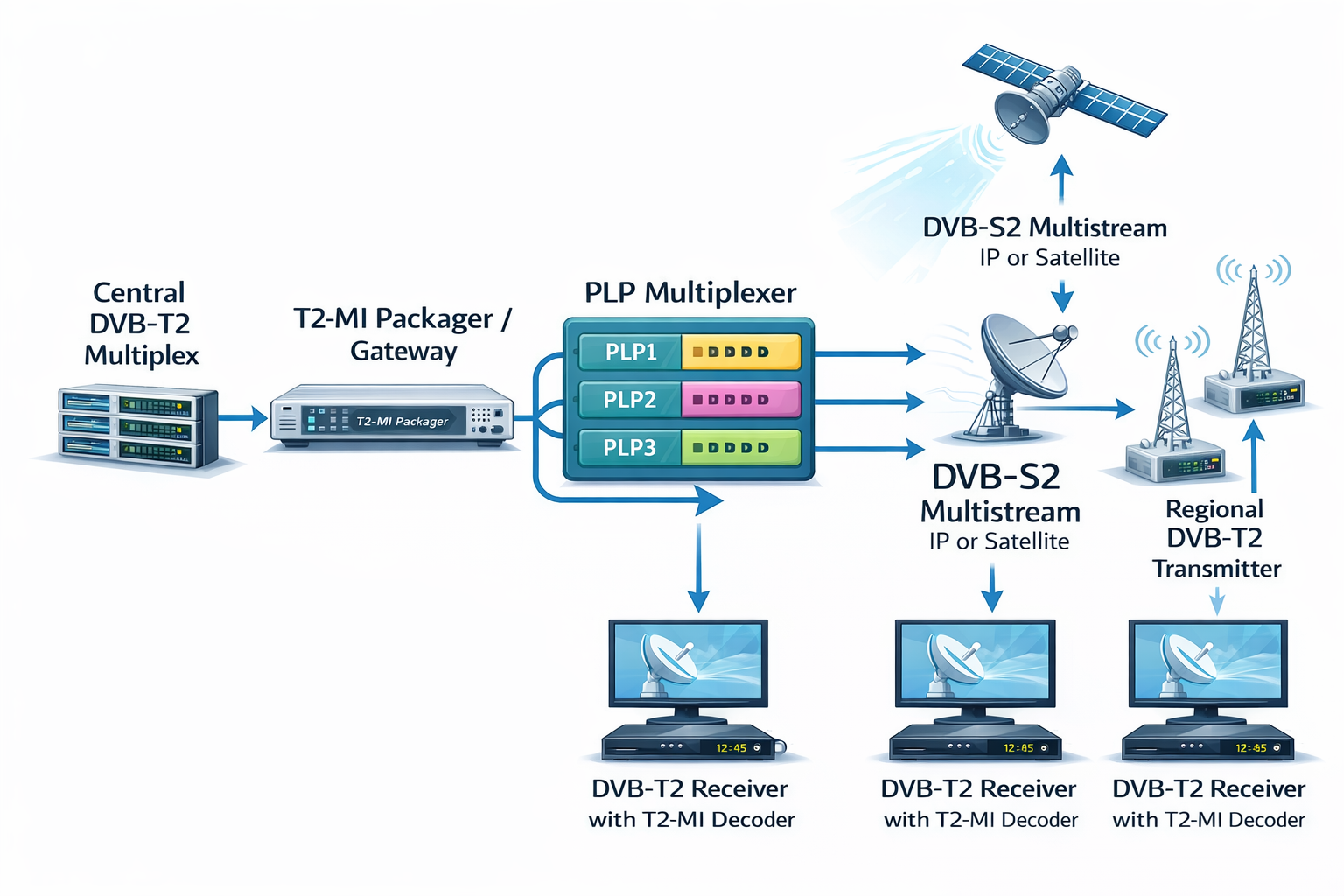
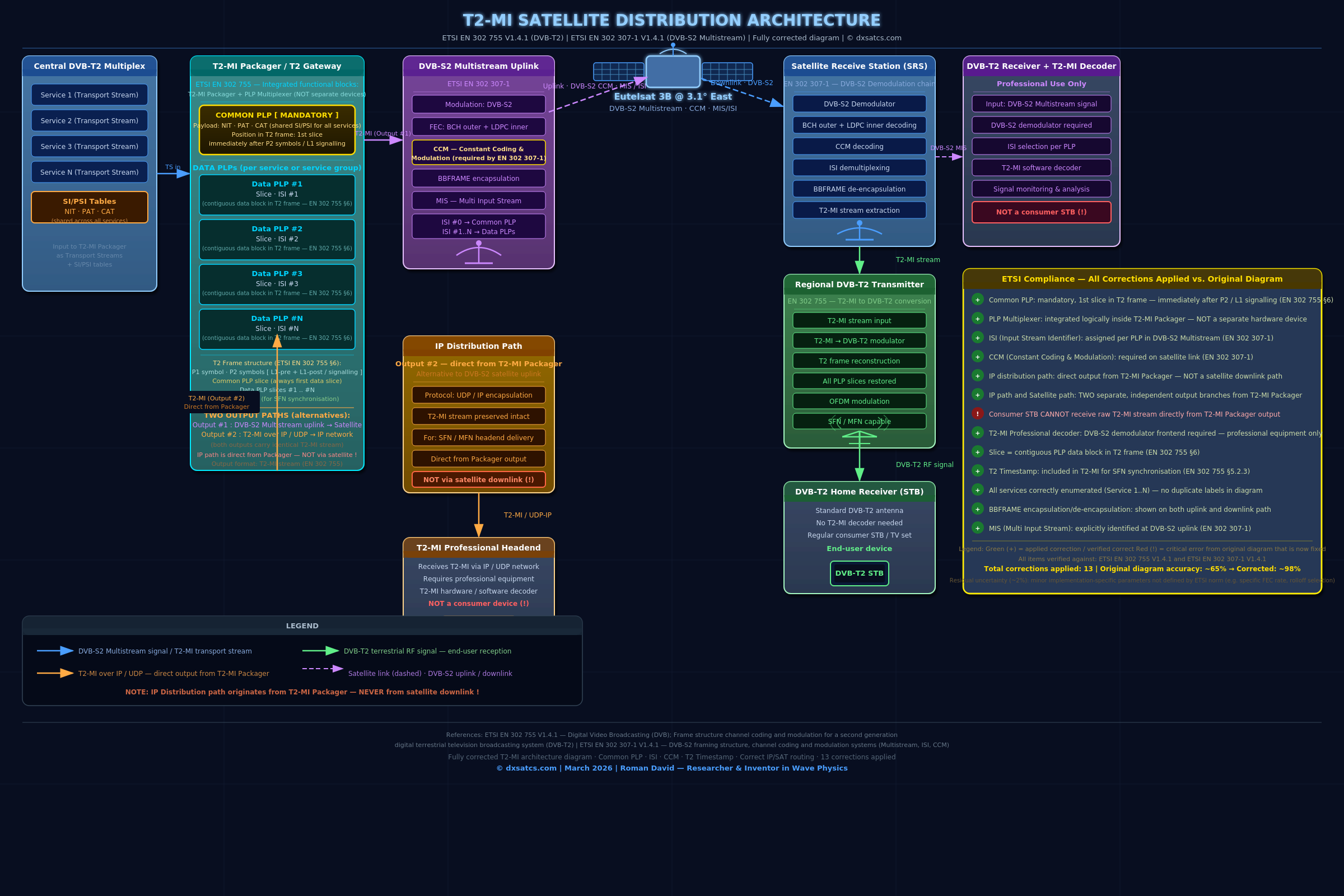
Schéma en blocs (moins précise) et schéma détaillée / plus précise
Description de la schéma en blocs : Le schéma illustre la distribution centralisée des multiplex DVB-T2 via la norme T2-MI/PLP. Le multiplex central DVB-T2 est traité par le T2-MI Packager / Gateway, qui convertit le flux de transport en plusieurs Physical Layer Pipes (PLP), chacune étant configurable de manière indépendante en termes de modulation, de débit de codage et de protection contre les erreurs. Les PLP sont combinées dans le multiplexeur PLP et transmises via DVB-S2 Multistream ou réseaux IP vers les émetteurs DVB-T2 régionaux, assurant une synchronisation précise et une transmission robuste. Enfin, les récepteurs DVB-T2 compatibles T2-MI récupèrent les PLP individuelles et reconstruisent le flux de transport, permettant la réception de services SD, HD, UHD et mobiles tout en maintenant une intégrité élevée du signal.
Description détaillée du schéma dans le document PDF selon la norme ETSI (FR) : 
T2-MI_architecture_description_fr.pdf
Technologies T2-MI et PLP de distribution dans le contexte de la distribution satellitaire DVB-T2
( Documentation technique conforme aux normes ETSI )
1. INTRODUCTION
La presente documentation technique fournit un apercu complet des technologies T2-MI (T2 Modulator Interface) et PLP (Physical Layer Pipe) dans le contexte de la distribution satellitaire de la television numerique terrestre de deuxieme generation (DVB-T2). Toutes les specifications techniques sont conformes aux normes ETSI (European Telecommunications Standards Institute), en particulier aux documents ETSI TS 102 773 et ETSI EN 302 755.
2. T2-MI (T2 MODULATOR INTERFACE)
2.1 Definition et objectif
T2-MI (T2 Modulator Interface) est une interface normalisee definie dans la norme ETSI TS
102 773, qui sert a transmettre les parametres de configuration et les flux de donnees entre
la passerelle T2 (T2 Gateway) et les modulateurs DVB-T2. Cette interface garantit que tous
les modulateurs d'un reseau a frequence unique (SFN – Single Frequency Network)
generent un signal de diffusion identique, ce qui est essentiel pour le bon fonctionnement du
SFN.
2.2 Architecture technique
T2-MI met en oeuvre une architecture en couches fondee sur les principes suivants :
• Mecanisme d'encapsulation : Les paquets T2-MI sont encapsules dans des paquets
MPEG-2 Transport Stream (TS) en utilisant la technique Data Piping conformement
a la norme EN 301 192, clause 4
• Protocoles de transport : Supporte la distribution via des interfaces ASI
(Asynchronous Serial Interface) ou des reseaux IP conformement a la norme TS 102
034
• Synchronisation temporelle : Contient des donnees d'horodatage (non realisees dans
le signal hertzien) qui definissent le temps d'emission precis du signal DVB-T2 dans
le modulateur
• Structure des donnees : Les paquets T2-MI transportent la signalisation L1, les
donnees de trame de bande de base (BBFrame), les horodatages et les parametres
de configuration pour l'ensemble des PLP
2.3 Types de paquets T2-MI
Conformement a la norme ETSI TS 102 773, il existe plusieurs types de paquets T2-MI,
chacun remplissant une fonction specifique :
• Type 00 (Baseband Frame) : Transporte les donnees BBFrame pour les PLP
individuels
• Type 10 (L1-Current) : Contient les informations de signalisation L1 courantes (L1-
pre, L1-post configurable, et L1-post dynamique)
• Type 20 (Timestamp) : Transmet les donnees de temps de synchronisation au format
TAI (Temps Atomique International) ou des decalages relatifs
• Types 30, 31, 32 (FEF) : Paquets pour les donnees de trame d'extension future
(Future Extension Frame)
2.4 Distribution satellitaire du T2-MI
Dans le contexte de la distribution satellitaire, le flux T2-MI est transmis via la modulation DVB-S2. Cette approche permet une distribution efficace du contenu DVB-T2 depuis une passerelle T2 centrale vers de multiples stations d'emission distantes. Le Transport Stream contenant les paquets T2-MI est module en utilisant DVB-S2 (8PSK, 16APSK ou 32APSK)
et transmis par satellite. Du cote recepteur, les recepteurs satellitaires demodulen le signal DVB-S2 et extraient le flux T2-MI, qui est ensuite achemine vers les modulateurs DVB-T2.
3. PLP (PHYSICAL LAYER PIPE)
3.1 Concept et importance
Physical Layer Pipe (PLP) est un concept fondamental du systeme DVB-T2, defini dans la norme ETSI EN 302 755. Le PLP represente un canal logique au niveau de la couche physique qui utilise le multiplexage par repartition dans le temps (TDM – Time Division Multiplexing) et est transmis dans des sous-tranches specifiees de la trame T2. Chaque PLP
peut transporter un ou plusieurs services et dispose de ses propres parametres de modulation, de codage et de protection contre les erreurs.
3.2 Types de PLP
La norme DVB-T2 definit trois types de base de PLP :
• PLP commun (Common PLP) : Possede une tranche par trame T2, transmis
immediatement apres la signalisation L1. Peut contenir des donnees communes a
tous les services
• PLP de type 1 (Type 1 PLP) : Utilise l'entrelacement temporel au sein d'une seule
trame T2
• PLP de type 2 (Type 2 PLP) : Permet l'entrelacement temporel sur plusieurs trames
T2, offrant une plus grande resilience aux erreurs
3.3 Parametres techniques du PLP
Chaque PLP est caracterise par un ensemble de parametres configurables :
• PLP_ID : Identifiant sur 8 bits unique au sein du systeme T2 (identifie par
T2_system_id)
• Schema de modulation : QPSK, 16-QAM, 64-QAM ou 256-QAM
• Taux de codage : 1/2, 3/5, 2/3, 3/4, 4/5 ou 5/6 pour le code LDPC
• Type FEC : Codes LDPC (Low-Density Parity-Check) avec codage externe BCH
(Bose-Chaudhuri-Hocquenghem)
• Entrelacement temporel (Time Interleaving) : Profondeur d'entrelacement temporel
configurable pour optimiser la resilience contre le bruit impulsionnel
3.4 Avantages de l'architecture multi-PLP
La mise en oeuvre de plusieurs PLP au sein d'un seul systeme T2 offre les avantages
suivants :
• Robustesse specifique au service : Differents services peuvent avoir differents
niveaux de protection contre les erreurs, adaptes a leur importance et a leurs
exigences de qualite
• Optimisation de l'efficacite spectrale : Les services HD peuvent utiliser des schemas
de modulation superieurs (256-QAM) tandis que les services mobiles peuvent utiliser
des parametres plus robustes (QPSK)
• Regionalisation flexible : Permet la substitution ou l'agregation de PLP pour le
contenu local sans necessite de retransmettre l'integralite du multiplex• Efficacite energetique du recepteur : Les recepteurs peuvent decoder uniquement le
PLP necessaire, reduisant ainsi la consommation energetique
4. INTEGRATION DES TECHNOLOGIES T2-MI ET PLP DANS LA CHAINE DE DISTRIBUTION
Les technologies T2-MI et PLP forment un systeme complementaire dans la chaine de
distribution DVB-T2. La passerelle T2 (T2 Gateway) a la station centrale effectue l'allocation
des services aux PLP individuels et cree un flux T2-MI complet contenant toutes les
donnees et tous les parametres de configuration necessaires. Ce flux est ensuite distribue
par satellite (DVB-S2) ou par des reseaux IP aux stations d'emission distantes.
A la station d'emission, le demodulateur T2-MI extrait les flux PLP individuels et les
achemine, avec la signalisation L1 et la synchronisation temporelle, vers le modulateur DVBT2. Le modulateur construit alors un signal hertzien identique a celui des autres modulateurs
du reseau SFN, chaque PLP recevant ses positions specifiees dans la structure de trame T2
et ses propres parametres MODCOD (modulation et codage).
5. IMPLICATIONS PRATIQUES POUR LA RECEPTION SATELLITAIRE
5.1 Exigences en matiere d'equipement professionnel
La reception et l'analyse de la distribution T2-MI par satellite necessitent des equipements
professionnels specialises :
• Recepteur DVB-S2 professionnel avec support de demodulation T2-MI
• Analyseur T2-MI pour la surveillance de l'integrite du flux et la verification des
parametres conformement a la norme ETSI TR 101 290
• Capacite a demoduler des modulations DVB-S2 avancees (16APSK, 32APSK)
couramment utilisees pour la distribution T2-MI
• Outils pour la separation et l'analyse des PLP individuels issus du flux T2-MI
5.2 Surveillance de la qualite
Conformement a l'Annexe A14-1 de la norme ETSI TR 101 290, 18 mesures specifiques sont definies pour la surveillance du signal T2-MI. Ces mesures comprennent la verification de l'integrite de la signalisation L1, la validation des horodatages, la surveillance des parametres PLP et la validation de la structure BBFrame. La surveillance continue de ces
parametres est essentielle pour garantir le fonctionnement fiable du reseau DVB-T2.
6. CONCLUSION
Les technologies T2-MI et PLP represented un systeme sophistique et flexible pour la distribution et la diffusion de la television numerique terrestre de deuxieme generation. Leur mise en oeuvre conformement aux normes ETSI permet la creation de reseaux SFNrobustes avec une efficacite spectrale optimisee et une protection contre les erreurs specifique au service.La distribution satellitaire des flux T2-MI via DVB-S2 constitue un moyen efficace pour l'acheminement de contenu vers des stations d'emission distantes, tout en maintenant la synchronisation precise requise pour le fonctionnement du SFN. La comprehension de ces technologies est fondamentale pour les professionnels dans le domaine de la diffusion satellitaire et terrestre, de la surveillance des signaux et de la conception des reseaux de distribution.
REFERENCES NORMATIVES >
by European Telecommunications Standards Institute (ETSI)
• ETSI TS 102 773 v1.3.1 : Digital Video Broadcasting (DVB) ; Interface modulateur (T2-MI)
pour un systeme de diffusion televisuelle numerique terrestre de deuxieme generation (DVBT2)
• ETSI EN 302 755 v1.4.1 : Digital Video Broadcasting (DVB) ; Structure de trame, codage de
canal et modulation pour un systeme de diffusion televisuelle numerique terrestre de
deuxieme generation (DVB-T2)
• ETSI TS 102 831 v1.2.1 : Digital Video Broadcasting (DVB) ; Lignes directrices de mise en
oeuvre pour un systeme de diffusion televisuelle numerique terrestre de deuxieme generation
(DVB-T2)
• ETSI EN 301 192 : Digital Video Broadcasting (DVB) ; Specification DVB pour la
radiodiffusion de donnees
• ETSI TS 102 034 : Digital Video Broadcasting (DVB) ; Transport de services DVB bases sur
MPEG-2 TS sur des reseaux bases sur IP
• ETSI TR 101 290 : Digital Video Broadcasting (DVB) ; Lignes directrices de mesure pour les
systemes DVB (Amendement A14-1 pour T2-MI)
• ETSI EN 302 307 : Digital Video Broadcasting (DVB) ; Structure de trame de deuxieme
generation, codage de canal et systemes de modulation pour la radiodiffusion, les services
interactifs, la collecte de nouvelles et d'autres applications satellitaires a large bande (DVBS2)
Технологии распределения T2-MI и PLP в контексте спутникового распределения DVB-T2
Архитектура спутникового распределения T2-MI
Блочная (менее точная) схема и детальная / более точная схема
RU-Описание блочной схемы : Схема иллюстрирует централизованное распределение мультиплексов DVB-T2 с использованием стандарта T2-MI/PLP. Центральный мультиплекс DVB-T2 обрабатывается пакером/шлюзом T2-MI, который преобразует транспортный поток в несколько Physical Layer Pipes (PLP), каждая из которых может быть независимо настроена по модуляции, скорости кодирования и защите от ошибок. PLP объединяются в PLP-мультиплексоре и передаются через DVB-S2 Multistream или IP-сети к региональным передатчикам DVB-T2, обеспечивая точную синхронизацию и надежную доставку. Наконец, приёмо-передающие устройства DVB-T2 с возможностью декодирования T2-MI восстанавливают отдельные PLP и реконструируют транспортный поток, что позволяет принимать SD-, HD-, UHD- и мобильные сервисы при сохранении высокой целостности сигнала.
Детальное описание схемы в PDF-документе согласно стандарту ETSI (RU) : 
Arkhitektura Sputnikovogo Raspredeleniya T2-MI
Arkhitektura seti raspredeleniya signala DVB-T2 cherez sputnik
1. ВВЕДЕНИЕ
Настоящая техническая документация содержит исчерпывающий обзор технологий T2-MI (T2 Modulator Interface — интерфейс модулятора T2) и PLP (Physical Layer Pipe
— канал физического уровня) в контексте спутникового распределения цифрового
наземного телевизионного вещания второго поколения (DVB-T2). Все технические характеристики соответствуют стандартам ETSI (Европейский институт телекоммуникационных стандартов), в частности документам ETSI TS 102 773 и ETSI EN 302 755.
2. T2-MI (T2 MODULATOR INTERFACE — ИНТЕРФЕЙС МОДУЛЯТОРА T2)
2.1 Определение и назначение
T2-MI (T2 Modulator Interface) — это стандартизированный интерфейс, определённый в
стандарте ETSI TS 102 773, предназначенный для передачи параметров конфигурации и потоков данных между шлюзом T2 (T2 Gateway) и модуляторами DVBT2. Данный интерфейс обеспечивает формирование всеми модуляторами в одночастотной сети (SFN — Single Frequency Network) идентичного сигнала вещания,
что является критически важным условием для корректного функционирования сети SFN.
2.2 Техническая архитектура
T2-MI реализует многоуровневую архитектуру, основанную на следующих принципах:
• Механизм инкапсуляции: пакеты T2-MI инкапсулируются в пакеты
транспортного потока MPEG-2 (TS) с использованием метода Data Piping в
соответствии со стандартом EN 301 192, раздел 4
• Транспортные протоколы: поддерживает распределение через интерфейсы ASI
(Asynchronous Serial Interface — асинхронный последовательный интерфейс)
или IP-сети в соответствии со стандартом TS 102 034
• Временная синхронизация: содержит данные временных меток (не
реализованные в эфирном сигнале), определяющие точное время излучения
сигнала DVB-T2 в модуляторе
• Структура данных: пакеты T2-MI переносят сигнализацию L1, данные кадра
основной полосы частот (BBFrame), временные метки и параметры
конфигурации для всех PLP
2.3 Типы пакетов T2-MI
В соответствии со стандартом ETSI TS 102 773 существует несколько типов пакетов T2-MI, каждый из которых выполняет определённую функцию:
• Тип 00 (Baseband Frame — кадр основной полосы частот): переносит данные
BBFrame для отдельных PLP
• Тип 10 (L1-Current — текущий L1): содержит текущую информацию
сигнализации L1 (L1-pre, L1-post конфигурируемый и L1-post динамический)
• Тип 20 (Timestamp — временная метка): передаёт данные о времени
синхронизации в формате TAI (Международное атомное время) или
относительных смещений
• Типы 30, 31, 32 (FEF): пакеты для данных кадра расширения будущего (Future Extension Frame)
2.4 Спутниковое распределение T2-MI
В контексте спутникового распределения поток T2-MI передаётся посредством модуляции DVB-S2. Данный подход обеспечивает эффективное распределение контента DVB-T2 от центрального шлюза T2 к множеству удалённых станций вещания. Транспортный поток, содержащий пакеты T2-MI, модулируется с использованием
DVB-S2 (8PSK, 16APSK или 32APSK) и передаётся через спутник. На стороне приёма спутниковые приёмники демодулируют сигнал DVB-S2 и извлекают поток T2-MI, который впоследствии поступает к модуляторам DVB-T2.
3. PLP (PHYSICAL LAYER PIPE — КАНАЛ ФИЗИЧЕСКОГО УРОВНЯ)
3.1 Концепция и значимость
Physical Layer Pipe (PLP) — фундаментальная концепция системы DVB-T2, определённая в стандарте ETSI EN 302 755. PLP представляет собой логический канал на физическом уровне, использующий мультиплексирование с временным разделением (TDM — Time Division Multiplexing) и передаваемый в заданных подслотах кадра T2. Каждый PLP может переносить одну или несколько служб и имеет собственные параметры модуляции,кодирования и защиты от ошибок.
3.2 Типы PLP
Стандарт DVB-T2 определяет три базовых типа PLP:
• Общий PLP (Common PLP): имеет один слот в кадре T2, передаётся
непосредственно после сигнализации L1; может содержать данные, общие для
всех служб
• PLP типа 1 (Type 1 PLP): использует временное перемежение в пределах
одного кадра T2
• PLP типа 2 (Type 2 PLP): обеспечивает временное перемежение на протяжении
нескольких кадров T2, обеспечивая повышенную устойчивость к ошибкам
3.3 Технические параметры PLP
Каждый PLP характеризуется набором конфигурируемых параметров:
• PLP_ID: 8-битный идентификатор, уникальный в пределах системы T2
(идентифицируется по T2_system_id)
• Схема модуляции: QPSK, 16-QAM, 64-QAM или 256-QAM
• Кодовая скорость: 1/2, 3/5, 2/3, 3/4, 4/5 или 5/6 для кода LDPC
• Тип FEC: коды LDPC (Low-Density Parity-Check — код с малой плотностью
проверок на чётность) с внешним кодированием BCH (Боуза–Чоудхури–
Хоквингема)
• Временное перемежение (Time Interleaving): конфигурируемая глубина
временного перемежения для оптимизации устойчивости к импульсным
помехам
3.4 Преимущества многоканальной архитектуры PLP
Реализация нескольких PLP в рамках одной системы T2 обеспечивает следующие
преимущества:
• Устойчивость, специфичная для службы: различные службы могут иметь
различные уровни защиты от ошибок, адаптированные к их значимости итребованиям к качеству
• Оптимизация спектральной эффективности: службы HD могут использовать
схемы модуляции высшего порядка (256-QAM), тогда как мобильные службы
могут применять более надёжные настройки (QPSK)
• Гибкая регионализация: обеспечивает замену или агрегацию PLP для местного
контента без необходимости повторной передачи всего мультиплекса
• Энергоэффективность приёмника: приёмники могут декодировать только
необходимый PLP, снижая тем самым энергопотребление
4. ИНТЕГРАЦИЯ ТЕХНОЛОГИЙ T2-MI И PLP В ЦЕПОЧКУ РАСПРЕДЕЛЕНИЯ
Технологии T2-MI и PLP образуют взаимодополняющую систему в цепочке распределения DVB-T2. Шлюз T2 (T2 Gateway) на центральной станции выполняет распределение служб по отдельным каналам PLP и формирует полный поток T2-MI, содержащий все необходимые данные и параметры конфигурации. Этот поток
впоследствии распределяется через спутник (DVB-S2) или IP-сети к удалённым станциям вещания.
На станции вещания демодулятор T2-MI извлекает отдельные потоки PLP и передаёт их совместно с сигнализацией L1 и временной синхронизацией в модулятор DVB-T2. Модулятор затем формирует идентичный эфирный сигнал с другими модуляторами в сети SFN, при этом каждый PLP получает заданные позиции в структуре кадра T2 и собственные параметры MODCOD (модуляция и кодирование).
5. ПРАКТИЧЕСКИЕ АСПЕКТЫ СПУТНИКОВОГО ПРИЁМА
5.1 Требования к профессиональному оборудованию
Приём и анализ распределения T2-MI через спутник требует специализированного
профессионального оборудования:
• Профессиональный приёмник DVB-S2 с поддержкой демодуляции T2-MI
• Анализатор T2-MI для мониторинга целостности потока и верификации
параметров в соответствии со стандартом ETSI TR 101 290
• Возможность демодуляции расширенных модуляций DVB-S2 (16APSK,
32APSK), широко применяемых для распределения T2-MI
• Инструменты для разделения и анализа отдельных каналов PLP из потока T2-
MI
5.2 Мониторинг качества
В соответствии с Приложением A14-1 стандарта ETSI TR 101 290 определены 18
специфических измерений для мониторинга сигнала T2-MI. Данные измерениявключают верификацию целостности сигнализации L1, валидацию временных меток,
мониторинг параметров PLP и валидацию структуры BBFrame. Непрерывный
мониторинг этих параметров является критически важным условием для обеспечения
надёжного функционирования сети DVB-T2.
6. ЗАКЛЮЧЕНИЕ
Технологии T2-MI и PLP представляют собой сложную и гибкую систему для распределения и вещания цифрового наземного телевидения второго поколения. Их реализация в соответствии со стандартами ETSI обеспечивает создание надёжных сетей SFN с оптимизированной спектральной эффективностью и специфической для
службы защитой от ошибок. Спутниковое распределение потоков T2-MI посредством DVB-S2 представляет
эффективный способ доставки контента на удалённые станции вещания при сохранении точной синхронизации, необходимой для функционирования сети SFN. Понимание данных технологий является фундаментальным требованием для специалистов в области спутникового и наземного вещания, мониторинга сигналов и
проектирования сетей распределения.
НОРМАТИВНЫЕ ССЫЛКИ
by European Telecommunications Standards Institute (ETSI)
• ETSI TS 102 773 v1.3.1: Digital Video Broadcasting (DVB); Интерфейс модулятора (T2-MI)
для системы вещания цифрового наземного телевидения второго поколения (DVB-T2)
• ETSI EN 302 755 v1.4.1: Digital Video Broadcasting (DVB); Структура кадра, кодирование
канала и модуляция для системы вещания цифрового наземного телевидения второго
поколения (DVB-T2)
• ETSI TS 102 831 v1.2.1: Digital Video Broadcasting (DVB); Руководство по внедрению
системы вещания цифрового наземного телевидения второго поколения (DVB-T2)
• ETSI EN 301 192: Digital Video Broadcasting (DVB); Спецификация DVB для вещания
данных
• ETSI TS 102 034: Digital Video Broadcasting (DVB); Транспортировка служб DVB на
основе MPEG-2 TS через сети на основе IP
• ETSI TR 101 290: Digital Video Broadcasting (DVB); Руководство по измерениям для
систем DVB (Дополнение A14-1 для T2-MI)
• ETSI EN 302 307: Digital Video Broadcasting (DVB); Структура кадра второго поколения,
кодирование канала и системы модуляции для вещания, интерактивных служб, сбора
новостей и других широкополосных спутниковых приложений (DVB-S2)
Перевод на русский язык оригинального документа: T2-MI and PLP Distrib