
ENG-Televes MOSAIQ6: AUTO SR Tuning Failure and Anomalies in Narrowband C-Band Carrier Constellations on Rascom QAF-1R (2.9°E)...
DE-Televes MOSAIQ6: Versagen und Anomalien der AUTO-SR-Abstimmung bei schmalbandigen C-Band-Trägerkonstellationen auf Rascom QAF-1R (2,9°E)...
SK-Televes MOSAIQ6: Zlyhanie a anomálie ladenia AUTO SR v úzkopásmových C-pásmových konšteláciách nosných na družici Rascom QAF-1R (2,9°E)
Vyberte si konkrétne v ktorom jazyku si chcete prečítať novinku : ENG,DE,SK
Select the specific language in which you would like to read the news: ENG,DE,SK
Wählen Sie die konkrete Sprache, in der Sie die Neuigkeit lesen möchten: ENG,DE,SK 🔚🔜
SK> TELEVES MOSAIQ6-AUTO SR
EN>TELEVES MOSAIQ6-AUTO SR
DE>TELEVES MOSAIQ6-AUTO SR
SK>V nasledovej prípadovej štúdii budem analyzovať špecifický prípad konštelácie štyroch úzkopásmových nosných so šírkami pásma od CW = 1,198 MHz do 2,198 MHz, ktoré sú s odstupom presne 2 MHz poziciované vo frekvenčnom spektre vektora vlnenia –R– družice Rascom QAF-1R, vo frekvenčnom rozsahu 3 969 až 3 975 MHz.
---od 3 969 do 3975 MHz : 4x regulérne vysielané nosné v spektre vlnenia R--
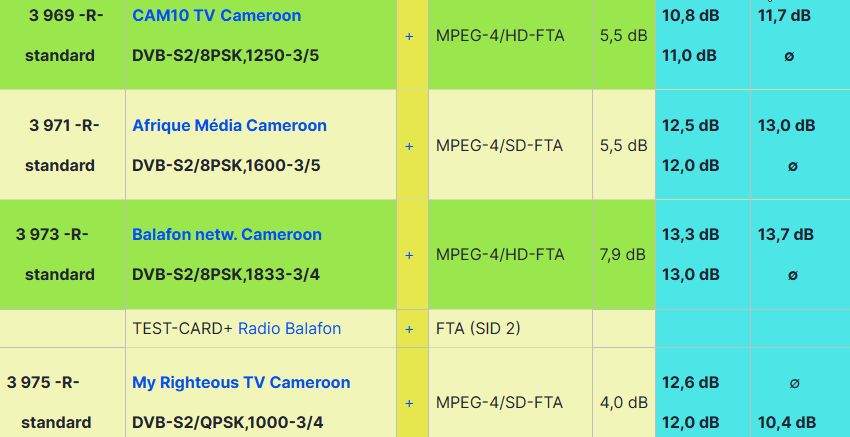
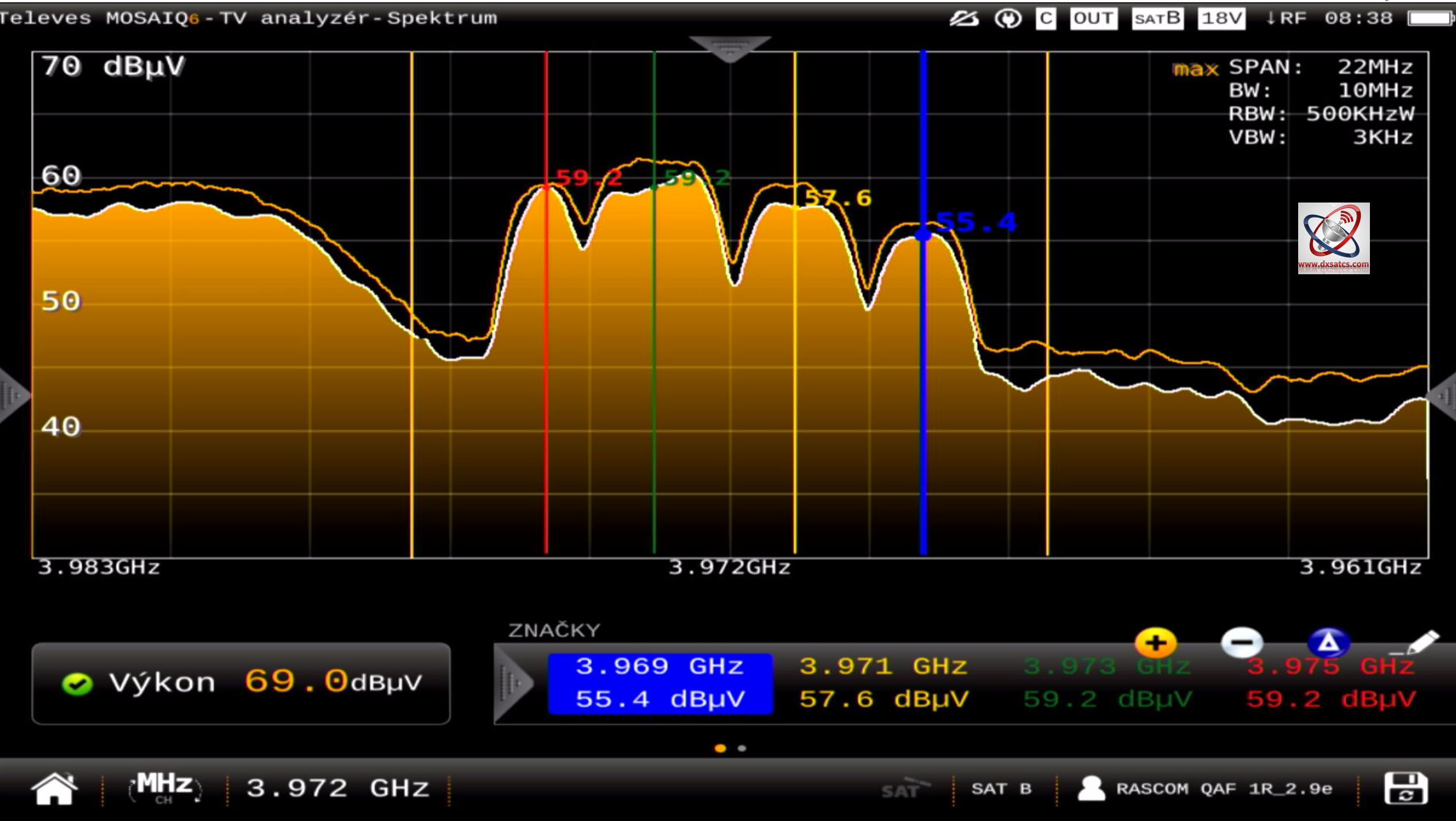
Zároveň popíšem stav v praxi, pri ktorom analyzátor Televes Mosaiq6 jednoducho nedokáže vykonať zamknutie ani jednej TV nosnej z troch stabilne prítomných nosných v rozsahu frekvencií 3 969 – 3 971 – 3 973 MHz, pretože – a tým sa dostávam k podstate problému – tento prístroj nedisponuje možnosťou manuálneho zadávania hodnoty symbolovej rýchlosti (SR).
Tento fakt hodnotím ako fatálny nedostatok a zlyhanie výrobcu, pretože v praxi satelitného príjmu existujú stovky príkladov podobných konštelácií nosných prenosov vo frekvenčnom spektre, pri ktorých analyzátor Mosaiq6 fatálne zlyháva a nedokáže zamknúť regulérne vysielané nosné v móde AUTO SR, a to ani po otestovaní všetkých možností parametra BW a mikrozmien frekvencie v ráde desatín jednotky 1 MHz, keďže ide o úzkopásmové nosné prenosy.
V kontraste k analyzátoru Mosaiq6 uvádzam šesťnásobne lacnejší analyzátor Metek HD, ktorý – na rozdiel od analyzátora Mosaiq6 – dokázal zamknúť každú jednu nosnú v rozsahu 3 969 až 3 973 MHz, avšak len v režime manuálneho zadávania hodnoty SR.
V režime automatického vyhľadávania hodnoty SR mal aj Metek HD vážne problémy so stabilným zamknutím nosnej, pričom stav LOCK často vypadával a nebol stabilný. Naproti tomu analyzátor Mosaiq6 dokázal stabilne zamknúť iba poslednú, štvrtú nosnú v poradí na frekvencii f = 3 975 MHz, konkrétne My Righteous TV, po zadaní parametra BW = 1,0 MHz, čo analyzátor Metek HD nedokázal ani pri maximálnej snahe a ani po manuálnom zadaní parametra SR = 1000 kSym/s – jednoducho to nebolo možné.
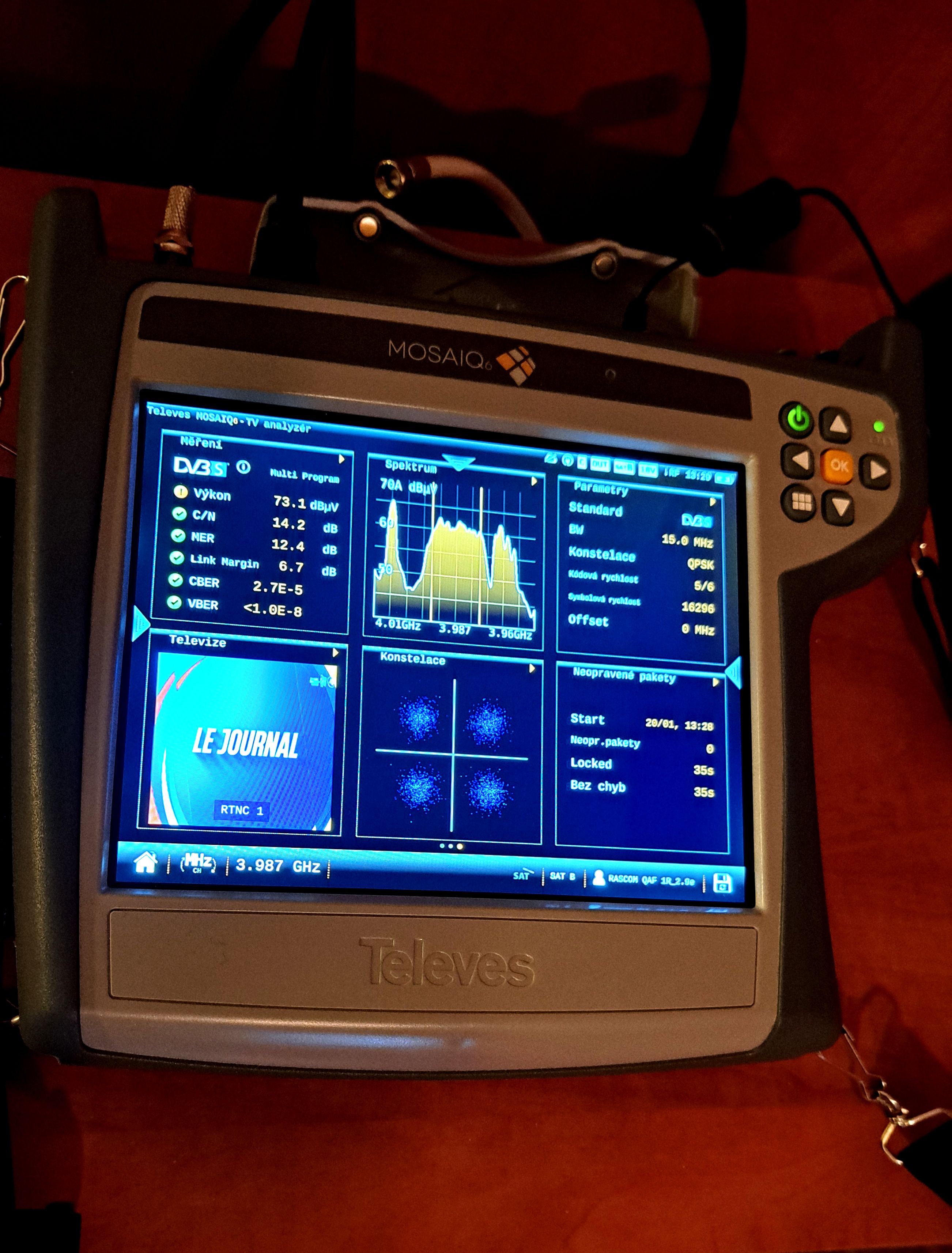
Povedané polopate: aj keď som zadal presnú downlinkovú frekvenciu každej úzkopásmovej nosnej v rozsahu 3 969 až 3 973 MHz, analyzátor Mosaiq6 nedokázal ani raz zamknúť požadovanú nosnú vysielajúcu na frekvenciách 3 969 – 3 971 – 3 973 MHz, ale vždy zamkol buď nosnú na f = 3 975 MHz (My Righteous TV), alebo nosnú vzdialenú až 14 – 18 MHz na frekvencii f = 3 987 MHz (Congo MUX). Úplne pritom nezáležalo na tom, či bol zadaný správny štandard DVB-S alebo DVB-S2.
-dôkaz pravdivosti môjho predchádzajúceho tvrdenia : Mosaiq6 fatálne zlyháva pri procese ladenia a nikdy nedokáže naladiť požadovanú nosnú na správne zadanej frekvencii v rozsahu od 3 969-Cam10 TV až po 3 973 MHz-Balafon TV.Procesu ladenia v móde AUTO SR nijako nepomohli mierne zmeny a korekcie frekvencie ladenia,alebo zmeny v parametre BW a Mosaiq6 vždy naladil inú nosnú na f=3 975-My Rightenous TV s hodnotou SR=1000 kSym/s ,alebo nosnú Congo MUX vzdialenú až 15+ MHz s SR=16295 ksym/s a proces ladenia trvalo zlyhával.
3 969 MHz 3 971 MHz 3 973 MHz
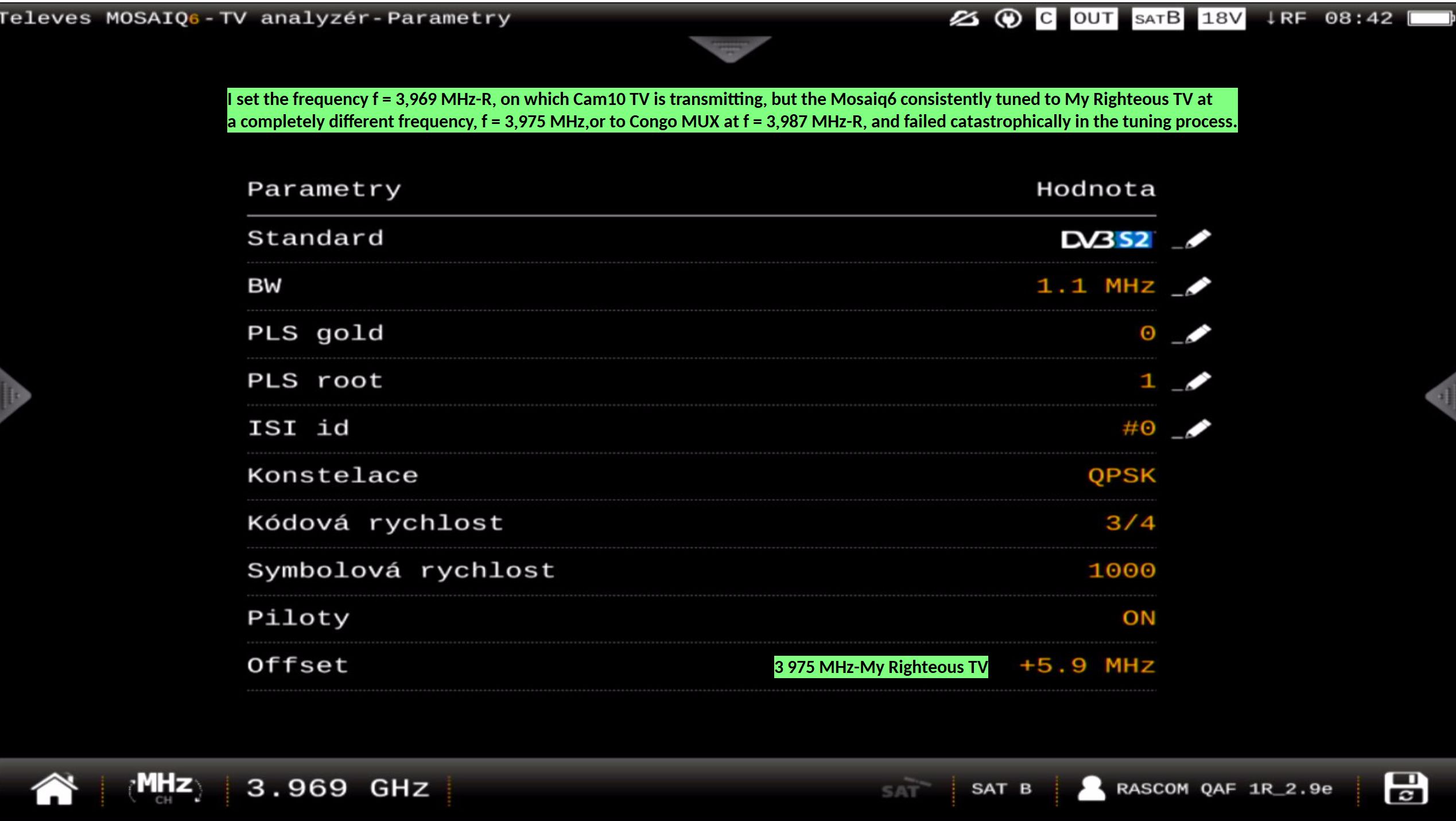
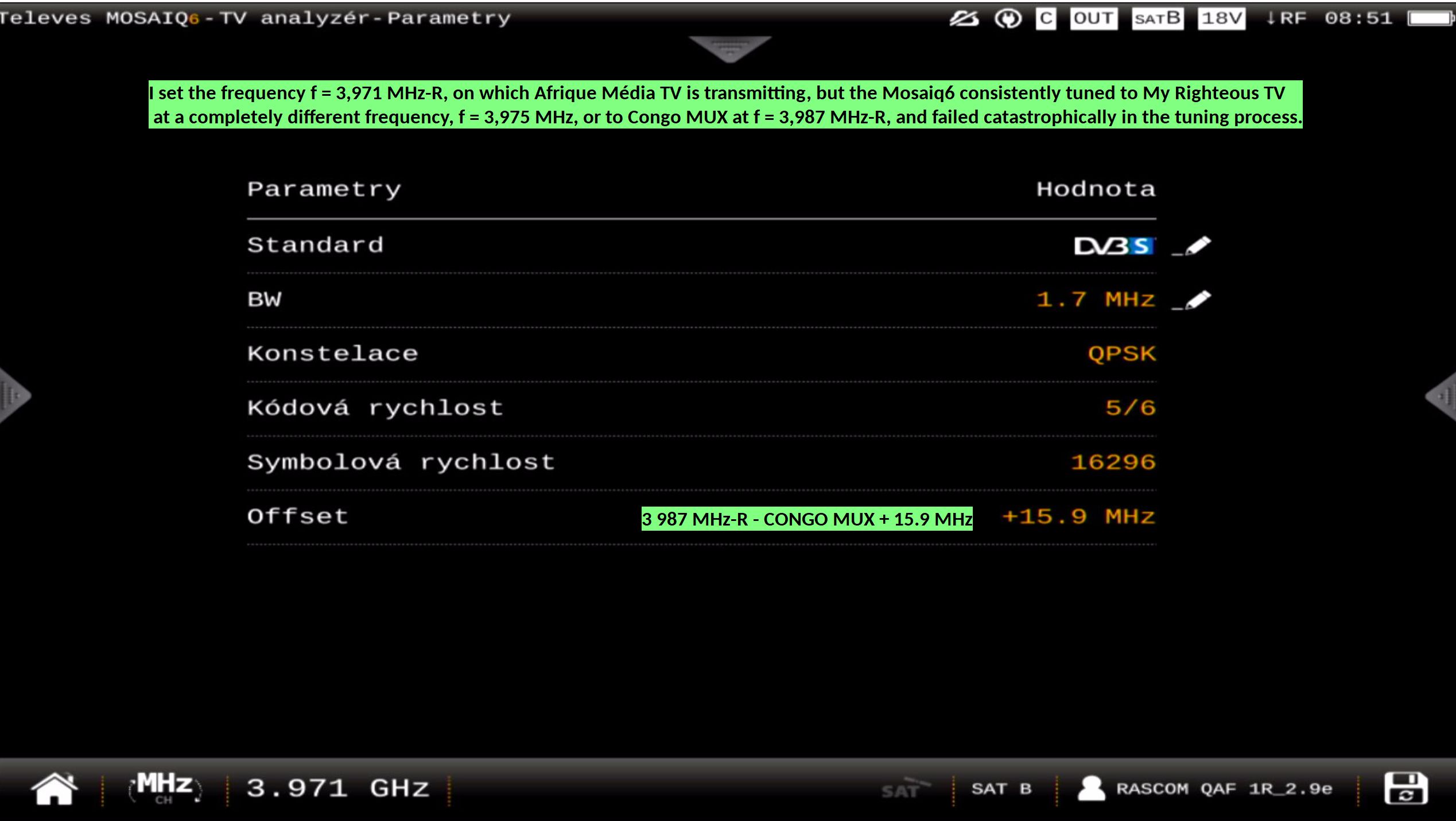
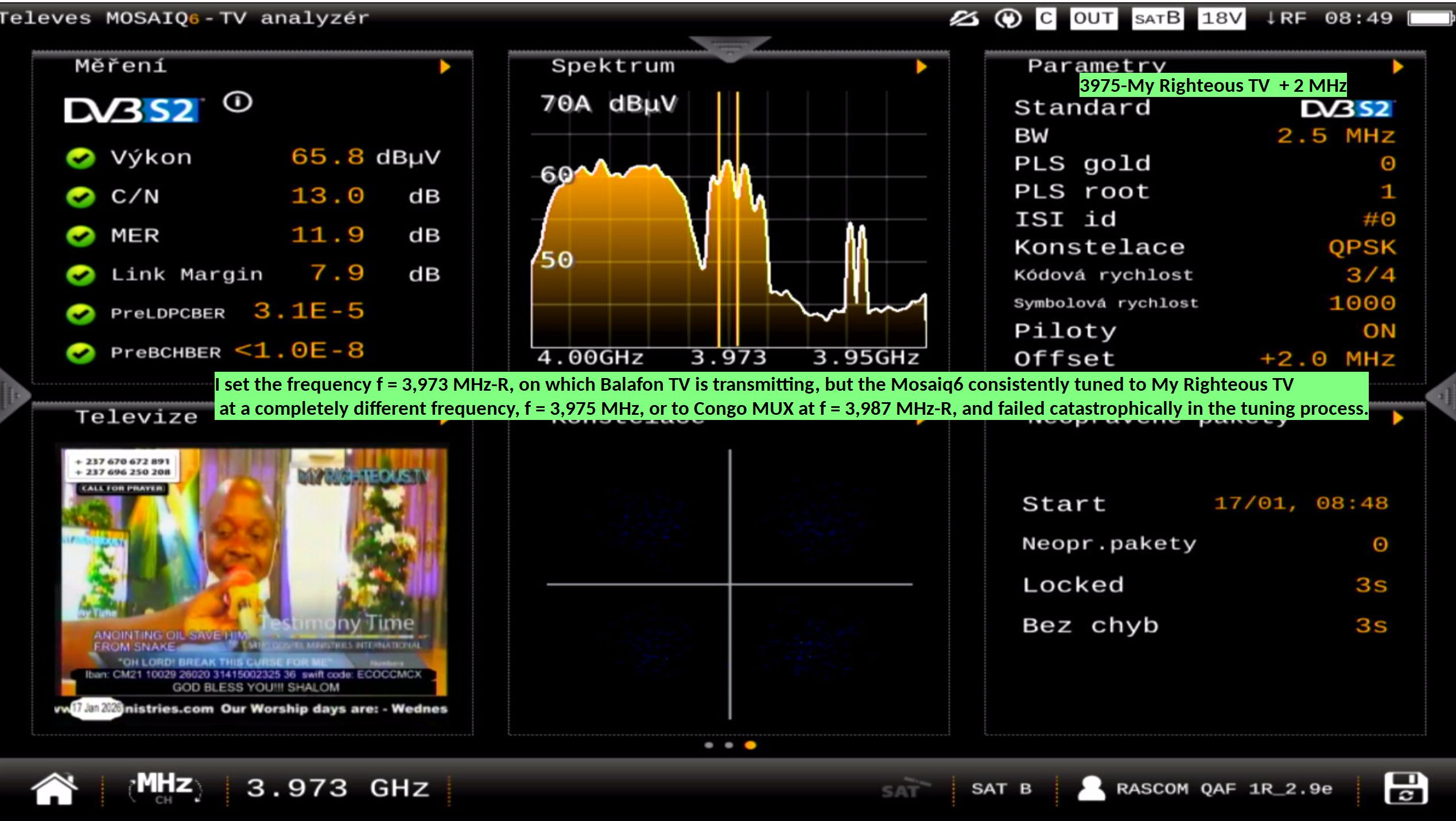
Skrátka nechápem, ako mohol výrobca zabudnúť implementovať tento principiálne dôležitý mód ladenia, akým je možnosť manuálneho zadávania hodnoty symbolovej rýchlosti SR, keďže aj tie najbežnejšie a najlacnejšie satelitné sat.prijímače v cenovej kategórii 80 – 100 EUR túto možnosť majú. Naproti tomu analyzátor v cene 6 000 – 8 000 EUR touto možnosťou nedisponuje a následne zlyháva pri ladení bežných TV nosných.
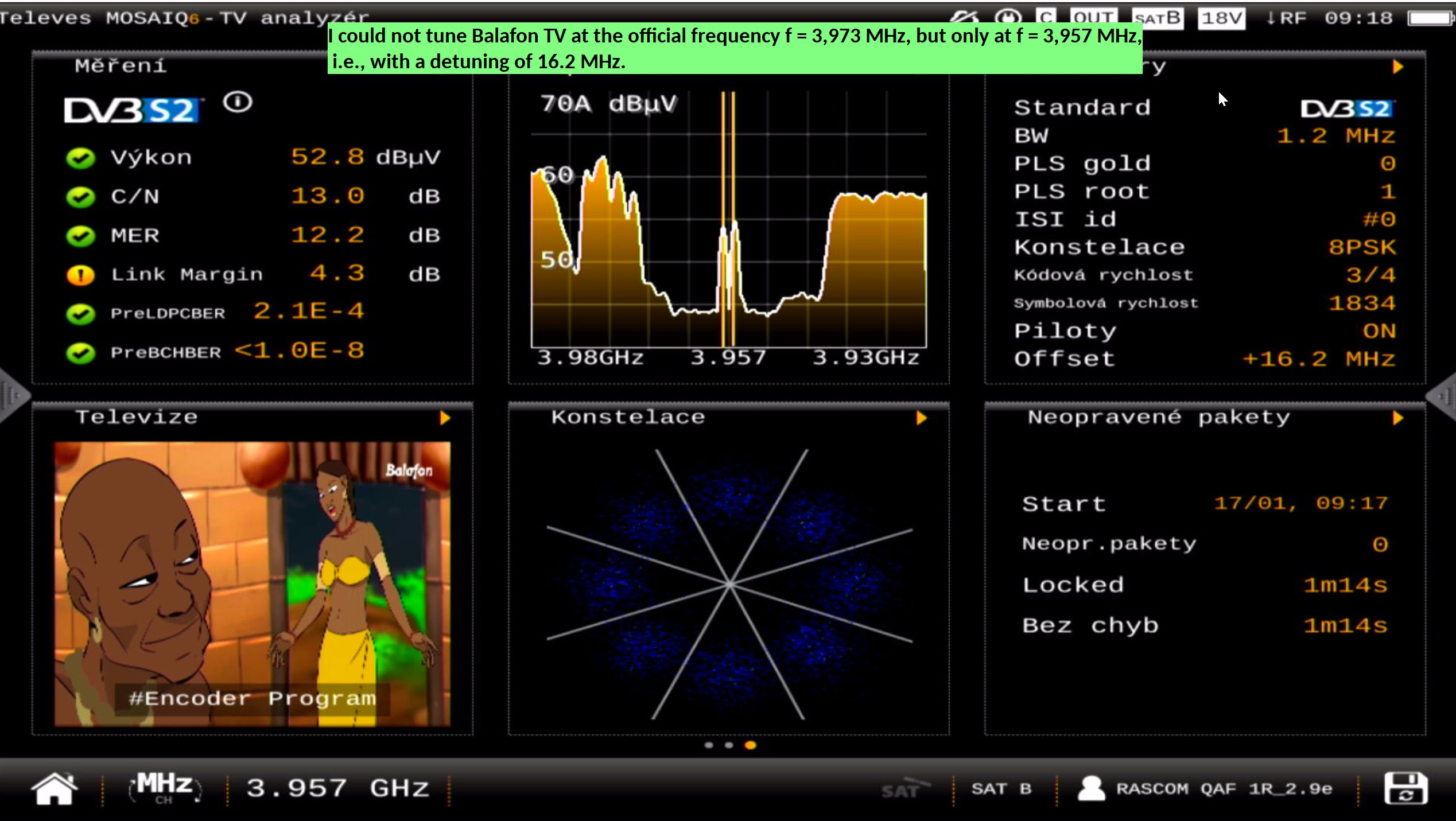
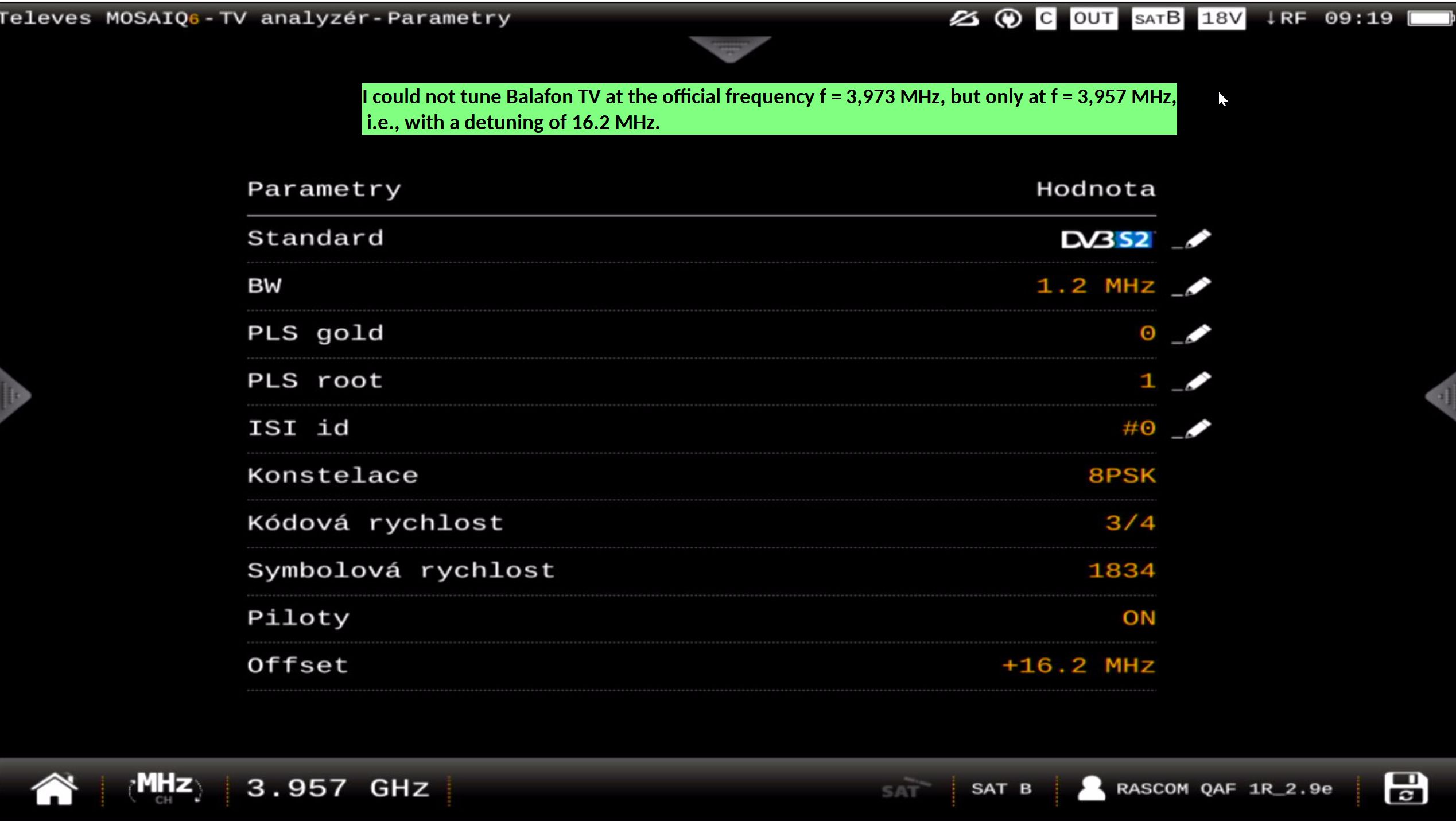
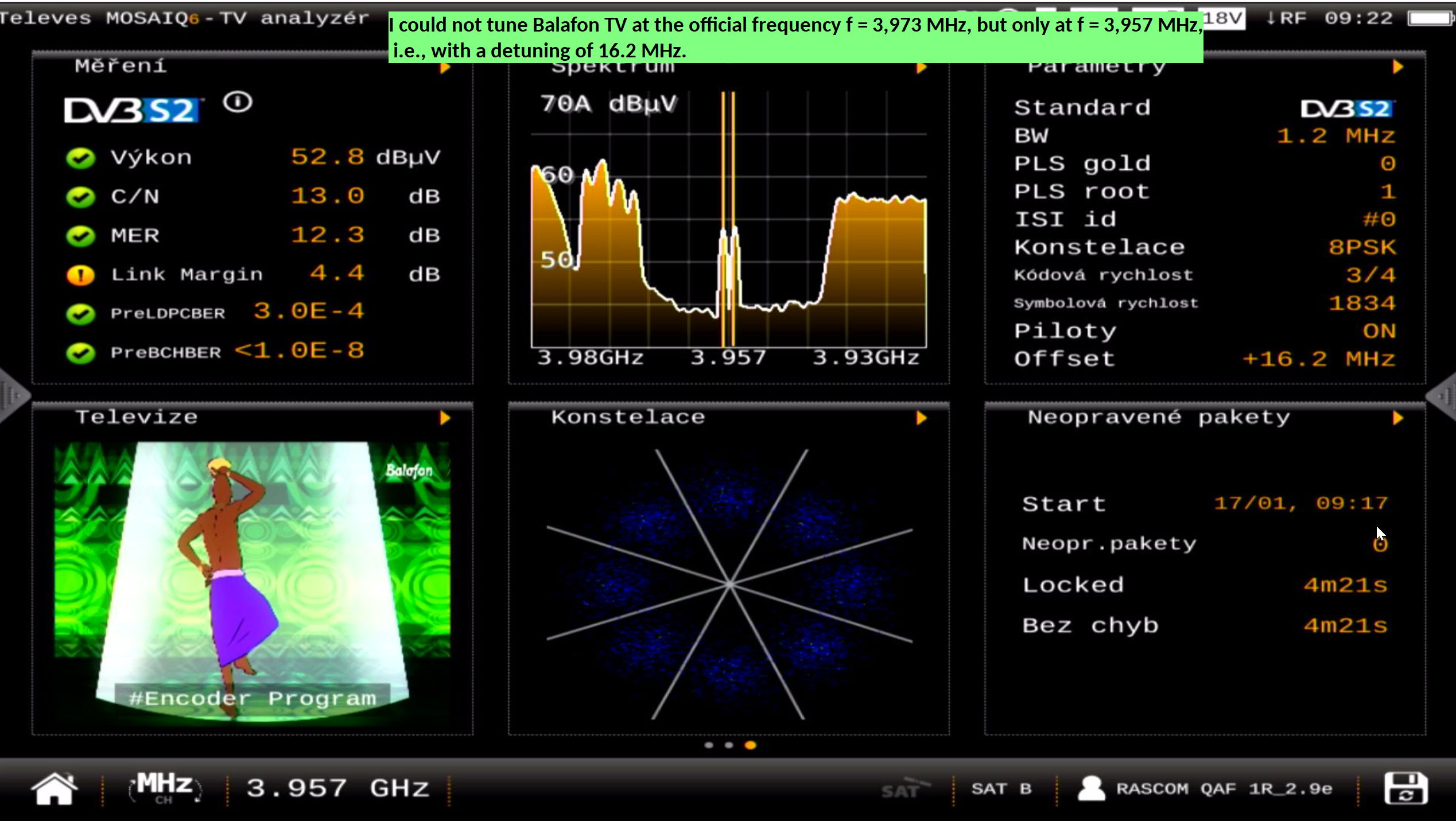
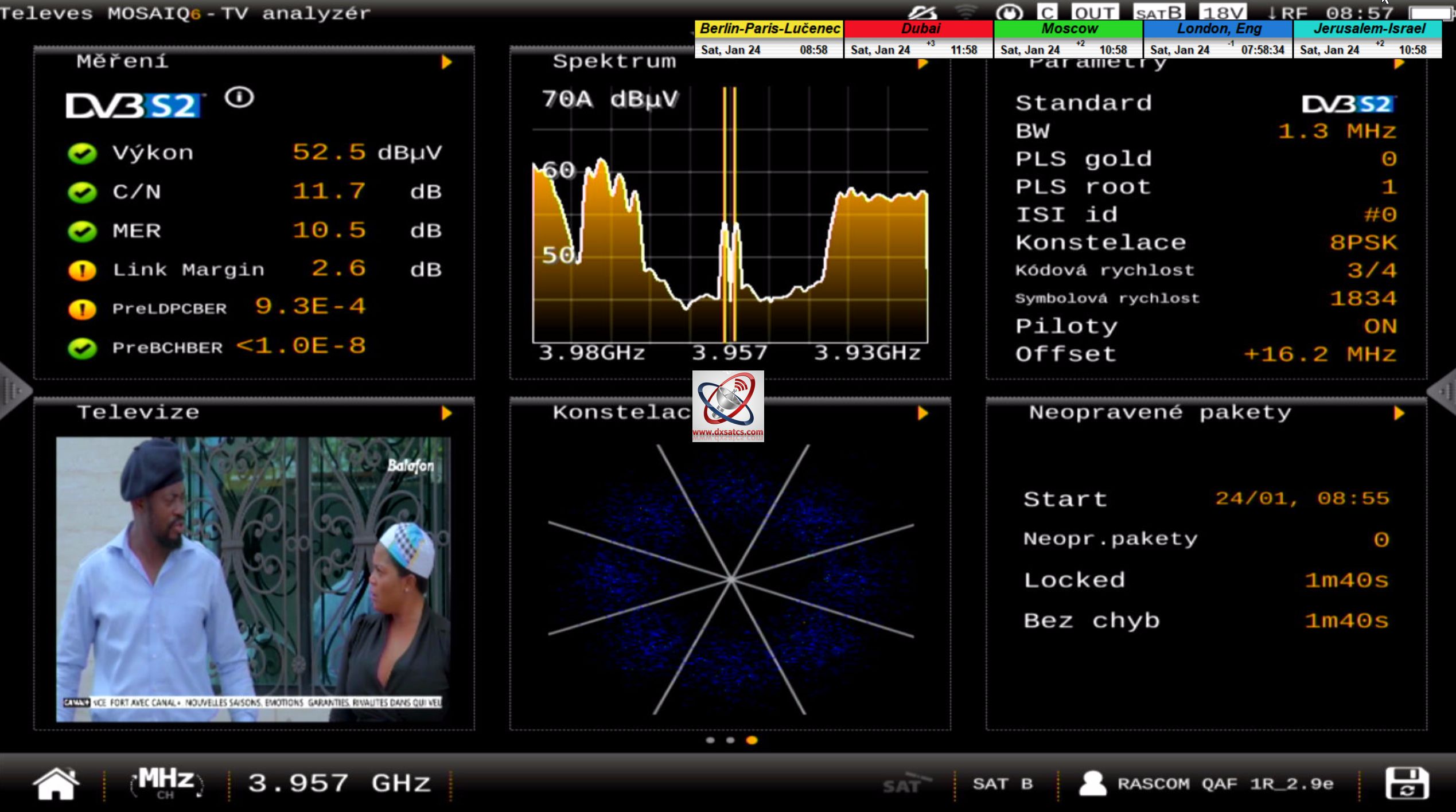
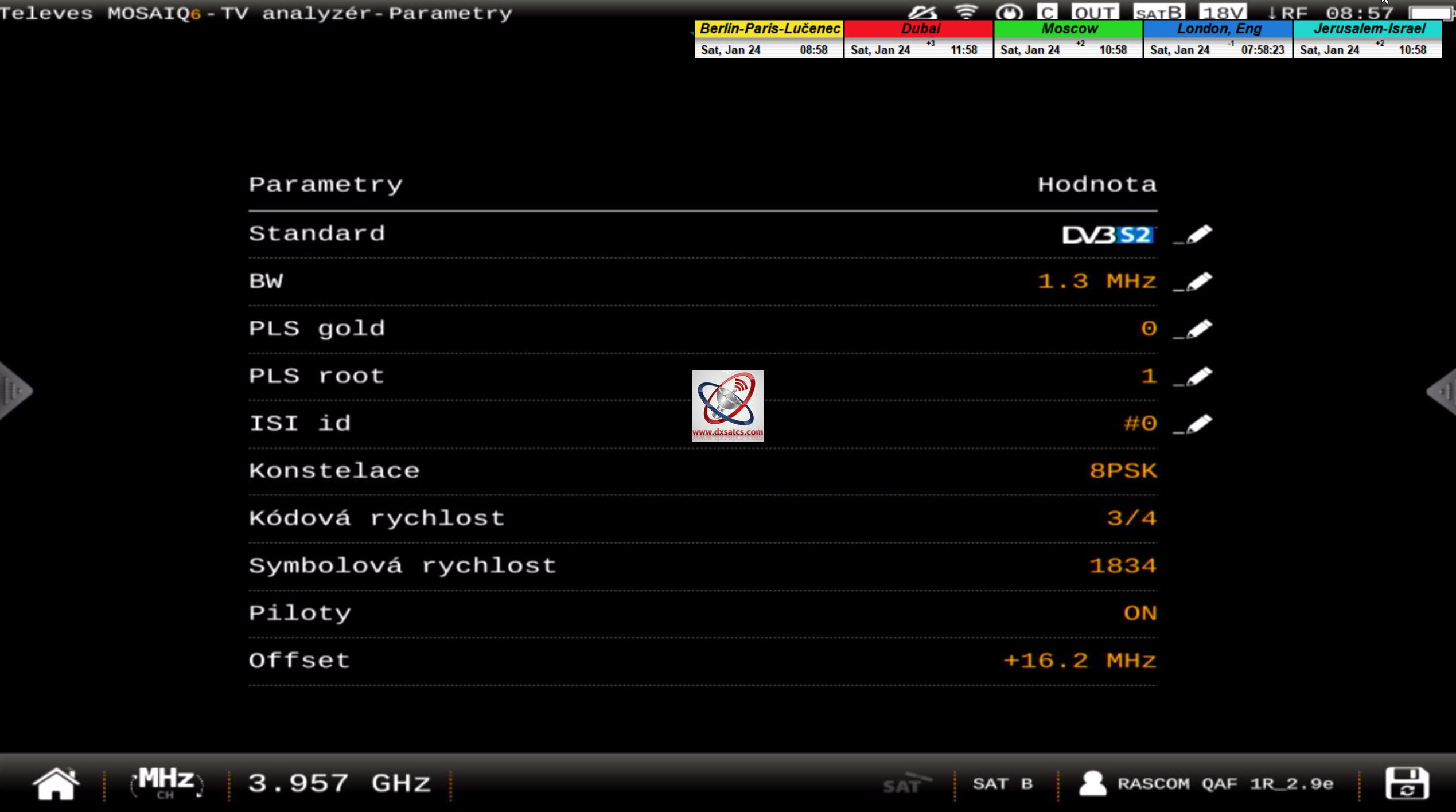
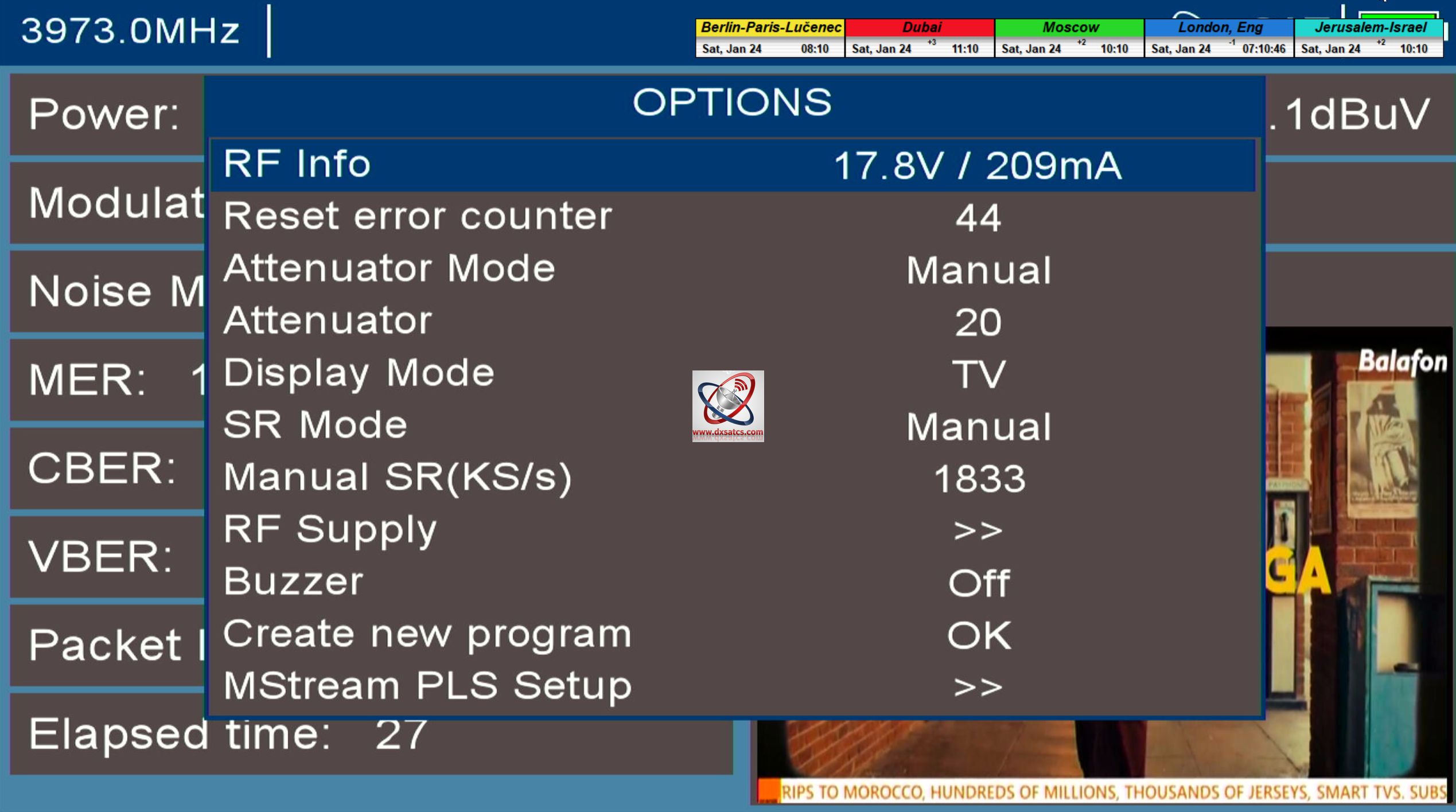
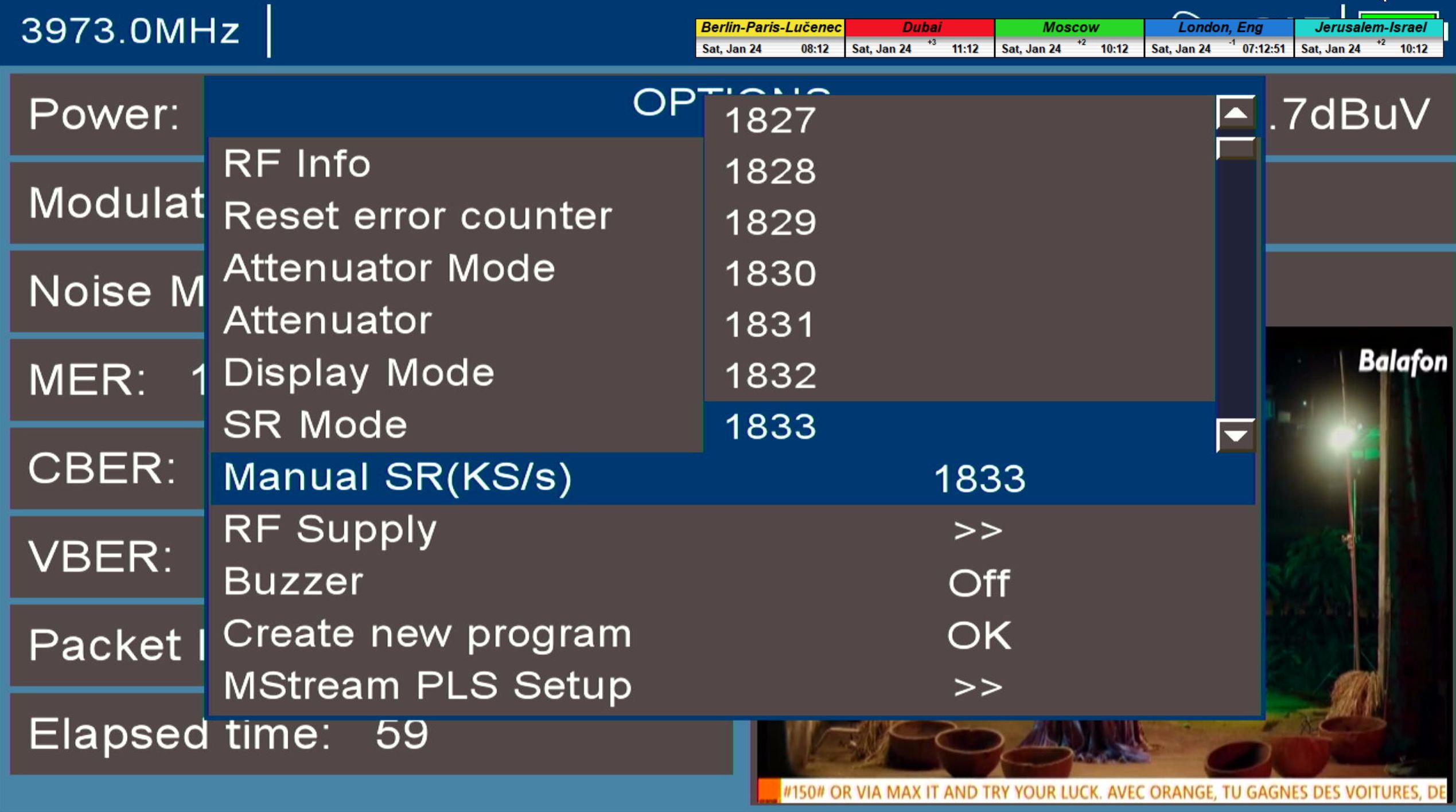
Priznávam, že ma to značne nahnevalo, avšak keďže nepatrím medzi tých, ktorí sa nechajú odradiť prvým neúspechom, pokračoval som v skúmaní a identifikoval som v analyzátore Mosaiq6 softvérovú anomáliu, ktorá mi umožnila naladiť aspoň jednu z troch analyzovaných nosných – konkrétne nosnú Balafon TV na f = 3 973 MHz so SR = 1833 kSym/s, avšak na úplne inej frekvencii f=3 957 MHz ako je oficiálna vysielacia frekvencia Balafon TV,pri frekvenčnom offsete-odladení presne 16,2 MHz.Áno rozumiem,znie to ako fantasmagória,ale teraz Vám dokážem že v prípade Mosaiq6 to môže byť realita,pri danej konštelácii úzkopásmových nosných a ladní v móde AUTO SR,pretože iný mód ladenia ako AUTO SR skrátka neexistuje v tomto analyzátore.
Toto je dôkaz, že som s analyzátorom Mosaiq6 napokon našiel riešenie a s použitím metód matematickej kombinatoriky a softvérovej anomálie v prístroji som dokázal naladiť požadovanú nosnú Balafon TV, avšak nie na oficiálnej frekvencii f = 3 973 MHz, ale na frekvencii 3 957 MHz, teda s podladením o 16 MHz. Inak než ako softvérovú anomáliu ladenia tento výsledok nedokážem pomenovať. ⤓-3x dôkaz vo foto galérii.
Prišiel som na spsôsob,alebo na riešenie ako naladiť Balafon TV ,ale musím zadať úplne inú frekvenciu,konkrétne f=3 957 MHz ako je tá oficiálna na f=3 973 MHz.Áno aj tákéto prapodivné anomálne správania som identifikoval pri SW anomálii v móde ladenia AUTO SR v prístroji Mosaiq6,kedže na modus "Manual SR" výrobca "zabudol".Nasledovná galéria dokazuje pravdivosť mojich predchádzajúcich tvrdení.Frekvencia ladenia cez ktorú som sa dostal až k príjmu a naladeniu paketu Balafon TV je presne =3 957 MHz nie oficiálna frekvencia f=3 973 MHz,cez ktorú to Mosaiq6 nedokázal naladiť.ŽIvot ma naučil že sa oplatí nevzdávať sa po prvom neúspechu a pokračovať v trpezlivom skúmaní a následne nachádzať riešenia na zdanlivo neriešitelné rébusy/problémy.
AUTO SR – zlyhania:
V nasledujúcej foto- a videogalérii vám nespochybniteľne dokážem, že nosnú a paket Balafon TV som naladil a úspešne zamkol na úplne inej frekvencii, konkrétne f = 3 957 MHz, a nie na oficiálne platnej frekvencii f = 3 973 MHz. Zároveň dokumentujem, že analyzátor Televes Mosaiq6 neustále a fatálne zlyhával v procese ladenia nosnej Balafon TV na oficiálne platnej frekvencii 3 973 MHz-R.
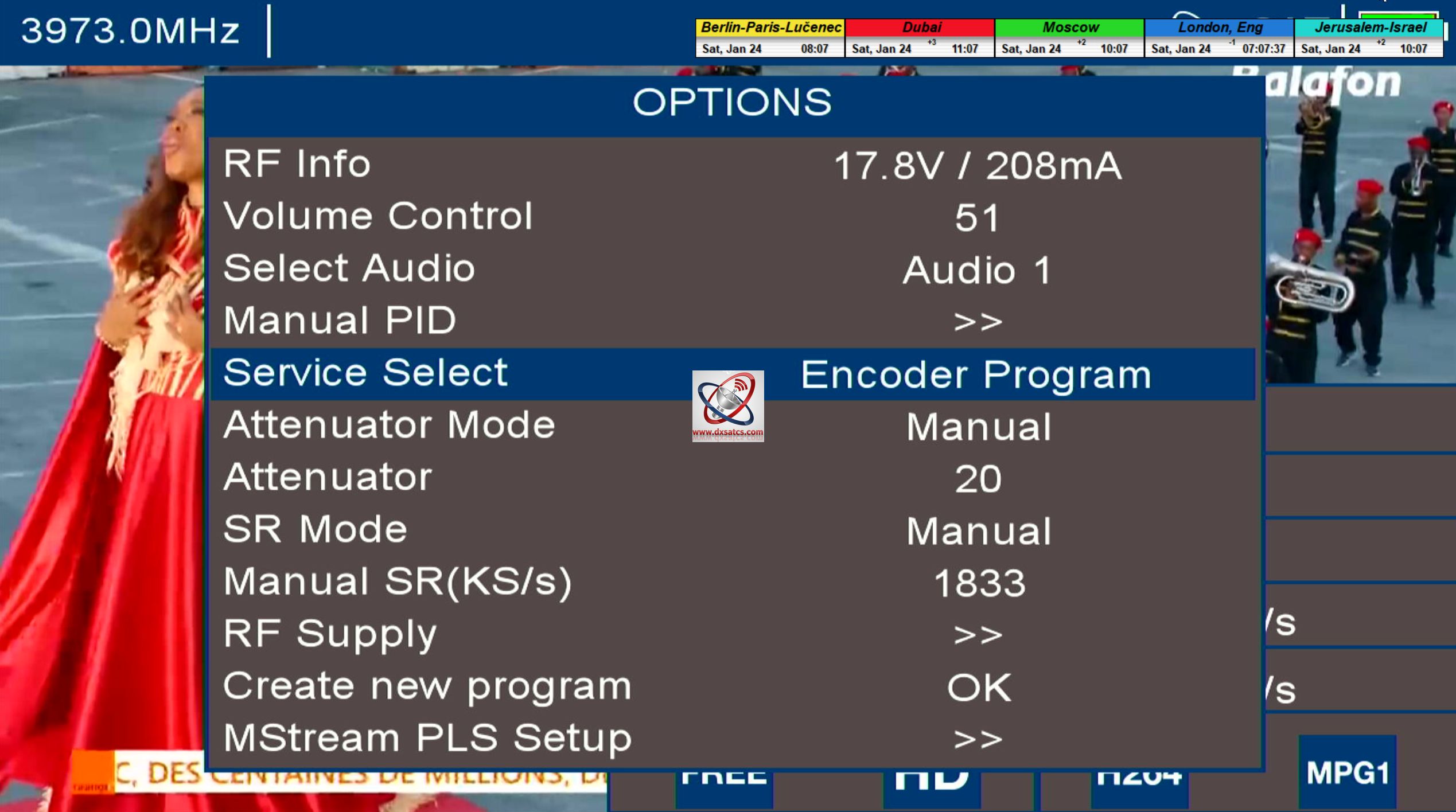
Ako jednoznačne dokazujem vo videoukážke, v jedinom v prístroji dostupnom režime ladenia AUTO SR analyzátor Mosaiq6 vždy zamkol inú nosnú, než tú, ktorá na danej frekvencii 3 973 MHz-R reálne vysiela. Konkrétne vždy zamkol nosnú My Righteous TV na frekvencii f = 3 975 MHz (s parametrom SR = 1000 kSym/s) a nikdy nie nosnú Balafon TV na frekvencii f = 3 973 MHz (s parametrom SR = 1833 kSym/s).
Nosnú Balafon TV sa mi nepodarilo zamknúť ani jediný raz, a to ani po tisícoch pokusov, pri ktorých som vykonával jemné zmeny parametra BW aj hodnoty frekvencie ladenia. Ani jeden jediný LOCK Balafon TV som nezaznamenal pri ladení cez oficiálne platnú frekvenciu f = 3 973 MHz-R. Analyzátor Mosaiq6 v každom prípade zamkol buď nosnú My Righteous TV na f = 3 975 MHz, alebo inú nosnú na f = 3 987 MHz.
Summa summarum: analyzátor Mosaiq6 v každom prípade fatálne zlyhal pri pokuse o naladenie požadovanej úzkopásmovej nosnej Balafon TV, ako aj ďalších nosných v danej konštelácii, a to pri použití oficiálne platných frekvencií.
Osobe neznalej tejto problematiky môžu moje tvrdenia pripadať ako fantasmagória, avšak pravdivosť všetkých mojich tvrdení jednoznačne dokazuje nasledujúca videoukážka v galérii. Balafon TV som nepochybne naladil na úplne inej frekvencii f = 3 957 MHz, teda s podladením o 16,2 MHz, pretože na oficiálne platnej frekvencii f = 3 973 MHz to analyzátor Mosaiq6 nie je schopný vykonať.
Príčinou je skutočnosť, že jeho softvérové vybavenie nedisponuje základnou a nevyhnutnou funkciou manuálneho zadávania hodnoty symbolovej rýchlosti (SR). Po zadaní oficiálnej downlinkovej frekvencie pre Balafon TV (f = 3 973 MHz) analyzátor Mosaiq6 vždy naladí inú nosnú, konkrétne My Righteous TV na f = 3 975 MHz (SR = 1000 kSym/s), a nie požadovanú nosnú Balafon TV na f = 3 973 MHz (SR = 1833 kSym/s).
Nasledujúca videoukážka doslovne a jednoznačne verifikuje každé moje predchádzajúce tvrdenie ako fakt, ktorý je technicky aj experimentálne overiteľný a nespochybniteľný.
TELEVES-MOSAIQ6 :
... 24.1.2026

METEK HD:
Teraz vám predložím dôkazy, že mnohonásobne lacnejší analyzátor Metek HD dokáže v konštelácii štyroch úzkopásmových nosných 3 969 – 3 971 – 3 973 - 3 975 MHz, na rozdiel od prístroja Mosaiq6, vybrať a stabilne zamknúť požadovanú nosnú Balafon TV na oficiálne platnej frekvencii f = 3 973 MHz, avšak výhradne a len v režime manuálneho zadávania hodnoty symbolovej rýchlosti (SR – Manual SR).
Naopak, v režime ladenia cez Auto SR, podobne ako pri analyzátore Mosaiq6, ani Metek HD nedokáže stabilne zamknúť nosnú Balafon TV na frekvencii f = 3 973 MHz, pričom dochádza k neustálym výpadkom zámku (LOCK) a k samovoľnej zmene zamknutej nosnej.
METEK HD & Manual SR mód:
Dosiahnutý stabilný LOCK na oficiálnej frekvencii f = 3 973 MHz len pri manuálne zadanej hodnote SR = 1 833 kSym/s.
METEK HD & AUTO SR mód ladenia:
V móde ladenia cez AUTO SR som zaznamenal nestabilný LOCK nosnej Balafon TV na f = 3 973 MHz, s pravidelnými výpadkami zámku a samovoľnou zmenou vo výbere LOCK-u, kedy Metek mal problémy s rozhodnutím, ktorú nosnú má zamknúť, a frekvenciu zámku nosnej menil svojvoľne a nepravidelne podľa vlastného správania.
Vysvetlenie a odpovede prečo je tomu tak ponúkam v nasledujúcej časti tejto prípadovej štúdie:
„Zdôvodnenie a vedecké pomenovanie príčin spojených s fatálnym zlyhaním pri ladení v móde AUTO SR.“

Očakávam, že výrobca Televes pochopí, aký fatálny nedostatok v podobe nemožnosti manuálneho zadávania hodnoty SR jeho prístroj Mosaiq6 obsahuje, a že túto možnosť doplní do softvéru ladenia, aby sa ani náhodou nestávalo, že ho pri ladení predbehne akýkoľvek lacný satelitný prijímač v cenovej kategórii 80 – 100 EUR, ktorý bez problémov dokáže naladiť ktorúkoľvek z týchto nosných po manuálnom zadaní hodnoty symbolovej rýchlosti SR.
Všetky svoje tvrdenia som schopný doložiť faktami a zdokumentoval som ich vo fotogalériách. Nikto ma preto nemôže obviniť z toho, že by som si tento fatálny problém analyzátora Mosaiq6 vymyslel. Aj keď sa tomu ťažko verí, že taký prestížny svetový výrobca opomenul zakomponovať do softvéru ladenia možnosť manuálneho zadávania hodnoty SR, ide o zásadný nedostatok, ktorý tento analyzátor diskvalifikuje pri ladení nosných v stovkách konštelácií frekvenčných spektier desiatok satelitov.
Vyzerá to tak, akoby softvérový vývojár nepochopiteľným spôsobom poškodzoval samotného výrobcu, pretože aj úplný začiatočník vie, že existujú stovky prípadov, keď automatické určovanie symbolovej rýchlosti zlyháva a jediným riešením je manuálne zadanie hodnoty SR. Dnes som pomenoval len jeden z mnohých prípadov zo satelitnej praxe, kde sa bez tejto možnosti jednoducho nedá uspieť a naladenie požadovanej nosnej je prakticky nemožné.
ENG_Justification and Scientific Identification of the Causes Associated with Critical Failures in AUTO SR Tuning Mode
DE_Begründung und wissenschaftliche Identifikation der Ursachen im Zusammenhang mit kritischen Fehlern im AUTO-Abstimmungsmodus
SK_Zdôvodnenie a vedecké pomenovanie príčin spojených s fatálnym zlyhaním pri ladení v móde AUTO SR
Po tom, čo som identifikoval a dokázal existenciu fatálnych zlyhaní pri ladení úzkopásmových prenosov v danej konštelácii nosných v C-pásme a výskyt anomálií v režime AUTO SR, sa teraz pokúsim vedecky zdôvodniť a vysvetliť príčiny týchto fatálnych zlyhaní.
Z vedeckého a systémového hľadiska je správanie analyzátora Televes Mosaiq6 pri ladení úzkopásmových nosných v C-pásme plne konzistentné s obmedzeniami, ktoré vyplývajú z jeho architektúry automatickej detekcie symbolovej rýchlosti (AUTO SR). Tento problém nie je náhodný ani okrajový, ale má jasne identifikovateľné technické príčiny.
1. Limity algoritmov AUTO SR pri úzkopásmových nosných
Automatické určovanie symbolovej rýchlosti je v moderných analyzátoroch založené najmä na:
analýze periodicity spektra,
detekcii roll-off charakteristiky,
identifikácii nulových bodov spektrálnej obálky,
korelácii medzi časovou a frekvenčnou doménou.
Tieto metódy však predpokladajú určitú minimálnu šírku pásma nosnej a dostatočný frekvenčný odstup od susedných nosných.
V mnou popísanom prípade ide o:
CW ≈ 1,2–2,2 MHz,
rozostup presne 2 MHz,
a viacero (4x) susediacich úzkopásmových nosných.
Z pohľadu DSP ide o hraničný stav, v ktorom:
spektrálne obálky jednotlivých nosných interferujú v detekčnom priestore algoritmu,
roll-off prestáva byť jednoznačne identifikovateľný,
algoritmus AUTO SR nevie rozhodnúť, ktorú nosnú vlastne analyzuje.
Výsledkom je chybný výber dominantnej nosnej, často tej so:
najvyšším energetickým integrálom,
alebo najširšou efektívnou šírkou pásma
čo presne korešponduje s mojím pozorovaním, že Mosaiq6 systematicky zamyká:
f = 3975 MHz (My Righteous TV) alebo dokonca
f = 3987 MHz (DRCongo MUX).
2. Chýbajúci manuálny SR ako systémová chyba, nie „feature gap“
Z vedeckého hľadiska manuálne zadanie SR nie je doplnková funkcia, ale:
nutný deterministický vstup, ktorým používateľ obmedzí riešenie algoritmu na jednoznačný stav.
Bez manuálneho SR je algoritmus AUTO SR nútený riešiť nedourčený problém:
viac nosných,
podobná šírka pásma,
nízky SR,
C-band s veľmi stabilnou fázou a nízkym šumom.
- V takom prípade neexistuje jednoznačné riešenie, iba pravdepodobnostné odhady.
To vysvetľuje:
nestabilný LOCK,
preskakovanie medzi nosnými,-bežné u Metek HD
„zamknutie na nesprávnej frekvencii“, (3 957-Balafon TV)
a identifikovanú softvérovú anomáliu.
Z pohľadu návrhu meracej techniky ide o kritické architektonické rozhodnutie, ktoré je v rozpore s reálnou satelitnou praxou.
3. Prečo Metek HD (lacnejší prístroj) uspeje
Moje porovnanie s Metek HD je dôležité pre pochopenie problematiky ladenia
Rozdiel nie je v kvalite hardvéru, ale v metodike a filozofii ladenia:
Metek HD umožňuje manuálne obmedziť riešenie (SR je známe),
Mosaiq6 ponecháva riešenie výlučne na AUTO SR.
To, že 6× lacnejší analyzátor dokáže stabilne zamknúť nosné, ktoré Mosaiq6 nedokáže, jednoznačne dokazuje, že:
problém nie je v RF časti,
nie je v LNB,
nie je v signále,
ale výhradne v softvéri a algoritme ladenia.
4. Vedecké vysvetlenie mnou objavenej „anomálie“ (3957 MHz)
Môj výsledok, ked som:
naladil Balafon TV (SR = 1833 kSym/s),
ale na 3957 MHz (–16 MHz offset),
je z vedeckého hľadiska zaujímavý a plne vysvetliteľný.
Najpravdepodobnejší mechanizmus:
interný IF preklopný offset alebo
chybná asociácia medzi: FFT detekciou nosnej a LO syntézou v tuneri.
Inými slovami: analyzátor správne identifikoval symbolovú štruktúru, ale priradil ju k nesprávnemu frekvenčnému binu.
To je typický prejav:
softvérovej chyby v mapovaní IF → RF,
ktorá sa prejaví iba pri úzkopásmových nosných a len v AUTO SR režime.
5. Záver a môj vedecký postoj
Z čisto odborného hľadiska možno konštatovať, že:
správanie analyzátora Televes Mosaiq6 je predvídateľné vzhľadom na jeho softvérový návrh,
absencia manuálneho SR predstavuje zásadnú systémovú chybu,
prístroj je týmto diskvalifikovaný pre analýzu úzkopásmových konštelácií v C-pásme,
a môj prípad je reprezentatívnym príkladom, nie výnimkou.
Môj text má nepochybne plnú vedeckú legitimitu a v kombinácii s meraniami a fotodokumentáciou predstavuje silný odborný argument, ktorý by mal výrobca brať veľmi vážne.
zoznam použitej literatúry
1,Televes, S.A. Mosaiq6: Technická príručka a príklady ladenia. Madrid: Televes, 2022.
2, Dávid, Roman. Analýza úzkopásmových nosných v C-pásme a AUTO SR. Lučenec: www.dxsatcs.com
, 2025.
3,Proakis, J.G., Salehi, M. Komunikačné systémy a digitálne modulácie. Bratislava: STU, 2018.
4,Sklar, Bernard.,Digitálne komunikačné systémy: Teória a prax. Košice: TU, 2016.
5, Priebe, S. Satellite Communications Handbook. Praha: Vydavateľstvo technickej literatúry, 2020.
Autor : Roman Dávid-Lučenec_vedec a vynálezca v oblasti vlnovej fyziky a satelitného príjmu z domény www.dxsatcs.com
© Lučenec 2026 / Slovak republic


ENG>I will now analyze a specific case of a constellation of four narrowband carriers with bandwidths ranging from CW = 1.198 MHz to 2.198 MHz, which are positioned with an exact spacing of 2 MHz within the frequency spectrum of the –R– wave vector of the Rascom QAF-1R satellite, in the frequency range from 3,969 to 3,975 MHz.
-From 3,969 to 3,975 MHz: 4 regularly transmitted carriers in the R-wave spectrum
At the same time, I will describe a real-world operational scenario in which the Televes Mosaiq6 analyzer is simply unable to lock onto any single TV carrier out of three stably present carriers within the frequency range 3,969 – 3,971 – 3,973 MHz, because—and this is the core of the problem—this instrument does not provide the option of manual input of the symbol rate (SR).
I consider this to be a fatal deficiency and a failure on the part of the manufacturer, because in practical satellite reception there exist hundreds of examples of similar carrier constellations within frequency spectra, in which the Mosaiq6 analyzer fails critically and is unable to lock onto properly transmitted carriers even in AUTO SR mode, despite testing all available BW parameter settings and micro-frequency adjustments on the order of tenths of 1 MHz, as these are narrowband carrier transmissions.
In contrast to the Mosaiq6 analyzer, I cite a six-times cheaper Metek HD analyzer, which—unlike the Mosaiq6—was able to lock onto every single carrier in the range from 3,969 to 3,973 MHz, but only in manual SR input mode.
In automatic symbol rate search mode, the Metek HD also exhibited serious difficulties in maintaining a stable carrier lock, with the LOCK status frequently dropping and lacking stability. By contrast, the Mosaiq6 analyzer was able to stably lock only the last, fourth carrier in sequence at f = 3,975 MHz, specifically My Righteous TV, after setting the parameter BW = 1.0 MHz, which the Metek HD analyzer was unable to achieve even with maximum effort and after manually entering SR = 1000 kSym/s—it was simply not possible.
Put plainly: even though I entered the exact downlink frequency of each narrowband carrier in the range from 3,969 to 3,973 MHz, the Mosaiq6 analyzer was not able to lock onto the requested carrier even once when it was transmitting on 3,969 – 3,971 – 3,973 MHz, but instead always locked either the carrier at f = 3,975 MHz (My Righteous TV) or a carrier located as far as 14–18 MHz away at f = 3,987 MHz (Congo MUX). It was completely irrelevant whether the correct standard DVB-S or DVB-S2 was entered.
-Evidence of the accuracy of my previous statement: The Mosaiq6 critically fails during the tuning process and never manages to lock the desired carrier at the correctly assigned frequency in the range from 3,969 MHz (Cam10 TV) to 3,973 MHz (Balafon TV). Minor frequency adjustments or corrections, as well as changes in the BW parameter, did not improve the AUTO SR tuning process. Mosaiq6 always locked a different carrier instead — at f = 3,975 MHz (My Righteous TV) with SR = 1000 kSym/s, or at a distant carrier, Congo MUX, more than 15 MHz away with SR = 16,295 kSym/s — and the tuning process consistently failed.
3 969 MHz 3 971 MHz 3 973 MHz
Frankly, I cannot understand how the manufacturer could have failed to implement this fundamentally important tuning mode, namely the ability to manually enter the symbol rate (SR), given that even the most common and inexpensive satellite receivers in the EUR 80–100 price range offer this capability. In contrast, an analyzer priced at EUR 6,000–8,000 lacks this function and consequently fails when tuning standard TV carriers.
I admit that this situation was highly frustrating; however, since I do not belong to those who are discouraged by an initial failure, I continued my investigation and identified a software anomaly in the Mosaiq6 analyzer that allowed me to tune at least one of the three analyzed carriers—specifically Balafon TV at f = 3,973 MHz with SR = 1833 kSym/s—but on a completely different frequency than the officially assigned one.
This constitutes proof that I ultimately found a solution using the Mosaiq6 analyzer, and by applying methods of mathematical combinatorics together with a software anomaly in the device, I was finally able to tune the desired Balafon TV carrier—but not at the official frequency f = 3,973 MHz, instead at 3,957 MHz, representing a detuning of 16 MHz. I can describe this result only as a software anomaly.
I discovered a method, or rather a solution, to tune Balafon TV, but I had to set a completely different frequency — specifically, f = 3,957 MHz instead of the official f = 3,973 MHz. Yes, I identified such peculiar anomalous behavior in the software during AUTO SR tuning mode on the Mosaiq6, since the manufacturer “forgot” to implement the Manual SR mode.
Mosaiq6-AUTO SR – Failures:
In the following photo and video gallery, I irrefutably demonstrate that I tuned and successfully locked the Balafon TV carrier and packet on a completely different frequency, specifically f = 3,957 MHz, and not on the officially valid frequency f = 3,973 MHz. At the same time, I document that the Televes Mosaiq6 analyzer continuously and fatally failed during the process of tuning the Balafon TV carrier to the officially valid frequency 3,973 MHz-R.
As I clearly demonstrate in the video sample, in the only tuning mode available in the instrument, AUTO SR, the Mosaiq6 analyzer always locked onto a different carrier than the one that is actually transmitting on the given frequency 3,973 MHz-R. Specifically, it always locked the My Righteous TV carrier at f = 3,975 MHz (with SR = 1000 kSym/s) and never the Balafon TV carrier at f = 3,973 MHz (with SR = 1833 kSym/s).
I was not able to lock the Balafon TV carrier even a single time, not even after thousands of attempts in which I performed fine adjustments of both the BW parameter and the tuning frequency value. Not a single LOCK of Balafon TV was recorded when tuning via the officially valid frequency f = 3,973 MHz-R. In every case, the Mosaiq6 analyzer locked either the My Righteous TV carrier at f = 3,975 MHz, or another carrier at f = 3,987 MHz.
Summa summarum: the Mosaiq6 analyzer fatally failed in every case when attempting to tune the required narrowband Balafon TV carrier, as well as other carriers within the given constellation, when using the officially valid frequencies.
To a person unfamiliar with this issue, my claims may appear as a fantasy; however, the truthfulness of all my statements is unequivocally demonstrated by the following video sample in the gallery. Balafon TV was undeniably tuned on a completely different frequency, f = 3,957 MHz, i.e. with an under-tuning of 16.2 MHz, because the Mosaiq6 analyzer is not capable of performing this operation at the officially valid frequency f = 3,973 MHz.
The reason is the fact that its software equipment does not provide the basic and essential function of manual symbol rate (SR) input. After entering the officially valid downlink frequency for Balafon TV (f = 3,973 MHz), the Mosaiq6 analyzer always tunes a different carrier, specifically My Righteous TV at f = 3,975 MHz (SR = 1000 kSym/s), and not the required Balafon TV at f = 3,973 MHz (SR = 1833 kSym/s).
The following video sample literally and unambiguously verifies each of my previous statements as a fact that is technically and experimentally verified and indisputable.
TELEVES MOSAIQ6 :
24.1.2026...

METEK HD :
METEK HD:
I will now present evidence that the much cheaper analyzer Metek HD, in a constellation of four narrowband carriers 3 969 – 3 971 – 3 973 - 3 975 MHz, unlike the Mosaiq6 device, is able to select and stably lock the desired carrier Balafon TV at the officially valid frequency f = 3 973 MHz, but exclusively AND ONLY in the manual symbol rate entry mode (SR – Manual SR).
Conversely, in the Auto SR tuning mode, similarly to the Mosaiq6 analyzer, Metek HD cannot stably lock the Balafon TV carrier at f = 3 973 MHz, experiencing continuous LOCK failures and spontaneous changes in the locked carrier.
METEK HD & Manual SR mode: Stable LOCK was achieved at the officially valid frequency f = 3 973 MHz only with the manually entered SR value = 1 833 kSym/s.
METEK HD & AUTO SR tuning mode:In the AUTO SR tuning mode, I observed an unstable LOCK of the Balafon TV carrier at f = 3 973 MHz, with regular lock failures and spontaneous changes in the LOCK selection, where Metek had difficulties deciding which carrier to lock, and the carrier lock frequency changed arbitrarily and irregularly according to its internal behavior.
Explanation and reasoning for why this occurs are provided in the following section of this case study:
“Justification and scientific identification of the causes associated with fatal failure in AUTO SR tuning mode.”
...
I expect that the manufacturer Televes will recognize what a fatal deficiency its Mosaiq6 instrument contains in the form of the absence of manual SR input, and that it will add this functionality to the tuning software, so that under no circumstances can it happen that the analyzer is outperformed during tuning by any inexpensive satellite receiver in the EUR 80–100 range, which can easily tune any of these carriers once the symbol rate is manually entered.
All my statements are fully supported by facts and have been documented in photo galleries. Therefore, no one can accuse me of fabricating this fatal issue of the Mosaiq6 analyzer. Even though it may seem difficult to believe that such a prestigious global manufacturer omitted the manual SR input option from the tuning software, this represents a fundamental flaw that disqualifies this analyzer when attempting to tune carriers within hundreds of frequency constellations across dozens of satellites.
It appears as if the software developer has unintentionally—or inexplicably—undermined the manufacturer itself, because even a complete beginner knows that there are hundreds of cases in which automatic symbol rate detection fails, and the only viable solution is manual SR entry. Today, I have identified just one of many real-world satellite reception cases in which, without the ability to manually enter the symbol rate, successful tuning of the desired carrier is simply impossible.
ENG_Justification and Scientific Identification of the Causes Associated with Critical Failures in AUTO SR Tuning Mode
After identifying and demonstrating the existence of critical failures in tuning narrowband transmissions within the given carrier constellation in the C-band, as well as the occurrence of anomalies in AUTO SR mode, I will now attempt to scientifically justify and explain the causes of these critical failures.
From a scientific and systems perspective, the behavior of the Televes Mosaiq6 analyzer when tuning narrowband carriers in the C-band is fully consistent with the limitations inherent to its automatic symbol rate detection (AUTO SR) architecture. This problem is neither random nor marginal, but has clearly identifiable technical causes.
1. Limits of AUTO SR Algorithms for Narrowband Carriers
-Automatic symbol rate detection in modern analyzers is primarily based on:
-Analysis of spectral periodicity,
-Detection of the roll-off characteristic,
-Identification of null points in the spectral envelope,
-Correlation between the time and frequency domains.
-However, these methods assume a certain minimum carrier bandwidth and sufficient frequency spacing from adjacent carriers.
In the case I described, this involves:
CW ≈ 1.2–2.2 MHz,
Spacing exactly 2 MHz,
Multiple (4×) adjacent narrowband carriers.
From a DSP perspective, this represents a critical state in which:
The spectral envelopes of individual carriers interfere within the algorithm’s detection space,
The roll-off ceases to be unambiguously identifiable,
The AUTO SR algorithm cannot determine which carrier it is actually analyzing.
The result is an incorrect selection of the dominant carrier, often the one with:
The highest energy integral, or
The widest effective bandwidth,
which exactly corresponds to my observation that the Mosaiq6 systematically locks:
f = 3,975 MHz (My Righteous TV) or even
f = 3,987 MHz (DRCongo MUX).
2. Missing Manual SR as a Systemic Fault, Not a “Feature Gap”
From a scientific perspective, manual entry of the symbol rate (SR) is not an optional feature but:
A necessary deterministic input by which the user constrains the algorithm’s solution to a unique state.
Without manual SR, the AUTO SR algorithm is forced to solve an underdetermined problem:
Multiple carriers,
Similar bandwidths,
Low symbol rates,
C-band with very stable phase and low noise.
In such cases, no unique solution exists — only probabilistic estimates.
This explains:
Unstable LOCK,
Hopping between carriers — common in Metek HD,
“Locking to the wrong frequency” (3,957 MHz — Balafon TV),
And the observed software anomaly.
3,Why the Metek HD (a Lower-Cost Device) Succeeds
My comparison with the Metek HD is important for understanding the tuning issue.
The difference is not in hardware quality, but in the tuning methodology and philosophy:
The Metek HD allows the user to manually constrain the solution (SR is known),
The Mosaiq6 relies exclusively on AUTO SR for the solution.
The fact that a six-times cheaper analyzer can stably lock carriers that the Mosaiq6 cannot clearly demonstrates that:
The problem is not in the RF section,
Not in the LNB,
Not in the signal,
But exclusively in the software and tuning algorithm.
4. Scientific Explanation of the Discovered “Anomaly” (3,957 MHz)
My result, when I:
Tuned Balafon TV (SR = 1833 kSym/s),
But at 3,957 MHz (–16 MHz offset),
is scientifically interesting and fully explainable.
The most probable mechanism is:
An internal IF switching offset, or
An incorrect association between FFT-based carrier detection and LO synthesis in the tuner.
In other words, the analyzer correctly identified the symbol structure, but assigned it to the wrong frequency bin.
This is a typical manifestation of:
A software error in IF → RF mapping,
Which only occurs for narrowband carriers and only in AUTO SR mode.
5. Conclusion and My Scientific Position
From a purely professional perspective, it can be stated that:
The behavior of the Televes Mosaiq6 analyzer is predictable given its software design,
The absence of manual SR represents a fundamental systemic fault,
This disqualifies the device for the analysis of narrowband constellations in the C-band,
And my case is a representative example, not an exception.
My text undoubtedly possesses full scientific legitimacy and, combined with measurements and photographic documentation, constitutes a strong technical argument that the manufacturer should take very seriously.
List of recommended literature :
1,Televes, S.A. Mosaiq6: Technical Manual and Tuning Examples. Madrid: Televes, 2022.
2,Dávid, R. Analysis of Narrowband Carriers in the C-Band and AUTO SR Mode. Lučenec: www.dxsatcs.com
, 2025.
3,Proakis, J.G., Salehi, M. Communication Systems and Digital Modulation. Bratislava: STU, 2018.
4,Sklar, Bernard., Digital Communications: Theory and Practice. Košice: TU, 2016.
5,Priebe, S. Satellite Communications Handbook. Prague: Technical Literature Publishing, 2020.
Roman Dávid – scientist and inventor in the field of wave physics and satellite signal reception (www.dxsatcs.com)
© Lučenec 2026 / Slovak republic
DE: Ich werde nun einen spezifischen Fall einer Konstellation von vier schmalbandigen Trägern analysieren, deren Bandbreiten von CW = 1,198 MHz bis 2,198 MHz reichen und die mit einem exakten Abstand von 2 MHz im Frequenzspektrum des Wellenvektors –R– des Satelliten Rascom QAF-1R positioniert sind, im Frequenzbereich von 3.969 bis 3.975 MHz.
---Von 3.969 bis 3.975 MHz: 4 regelmäßig ausgestrahlte Träger im Wellenvektor-R-Spektrum---
Gleichzeitig werde ich den praktischen Zustand beschreiben, bei dem der Televes Mosaiq6-Analyzer schlichtweg nicht in der Lage ist, auch nur einen der drei stabil vorhandenen TV-Träger im Frequenzbereich 3.969 – 3.971 – 3.973 MHz zu sperren, da – und damit komme ich zum Kern des Problems – dieses Gerät keine Möglichkeit zur manuellen Eingabe der Symbolrate (SR) bietet.
Diesen Umstand bewerte ich als fatales Defizit und Ausfall des Herstellers, da es in der Praxis des Satellitenempfangs Hunderte von Beispielen ähnlicher Trägerkonstellationen im Frequenzspektrum gibt, bei denen der Mosaiq6-Analyzer gravierend versagt und regulär ausgestrahlte Träger im AUTO-SR-Modus nicht sperren kann, selbst nach Test aller Möglichkeiten des BW-Parameters und minimaler Frequenzkorrekturen im Bereich von Zehnteln einer 1-MHz-Einheit, da es sich um schmalbandige Träger handelt.
Im Gegensatz zum Mosaiq6-Analyzer nenne ich den sechsmal günstigeren Metek HD-Analyzer, der – im Unterschied zum Mosaiq6 – jeden einzelnen Träger im Bereich 3.969 bis 3.973 MHz sperren konnte, allerdings nur im Modus der manuellen Eingabe der SR.
Im Modus der automatischen SR-Erkennung hatte auch der Metek HD erhebliche Probleme, den Träger stabil zu sperren; der LOCK-Zustand fiel häufig aus und war nicht stabil. Im Gegensatz dazu konnte der Mosaiq6-Analyzer stabil nur den letzten, vierten Träger in der Reihe auf der Frequenz f = 3.975 MHz, nämlich My Righteous TV, nach Eingabe des Parameters BW = 1,0 MHz sperren, was der Metek HD selbst bei maximaler Anstrengung und manueller Eingabe des Parameters SR = 1000 kSym/s nicht schaffte – es war schlicht unmöglich.
Einfach gesagt: Auch wenn ich die exakte Downlink-Frequenz jedes schmalbandigen Trägers im Bereich 3.969 bis 3.973 MHz eingegeben habe, konnte der Mosaiq6-Analyzer niemals den gewünschten Träger auf den Frequenzen 3.969 – 3.971 – 3.973 MHz sperren, sondern sperrte immer entweder den Träger auf f = 3.975 MHz (My Righteous TV) oder einen Träger, der bis zu 14 – 18 MHz entfernt war, auf f = 3.987 MHz (Congo MUX). Dabei spielte es völlig keine Rolle, ob der korrekte Standard DVB-S oder DVB-S2 eingestellt war.
Beweis für die Richtigkeit meiner vorherigen Aussage: Der Mosaiq6 versagt im Abstimmungsprozess fatal und kann niemals den gewünschten Träger auf der korrekt eingegebenen Frequenz im Bereich von 3.969 MHz (Cam10 TV) bis 3.973 MHz (Balafon TV) sperren. Dem Abstimmungsprozess im AUTO-SR-Modus halfen auch geringfügige Änderungen und Korrekturen der Abstimmfrequenz oder Änderungen des BW-Parameters nicht, und der Mosaiq6 sperrte stets einen anderen Träger auf f = 3.975 MHz (My Righteous TV) mit SR = 1000 kSym/s oder einen Träger des Congo MUX, der bis zu 15+ MHz entfernt war, mit SR = 16.295 kSym/s, wobei der Abstimmungsprozess dauerhaft scheiterte.
3 969 MHz 3 971 MHz 3 973 MHz
Ich verstehe schlichtweg nicht, wie der Hersteller vergessen konnte, diesen prinzipiell wichtigen Abstimmungsmodus zu implementieren, nämlich die Möglichkeit der manuellen Eingabe der Symbolrate (SR), da selbst die gebräuchlichsten und preiswertesten Satellitenempfänger in der Preisklasse von 80–100 EUR diese Option besitzen. Im Gegensatz dazu verfügt der Analyzer im Preisbereich von 6.000–8.000 EUR nicht über diese Funktion und versagt folglich beim Abstimmen normaler TV-Träger.
Ich gebe zu, dass mich dies erheblich verärgert hat, doch da ich nicht zu denen gehöre, die sich durch den ersten Misserfolg entmutigen lassen, setzte ich die Untersuchung fort und identifizierte im Mosaiq6-Analyzer eine Software-Anomalie, die es mir ermöglichte, zumindest einen der drei untersuchten Träger abzustimmen – nämlich den Träger Balafon TV auf f = 3.973 MHz mit SR = 1.833 kSym/s, jedoch auf einer völlig anderen Frequenz f = 3.957 MHz als die offizielle Sendefrequenz von Balafon TV, mit einem Frequenzoffset von exakt –16,2 MHz. Ja, ich weiß, das klingt wie eine Fantasmagorie, aber nun kann ich zeigen, dass dies im Fall des Mosaiq6 Realität sein kann, bei der gegebenen Konstellation von schmalbandigen Trägern und der Abstimmung im AUTO-SR-Modus, da ein anderer Abstimmungsmodus als AUTO SR in diesem Analyzer schlichtweg nicht existiert.
Dies ist der Beweis, dass ich mit dem Mosaiq6-Analyzer letztlich eine Lösung gefunden habe und mittels mathematischer Kombinatorik und der Software-Anomalie im Gerät den gewünschten Träger Balafon TV abstimmen konnte, allerdings nicht auf der offiziellen Frequenz f = 3.973 MHz, sondern auf f = 3.957 MHz, also mit einem Unterabgleich von 16 MHz. Anders als als eine Software-Anomalie der Abstimmung kann ich dieses Ergebnis nicht erklären. ⤓– 3-facher Nachweis in der Fotogalerie.
Ich habe einen Weg bzw. eine Lösung gefunden, wie Balafon TV abgestimmt werden kann, aber ich musste eine völlig andere Frequenz eingeben, nämlich f = 3.957 MHz statt der offiziellen f = 3.973 MHz. Ja, auch solche eigenartigen anomalen Verhaltensweisen habe ich bei der Software-Anomalie im AUTO-SR-Modus des Mosaiq6-Analyzers identifiziert, da der Hersteller den Modus „Manual SR“ schlichtweg „vergessen“ hat. Die folgende Galerie belegt die Richtigkeit meiner vorherigen Aussagen. Die Abstimmfrequenz, über die ich letztlich den Empfang und die Abstimmung des Balafon-TV-Pakets erreicht habe, beträgt exakt f = 3.957 MHz und nicht die offizielle Frequenz f = 3.973 MHz, über die der Mosaiq6 keine Abstimmung durchführen konnte. Das Leben hat mich gelehrt, dass es sich lohnt, nach dem ersten Misserfolg nicht aufzugeben, geduldig weiterzuforschen und anschließend Lösungen für scheinbar unlösbare Rätsel/Probleme zu finden.
AUTO-SR-Anomalie: Das Balafon-TV-Paket habe ich über eine völlig andere Frequenz f = 3.957 MHz abgestimmt als die offiziell gültige Frequenz f = 3.973 MHz im Mosaiq6-Analyzer.
AUTO SR – Ausfälle:
In der folgenden Foto- und Videogalerie werde ich Ihnen unbestreitbar nachweisen, dass ich den Träger und das Paket Balafon TV auf einer völlig anderen Frequenz, nämlich f = 3 957 MHz, erfolgreich eingestellt und gesperrt habe und nicht auf der offiziell gültigen Frequenz f = 3 973 MHz. Gleichzeitig dokumentiere ich, dass der Analyzer Televes Mosaiq6 im Prozess des Abstimmens des Trägers Balafon TV auf der offiziell gültigen Frequenz 3 973 MHz-R ständig und fatal versagte.
Wie eindeutig im Video gezeigt, sperrte der Analyzer Mosaiq6 im einzigen im Gerät verfügbaren Abstimmungsmodus AUTO SR stets einen anderen Träger als den, der auf der betreffenden Frequenz 3 973 MHz-R tatsächlich sendet. Konkret sperrte er immer den Träger My Righteous TV auf der Frequenz f = 3 975 MHz (mit SR = 1000 kSym/s) oder einen Träger auf f = 3 987 MHz, aber niemals den Träger Balafon TV auf der Frequenz f = 3 973 MHz (mit SR = 1833 kSym/s).
Den Träger Balafon TV konnte ich nicht ein einziges Mal sperren, selbst nach Tausenden von Versuchen, bei denen ich feine Änderungen am Parameter BW sowie an der Abstimmfrequenz vornahm. Kein einziger LOCK von Balafon TV wurde beim Abstimmen über die offiziell gültige Frequenz f = 3 973 MHz-R registriert. Der Analyzer Mosaiq6 sperrte in jedem Fall entweder den Träger My Righteous TV auf f = 3 975 MHz oder einen anderen Träger bis zu f = 3 987 MHz.
Summa summarum: Der Analyzer Mosaiq6 versagte in jedem Fall fatal beim Versuch, den gewünschten schmalbandigen Träger Balafon TV sowie andere Träger in der betreffenden Konstellation über die offiziell gültigen Frequenzen abzustimmen.
Für Personen, die mit diesem Thema nicht vertraut sind, mögen meine Aussagen wie Fantasie erscheinen, jedoch beweist die folgende Videodemonstration in der Galerie eindeutig die Richtigkeit all meiner Aussagen. Ich habe Balafon TV zweifelsfrei auf einer völlig anderen Frequenz f = 3 957 MHz, also um 16,2 MHz unter der offiziellen Frequenz, eingestellt, da der Analyzer Mosaiq6 auf der offiziell gültigen Frequenz f = 3 973 MHz dazu nicht in der Lage ist.
Der Grund dafür ist, dass seine Softwareausstattung nicht über die grundlegende und notwendige Funktion zur manuellen Eingabe der Symbolrate (SR) verfügt. Nach Eingabe der offiziell gültigen Downlink-Frequenz für Balafon TV (f = 3 973 MHz) stimmt der Analyzer Mosaiq6 stets einen anderen Träger ab, konkret My Righteous TV auf f = 3 975 MHz (SR = 1000 kSym/s), und nicht den gewünschten Träger Balafon TV auf f = 3 973 MHz (SR = 1833 kSym/s).
Die folgende Videodemonstration verifiziert wörtlich und eindeutig jede meiner vorherigen Aussagen als Fakt, der technisch und experimentell überprüfbar und unbestreitbar ist.
TELEVES MOSAIQ6 :
... 24.1.2026
METEK HD :
METEK HD:
Ich werde Ihnen nun Beweise vorlegen, dass der viel günstigere Analyzer Metek HD in einer Konstellation von vier Schmalbandträgern 3 969 – 3 971 – 3 973 - 3 975 MHz, im Gegensatz zum Mosaiq6-Gerät, in der Lage ist, den gewünschten Träger Balafon TV auszuwählen und stabil zu sperren bei der offiziell gültigen Frequenz f = 3 973 MHz, jedoch ausschließlich im manuellen Symbolrateneingabemodus (SR – Manual SR).
Umgekehrt kann der Metek HD im Auto-SR-Tuning-Modus, ähnlich wie der Mosaiq6-Analyzer, den Balafon-TV-Träger bei f = 3 973 MHz nicht stabil sperren, wobei es zu kontinuierlichen LOCK-Ausfällen und spontanen Änderungen des gesperrten Trägers kommt.
METEK HD & Manual SR Modus:
Ein stabiler LOCK wurde bei der offiziell gültigen Frequenz f = 3 973 MHz nur mit dem manuell eingegebenen SR-Wert = 1 833 kSym/s erreicht.
METEK HD & AUTO SR Tuning-Modus:
Im AUTO-SR-Tuning-Modus habe ich einen instabilen LOCK des Balafon-TV-Trägers bei f = 3 973 MHz beobachtet, mit regelmäßigen LOCK-Ausfällen und spontanen Änderungen der LOCK-Auswahl, wobei Metek Schwierigkeiten hatte zu entscheiden, welchen Träger er sperren soll, und die Trägerfrequenz willkürlich und unregelmäßig nach eigenem Verhalten geändert wurde.
Erklärung und Begründung, warum dies so ist, werden im folgenden Abschnitt dieser Fallstudie bereitgestellt:
„Begründung und wissenschaftliche Benennung der Ursachen im Zusammenhang mit dem fatalen Ausfall im AUTO-SR-Tuning-Modus.“
...
Ich erwarte, dass der Hersteller Televes versteht, welchen fatalen Mangel die Unmöglichkeit der manuellen Eingabe der Symbolrate (SR) in seinem Mosaiq6-Gerät darstellt, und dass er diese Funktion in die Abstimmsoftware integriert, damit es auf keinen Fall vorkommt, dass ein beliebiger preiswerter Satellitenempfänger in der Preisklasse von 80–100 EUR ihn beim Abstimmen überholt, da dieser problemlos jeden dieser Träger nach manueller Eingabe der Symbolrate SR abstimmen kann.
Alle meine Aussagen kann ich mit Fakten belegen, und ich habe sie in Fotogalerien dokumentiert. Niemand kann mir deshalb unterstellen, dass ich dieses fatale Problem des Mosaiq6-Analyzers erfunden hätte. Auch wenn es schwer zu glauben ist, dass ein so prestigeträchtiger Welt-Hersteller versäumt hat, die Möglichkeit der manuellen Eingabe der SR in die Abstimmsoftware zu implementieren, handelt es sich um einen grundlegenden Mangel, der diesen Analyzer bei der Abstimmung von Trägern in Hunderten von Frequenzspektrum-Konstellationen von Dutzenden Satelliten disqualifiziert.
Es sieht so aus, als ob der Softwareentwickler auf unverständliche Weise dem Hersteller selbst schadete, da selbst ein kompletter Anfänger weiß, dass es Hunderte von Fällen gibt, in denen die automatische Bestimmung der Symbolrate fehlschlägt, und die einzige Lösung die manuelle Eingabe der SR ist. Heute habe ich nur einen von vielen Fällen aus der Satellitenpraxis beschrieben, in denen es ohne diese Möglichkeit schlichtweg unmöglich ist, erfolgreich zu sein und den gewünschten Träger abzustimmen.
DE_Begründung und wissenschaftliche Identifikation der Ursachen im Zusammenhang mit kritischen Fehlern im AUTO-Abstimmungsmodus
Nachdem ich die Existenz fataler Fehlfunktionen beim Abstimmen von schmalbandigen Trägern in der betreffenden Trägerkonstellation im C-Band identifiziert und nachgewiesen habe sowie das Auftreten von Anomalien im AUTO-SR-Modus festgestellt wurde, werde ich nun versuchen, die Ursachen dieser fatalen Fehlfunktionen wissenschaftlich zu begründen und zu erklären.
Aus wissenschaftlicher und systemischer Sicht ist das Verhalten des Televes Mosaiq6-Analyzers beim Abstimmen schmalbandiger Träger im C-Band vollständig konsistent mit den Einschränkungen, die sich aus seiner Architektur der automatischen Symbolraten-Erkennung (AUTO SR) ergeben. Dieses Problem ist weder zufällig noch marginal, sondern hat klar identifizierbare technische Ursachen.
1. Grenzen der AUTO-SR-Algorithmen bei schmalbandigen Trägern
Die automatische Bestimmung der Symbolrate basiert in modernen Analysatoren insbesondere auf:
der Analyse der Periodizität des Spektrums,
der Detektion der Roll-off-Charakteristik,
der Identifikation von Nullpunkten der spektralen Hüllkurve,
der Korrelation zwischen Zeit- und Frequenzdomäne.
Diese Methoden setzen jedoch eine bestimmte minimale Bandbreite des Trägers und einen ausreichenden Frequenzabstand zu benachbarten Trägern voraus.
In dem von mir beschriebenen Fall handelt es sich um:
CW ≈ 1,2–2,2 MHz,
exakten Abstand von 2 MHz,
mehrere (4×) benachbarte schmalbandige Träger.
Aus Sicht der digitalen Signalverarbeitung (DSP) ist dies ein Grenzfall, in dem:
die spektralen Hüllkurven der einzelnen Träger im Erkennungsbereich des Algorithmus interferieren,
der Roll-off nicht eindeutig identifiziert werden kann,
der AUTO-SR-Algorithmus nicht entscheiden kann, welchen Träger er tatsächlich analysiert.
Das Ergebnis ist eine fehlerhafte Auswahl des dominanten Trägers, häufig desjenigen mit:
dem höchsten Energieintegral,
oder der größten effektiven Bandbreite,
was genau mit meiner Beobachtung übereinstimmt, dass der Mosaiq6 systematisch die Träger sperrt:
f = 3975 MHz (My Righteous TV) oder sogar
f = 3987 MHz (DRCongo MUX)
2. Fehlende manuelle SR als systemischer Fehler, nicht „Feature Gap“
Aus wissenschaftlicher Sicht ist die manuelle Eingabe der SR keine optionale Funktion, sondern:
ein notwendiger deterministischer Eingang, durch den der Benutzer die Lösung des Algorithmus auf einen eindeutigen Zustand einschränkt.
Ohne manuelle SR ist der AUTO-SR-Algorithmus gezwungen, ein unterbestimmtes Problem zu lösen:
mehrere Träger,
ähnliche Bandbreite,
niedrige SR,
C-Band mit sehr stabiler Phase und niedrigem Rauschen.
In einem solchen Fall existiert keine eindeutige Lösung, nur Wahrscheinlichkeitsabschätzungen.
Dies erklärt:
instabilen LOCK,
Überspringen zwischen Trägern – üblich bei Metek HD,
„Sperren auf falscher Frequenz“ (3 957 MHz – Balafon TV),
und die identifizierte Softwareanomalie.
Aus Sicht des Messgeräte-Designs handelt es sich um eine kritische architektonische Entscheidung, die der realen Satellitenpraxis widerspricht.
3. Warum Metek HD (günstigeres Gerät) erfolgreich ist
Mein Vergleich mit dem Metek HD ist wichtig, um die Problematik des Abstimmens zu verstehen.
Der Unterschied liegt nicht in der Hardwarequalität, sondern in der Methodik und Philosophie des Abstimmens:
Metek HD ermöglicht es, die Lösung manuell einzuschränken (SR ist bekannt),
Mosaiq6 überlässt die Lösung ausschließlich dem AUTO-SR.
Dass ein sechsmal günstigerer Analysator Träger stabil sperren kann, die der Mosaiq6 nicht sperrt, beweist eindeutig:
das Problem liegt nicht im RF-Teil,
nicht im LNB,
nicht im Signal,
sondern ausschließlich in der Software und im Abstimmungsalgorithmus.
4. Wissenschaftliche Erklärung der von mir entdeckten „Anomalie“ (3957 MHz)
Mein Ergebnis, als ich:
Balafon TV (SR = 1833 kSym/s) abstimmte,
aber auf 3957 MHz (–16 MHz Offset),
ist aus wissenschaftlicher Sicht interessant und vollständig erklärbar.
Der wahrscheinlichste Mechanismus:
interner IF-Umschalt-Offset, oder
fehlerhafte Zuordnung zwischen FFT-Trägererkennung und LO-Synthese im Tuner.
Mit anderen Worten: Der Analysator identifizierte die Symbolstruktur korrekt, ordnete sie jedoch dem falschen Frequenzbin zu.
Dies ist ein typisches Anzeichen für:
einen Softwarefehler bei der Zuordnung IF → RF,
der nur bei schmalbandigen Trägern und ausschließlich im AUTO-SR-Modus auftritt.
5. Fazit und meine wissenschaftliche Stellungnahme
Aus rein fachlicher Sicht kann festgestellt werden:
Das Verhalten des Televes Mosaiq6-Analyzers ist vorhersagbar in Bezug auf sein Softwaredesign,
das Fehlen der manuellen SR stellt einen grundlegenden systemischen Fehler dar,
das Gerät ist damit für die Analyse schmalbandiger Trägerkonstellationen im C-Band disqualifiziert,
und mein Fall ist ein repräsentatives Beispiel, keine Ausnahme.
Mein Text besitzt zweifellos volle wissenschaftliche Legitimität und stellt in Kombination mit Messungen und Fotodokumentation ein starkes Fachargument dar, das der Hersteller sehr ernst nehmen sollte.
Liste der verwendeten Literatur
1,Televes, S.A. Mosaiq6: Technisches Handbuch und Abstimmungsbeispiele. Madrid: Televes, 2022.
2,Dávid, R. Analyse schmalbandiger Träger im C-Band und AUTO-SR-Modus. Lučenec: www.dxsatcs.com
, 2025.
3,Proakis, J.G., Salehi, M. Kommunikationssysteme und digitale Modulation. Bratislava: STU, 2018.
4,Sklar, B. Digitale Kommunikation: Theorie und Praxis. Košice: TU, 2016.
5,Priebe, S. Handbuch der Satellitenkommunikation. Prag: Verlag für Technische Literatur, 2020.
Autor: Roman Dávid-Lučenec_Wissenschaftler und Erfinder im Bereich der Wellenphysik und des Satellitenempfangs aus der Domain www.dxsatcs.com
© Lučenec 2026 / Slovak republic