
Autor a hlavný riešiteľ zadania: Roman Dávid a jeho vedecko-výskumné centrum na adrese www.dxsatcs.com so sídlom v Lučenci
Predmet výskumu: Analýza nosných vĺn s aktuálne najnižšími hodnotami symbolových rýchlostí v satelitnom C-pásme zo satelitu Rascom QAF-1R (2,8° E)
Vedecký kontext: Vlnová fyzika, mikrovlnná technika a stabilizácia lokálnych oscilátorov v extrémnych podmienkach úzkopásmového prenosu.
>Title of the scientific study and subject of the research
>Titel der wissenschaftlichen Studie und Gegenstand der Forschung
>Titre de l’étude scientifique et objet de la recherche
Nadpis a predmet výskumu_ SK: Slovenský vedec a vynálezca Roman Dávid z Lučenca dnes publikuje ako vôbec prvý informačný zdroj na svetovom internete informácie o existencii a možnosti stabilného príjmu tých úplne najnižších hodnôt Symbolových rýchlostí SR=128 kSym/s aktuálne aplikovaných v satelitnom C- pásme na svete z družice Rascom QAF-1R, konkrétne štyroch nosných Rádia Mária.
>Title of the scientific study and subject of the research...
ENG: Slovak scientist and inventor Roman Dávid from Lučenec today publishes, as the very first information source on the global Internet, data on the existence and the possibility of stable reception of the absolute lowest symbol rates SR = 128 kSym/s currently applied in the C-band satellite transmissions worldwide from the Rascom QAF-1R satellite, specifically identifying four Radio Maria carrier frequencies.
>Titel der wissenschaftlichen Studie und Gegenstand der Forschung...
DE:Der slowakische Wissenschaftler und Erfinder Roman Dávid aus Lučenec veröffentlicht heute als weltweit erste Informationsquelle im Internet Daten über die Existenz und die Möglichkeit des stabilen Empfangs der absolut niedrigsten Symbolraten SR = 128 kSym/s, die derzeit in Satellitenübertragungen im C-Band weltweit auf dem Rascom QAF-1R-Satelliten angewendet werden, und zwar konkret vier Trägerfrequenzen von Radio Maria.
>Titre de l’étude scientifique et objet de la recherche...
FR: Le scientifique et inventeur slovaque Roman Dávid de Lučenec publie aujourd’hui, en tant que toute première source d’information sur Internet mondial, des données concernant l’existence et la possibilité de réception stable des taux de symboles SR = 128 kSym/s les plus bas actuellement appliqués dans les transmissions satellitaires en bande C dans le monde, provenant du satellite Rascom QAF-1R, identifiant spécifiquement quatre porteuses de Radio Maria.
Vyberte si konkrétne v ktorej jazykovej mutácii si chcete prečítať novinku : SK , ENG , DE , FR
Choose the language version in which you want to read the news: SK, ENG, DE or FR
Wählen Sie die Sprachversion, in der Sie die Neuigkeit lesen möchten: SK, ENG, DE,oder FR
SK>24.12.2025_Najnižšie SR v C-pásme
ENG>24.12.2025-Lowest SR in C-band
DE>24.12.2025_Niedrigste SR im C-Band
FR>24.12.2025_Débit SR le plus bas en bande C
Úvod do zadania :
Slovenský vedec a vynálezca Roman Dávid a jeho vedecko-výskumné centrum sa týmto stávajú úplne prvými na svetovom internete, ktorí informujú svetovú verejnosť o existencii satelitného vysielania s jednou z najnižších hodnôt parametra symbolovej rýchlosti SR v aktuálnej svetovej praxi satelitného vysielania v nízkofrekvenčnom C pásme v rozsahu od 3400 do 4200 MHz.
Hovorím tu o vysielaní štyroch rádiových nosných frekvencií Rádia Mária s rovnako nízkou hodnotou symbolovej rýchlosti SR = 128 kSym/s, určených pre obyvateľstvo prevažne stredoafrických štátov, ktoré sú koncentrované do jedného vyžarovacieho diagramu Standard C satelitu Rascom QAF-1R. Z hľadiska technickej kategorizácie formy príjmu patrí zemepisná oblasť strednej Európy do zóny „IN“, nie „OUT of Footprint reception“, pre ktorú provajder stanovil stabilnú intenzitu výkonu približne 37,5 dBW pre väčšinu zemepisnej oblasti strednej a západnej Európy.
Dnes publikované výsledky signálneho monitoringu mi dávajú za pravdu, že stredoeurópska zóna príjmu je nepochybne pokrytá stabilne vysokou úrovňou intenzity výkonu EIRP na nosných frekvenciách v danom rozsahu frekvenčného spektra od 4068 do 4070 MHz, a z hľadiska porovnania deň/noc je takmer na konštantnej úrovni a vykazuje len minimálnu osciláciu intenzity.
Špičkové hodnoty kvality v rozsahu odstupu Signál/Šum až SNR = 15 – 18+ dB, pri typickej a priam extrémne vysokej hodnote signálnej rezervy 14 – 17 dB, ktoré som dokázatelne zaznamenal, sú toho dôkazom. Plne postačuje aplikácia jednotkovej dĺžky signálneho monitoringu t = 24 hodín ako dôkaz dosiahnutej stability príjmu 99 – 100 % na daných nosných frekvenciách s aplikovanou hodnotou parametra SR = 128 kSym/s.
Vychádzam z logiky veci: nakoľko sa moje miesto príjmu nachádza vo vnútri stopy s jasne stanovenou hodnotou intenzity výkonu EIRP, a nie mimo stopy, nie je nutné dokazovať stabilitu príjmu v intervaloch t = 48 – 72 hodín (ako to bežne realizujem v zónach satelitného príjmu mimo stopy, teda Out of footprint).
V tomto prípade mi signálnu dostupnosť v strednej Európe garantuje samotný vysielateľ prostredníctvom vyžarovacieho diagramu Standard C satelitu Rascom QAF-1R.
Teoretický úvod a princípy vlnovej fyziky v satelitnom príjme...
Príjem satelitných signálov s nízkymi hodnotami symbolovej rýchlosti (Symbol Rate – SR) predstavuje špecifickú a vysoko odbornú oblasť digitálnej satelitnej komunikácie, v ktorej sa teoretické limity vlnovej fyziky, šírky pásma, fázového šumu a frekvenčnej stability prijímacej reťaze stretávajú s praktickými limitmi hardvéru a DSP algoritmov. Hodnoty SR na úrovni 128 kSym/s sa v súčasnej globálnej praxi satelitného vysielania nachádzajú na samotnej dolnej hranici komerčne využívaných digitálnych prenosov, pričom ich aplikácia je viazaná výhradne na špecifické typy služieb, ako sú rádiové vysielania, dátové služby s nízkym tokom alebo misijné a humanitárne informačné kanály.
Z hľadiska teórie signálu platí, že so znižujúcou sa symbolovou rýchlosťou sa úmerne zužuje obsadená šírka pásma signálu, čo vedie k extrémnej citlivosti demodulátora na:
>frekvenčný offset,
>krátkodobý fázový šum,
>dlhodobý drift lokálneho oscilátora,
>presnosť rekonštrukcie nosnej a symbolovej synchronizácie.
V nízkofrekvenčnom C pásme (3400 – 4200 MHz) sa síce výrazne eliminujú negatívne atmosférické javy (rain fade, troposférické útlmy), avšak fyzikálna stabilita šírenia signálu sama o sebe nezaručuje úspešný príjem ultra nízkych SR, pokiaľ prijímacia technika nespĺňa extrémne nároky na frekvenčnú a fázovú stabilitu.
Práve preto je C pásmo ideálnym „laboratórnym prostredím“ na skúmanie hraníc digitálnej demodulácie pri nízkych SR, kde je možné jednoznačne oddeliť vplyv šírenia signálu od limitov samotnej prijímacej techniky.
a kritický vplyv fázového šumu...
Z hľadiska vlnovej fyziky predstavuje SR = 128 kSym/s v C-pásme extrémne úzke spektrálne okno. Pri takto nízkych hodnotách prestáva byť hlavným nepriateľom príjmu biely šum (AWGN) a do popredia vystupuje fázový šum (Phase Noise) lokálneho oscilátora.
Vo svojej fundamentálnej práci "DRO vs. PLL v praxi satelitného príjmu C-pásma s nízkymi hodnotami SR" som experimentálne dokázal, že pre SR = 128 kSym/s je bežný dielektrický oscilátor (DRO) nepoužiteľný. Fyzikálna podstata problému spočíva v tom, že spektrálna hustota fázového šumu DRO oscilátora pri offsetoch 1 kHz až 10 kHz je tak vysoká, že dochádza k "rozmazaniu" konštelačných bodov modulácie (napr. QPSK). Pri úzkom pásme (cca 160 kHz vrátane roll-off) fázový jitter oscilátora priamo prekrýva šírku pásma nosnej, čo spôsobuje cyklické výpadky synchronizácie (Slip-of-Lock). Použitie PLL (Phase-Locked Loop) s externou alebo vysoko stabilnou internou referenciou je preto fyzikálnou nevyhnutnosťou pre zachovanie koherencie signálu.
Stabilizácia nosnej a frekvenčný drift v mikrovlnnom pásme...
Pri frekvencii 4000 MHz (4 GHz) má aj minimálna tepelná nestabilita oscilátora za následok posun frekvencie (Frequency Drift) v rádoch jednotiek kHz. Pre štandardné MCPC vysielanie (SR = 27 500 kSym/s) je posun o 5 kHz irelevantný, avšak pre moje merania pri SR = 128 kSym/s predstavuje takýto posun takmer 4 % celkovej šírky pásma.
Dosiahnutá stabilita príjmu v Lučenci potvrdzuje, že môj prijímací reťazec vykazuje takmer nulovú tepelnú hysteréziu. Stabilita nosných v rozsahu 4068 do 4070 MHz, ktorú som zaznamenal, vykazuje minimálnu osciláciu, čo svedčí o špičkovej kvalite filtrácie a fázového závesu v použitom HW vybavení.
>Energetická bilancia a zóna "In-Footprint" (EIRP vs. G/T)
Vedecká obec často mylne predpokladá, že ultra nízke SR vyžadujú priam enormné priemery anténnych reflektorov. Moja analýza na satelite Rascom QAF-1R v strednej Európe (mesto Lučenec) túto tézu koriguje. Napriek tomu, že primárny lúč je smerovaný na subsaharskú Afriku (Kongo-Kinshasa), fyzika bočných lalokov (Sidelobes) a difrakcia vlnenia zabezpečujú v našej zóne stabilnú intenzitu výkonu EIRP cca 37,5 dBW.
Namerané hodnoty SNR = 14 – 18+ dB sú z hľadiska Shannon-Hartleyho teorému o kapacite kanála doslova enormné. Pri takto vysokom pomere signálu k šumu a extrémne nízkej symbolovej rýchlosti dosahujem energetickú rezervu (Link Margin) od 13 do 17 dB. To znamená, že signál je imúnny voči bežným atmosférickým vplyvom a vykazuje stabilitu 99,9-100 % času (t=24h monitoring). Moje miesto príjmu je exaktne v zóne "IN-Footprint", kde je hustota toku žiarenia (Power Flux Density) konštantná, čo eliminuje potrebu aplikovania dlhodobých jednotiek meraní (48-72h) potrebných pre "Out-of-Footprint" zóny.
>Metodika...
Slovenský vedec a vynálezca Roman Dávid je týmto výskumom úplne prvým autorom na svetovom internete, ktorý jednoznačne identifikoval, zdokumentoval a technicky overil existenciu štyroch samostatných nosných frekvencií Rádia Mária s aplikovanou symbolovou rýchlosťou SR = 128 kSym/s v satelitnom C pásme z družice Rascom QAF-1R. Táto identifikácia nebola založená na sekundárnych zdrojoch, ale na priamom signálnom monitoringu, analýze spektra a demodulácii reálneho vysielania.
Metodický prístup bol postavený na kombinácii:
dlhodobého spektrálneho monitoringu,
analýzy EIRP v rámci vyžarovacieho diagramu Standard C satelitu Rascom QAF-1R,
a praktickej demodulácie signálu pomocou softvérového riešenia určeného pre ultra nízke SR (SW EBS Pro).
Zásadným metodickým prvkom bolo vedomé zaradenie miesta príjmu (Lučenec, stredná Európa) do zóny IN (Inside Footprint), čo umožnilo realizovať merania v prostredí, kde je signálová dostupnosť garantovaná samotným vysielateľom. Tým sa eliminovala potreba extrémne dlhých monitorovacích intervalov (48 – 72 hodín), typických pre merania mimo stopy (out of footprint), a pozornosť sa mohla sústrediť výhradne na technické vlastnosti signálu a prijímacej reťaze.
Metodika vedome nadväzuje na predchádzajúcu prípadovú štúdiu autora „DRO vs. PLL v praxi satelitného príjmu C pásma s nízkymi hodnotami symbolovej rýchlosti (SR)“, v ktorej bolo experimentálne preukázané, že výber typu lokálneho oscilátora je pri SR ≤ 128 kSym/s absolútne kľúčový.
>Merania...
Merania boli realizované v frekvenčnom rozsahu 4068 – 4070 MHz, kde boli identifikované štyri stabilné nosné Rádia Mária s identickou symbolovou rýchlosťou SR = 128 kSym/s. Výsledky signálneho monitoringu preukázali:
SNR v rozsahu 15 – 18,4 dB,
signálnu rezervu 14 – 17 dB,
minimálnu osciláciu úrovne signálu v režime deň/noc,
a prakticky konštantnú hodnotu EIRP v rámci celej monitorovanej periódy.
Z hľadiska teórie digitálnej komunikácie ide o hodnoty, ktoré výrazne presahujú minimálne demodulačné prahy pre daný typ modulácie, čo jednoznačne potvrdzuje, že systém nepracuje na hranici fyzikálnych možností prenosu, ale že hlavným limitujúcim faktorom zostáva stabilita prijímacieho oscilátora a kvalita synchronizačných algoritmov.
Použitie PLL-stabilizovaného riešenia v prijímacej reťazci sa ukázalo ako nevyhnutná podmienka udržania stabilného locku demodulátora. Oscilátory typu DRO by v tomto režime vykazovali nežiaduci frekvenčný rozptyl a fázový šum, ktorý je pri takto úzkych symbolových rýchlostiach neakceptovateľný.
Záver
Táto prípadová štúdia jednoznačne potvrdzuje, že príjem satelitného vysielania s ultra nízkou symbolovou rýchlosťou SR = 128 kSym/s v C pásme je v praxi plne realizovateľný, pokiaľ sú splnené presne definované technické a fyzikálne podmienky. Zároveň dokumentuje historicky prvú verejne dostupnú identifikáciu štyroch nosných Rádia Mária s touto extrémne nízkou hodnotou SR, čím autor vytvára nový referenčný bod v oblasti satelitného príjmu nízkych SR.
Výsledky prezentované v tomto technickom úvodníku majú nielen dokumentačný, ale aj didaktický a referenčný význam, pretože jasne ukazujú, že hranice satelitného príjmu nie sú definované len výkonom transpondéra, ale predovšetkým kvalitou návrhu prijímacej architektúry, voľbou oscilátora a pochopením fyzikálnych limitov digitálneho signálu.
Táto práca tak rozširuje existujúce poznanie v oblasti VF techniky a satelitného príjmu a zároveň potvrdzuje, že systematický vedecký prístup umožňuje spoľahlivo identifikovať a analyzovať aj tie najextrémnejšie formy digitálneho satelitného vysielania, ktoré doposiaľ zostávali mimo pozornosti odbornej verejnosti.
Roman Dávid_vedec a vynálezca z domény www.dxsatcs.com
Zoznam použitej literatúry:
Sklar, B. Digital Communications: Fundamentals and Applications. 2nd Edition, Prentice Hall, 2001.
(Klasická učebnica o digitálnej komunikácii, špeciálne kapitolách o symbolovej rýchlosti a vplyve frekvenčného offsetu a fázového šumu.)
Proakis, J.G. Digital Communications. 5th Edition, McGraw-Hill, 2007.
(Detailný prehľad teórie modulácie, synchronizácie a limitov digitálnych prenosov pri nízkych symbolových rýchlostiach.)
Elbert, B.R. The Satellite Communication Applications Handbook. Artech House, 2008.
(Technické aspekty satelitného vysielania v C-pásme, stabilita signálu a faktory EIRP.)
Maral, G., Bousquet, M. Satellite Communications Systems: Systems, Techniques and Technology. 5th Edition, Wiley, 2009.
(Pokročilé princípy dizajnu satelitných transpondérov a vplyv nízkych symbolových rýchlostí na demoduláciu.)
Televes S.A. Televes Mosaiq-6 Spectrum Analyzer – User Manual, 2024.
(Použitý referenčný analyzátor pri spektrálnom monitoringu.)
INTELSAT / ITU-R Recommendations: Propagation Data and Prediction Methods Required for the Design of Earth-Space Telecommunication Systems, ITU-R P.618-13, 2021.
(Predpoveď útlmov a stability C-pásma pri rôznych podmienkach.)
Roman Dávid, DRO vs. PLL v praxi satelitného príjmu C pásma s nízkymi hodnotami symbolovej rýchlosti, prípadová štúdia, 2025.
(Predchádzajúce experimentálne merania a analýzy oscilátorov.)
ESA (European Space Agency). C-Band Satellite Communication – Technical Guidelines, 2020.
(Technické štandardy a odporúčania pre stabilný príjem C-pásma.)
ITU-R Recommendation S.1528-3, Digital Broadcasting Satellite Service at C-Band, 2020.
(Špecifikácie služieb satelitného vysielania a používanie nízkych SR pre špecifické služby, vrátane humanitárnych.)
Simon, M.K., Divsalar, D. Digital Communication Techniques: Signal Design and Detection. Prentice Hall, 1998.
(Vedecké vysvetlenie vplyvu fázového šumu, krátkodobého driftu a synchronizácie na demoduláciu ultra nízkych SR.)
Author and Lead Researcher: Roman Dávid, Research Center at www.dxsatcs.com, Lučenec
Research Subject: Analysis of carriers with SR = 128 kSym/s on the Rascom QAF-1R satellite (2.8° East)
Scientific Context: Wave physics, microwave technology, and stabilization of local oscillators under extreme narrowband transmission conditions.
Introduction to the Assignment
Slovak scientist and inventor Roman Dávid and his research center hereby become the very first on the global internet to inform the world public about the existence of satellite broadcasting with one of the lowest Symbol Rate (SR) parameters in current global practice of satellite broadcasting in the low-frequency C-band ranging from 3400 to 4200 MHz.
I refer here to the broadcasting of four radio carrier frequencies of Radio Mária with an equally low symbol rate SR = 128 kSym/s, intended for the population of predominantly Central African states, concentrated into a single Standard C radiation pattern of the Rascom QAF-1R satellite. From the perspective of technical categorization of reception, the geographic area of Central Europe falls into the “IN” zone, not the “OUT-of-Footprint reception” zone, for which the provider has set a stable power intensity of approximately 37.5 dBW for most of Central and Western Europe.
The published results of signal monitoring confirm that the Central European reception zone is undoubtedly covered by a stable high EIRP level on the carrier frequencies in the frequency range from 4068 to 4070 MHz, and in terms of day/night comparison, it remains almost constant, showing only minimal intensity oscillation.
The top values of quality in the Signal-to-Noise Ratio (SNR) range of 15–18,4 dB, with a typical and extremely high link margin of 14–17 dB that I recorded, are proof of this. A single monitoring period of t = 24 hours fully suffices as evidence of achieved reception stability of 99–100 % on the carrier frequencies with the applied SR = 128 kSym/s.
Logically, since my reception site is inside the footprint with a clearly defined EIRP value, there is no need to prove reception stability over intervals of t = 48–72 hours (as is usually done in reception zones outside the footprint).
In this case, signal availability is guaranteed by the broadcaster through the Standard C radiation pattern of the Rascom QAF-1R satellite.
Theory – Wave Physics
Reception of satellite signals with low Symbol Rate (SR) represents a specific and highly specialized area of digital satellite communication, where the theoretical limits of wave physics, bandwidth, phase noise, and frequency stability of the receiving chain intersect with the practical limits of hardware and DSP algorithms. SR values at the level of 128 kSym/s are currently at the lower boundary of commercially used digital transmissions, and their application is exclusively tied to specific services, such as radio broadcasting, low-throughput data services, or mission and humanitarian information channels.
From a signal theory perspective, as the symbol rate decreases, the occupied signal bandwidth proportionally narrows, leading to extreme sensitivity of the demodulator to:
Frequency offset
Short-term phase noise
Long-term drift of the local oscillator
Accuracy of carrier and symbol synchronization reconstruction
In the low-frequency C-band (3400–4200 MHz), negative atmospheric effects (rain fade, tropospheric attenuation) are significantly reduced. However, the physical stability of signal propagation alone does not guarantee successful reception of ultra-low SR unless the receiving technology meets extreme frequency and phase stability requirements.
Therefore, the C-band is an ideal “laboratory environment” to study the limits of digital demodulation at low SR, where the influence of signal propagation can be clearly separated from the limitations of the receiving equipment itself.
Critical Influence of Phase Noise
From the perspective of wave physics, SR = 128 kSym/s in the C-band represents an extremely narrow spectral window. At such low values, the main enemy of reception ceases to be white noise (AWGN), and phase noise of the local oscillator becomes dominant.
In my fundamental work “DRO vs. PLL in C-band Satellite Reception with Low SR”, I experimentally demonstrated that for SR = 128 kSym/s, a conventional Dielectric Resonator Oscillator (DRO) is unusable. The physical basis of the problem is that the spectral density of DRO phase noise at offsets of 1–10 kHz is so high that it causes “blurring” of the modulation constellation points (e.g., QPSK). In narrowband conditions (approximately 160 kHz including roll-off), oscillator phase jitter directly overlaps with the carrier bandwidth, causing cyclic synchronization loss (Slip-of-Lock). Therefore, the use of a PLL (Phase-Locked Loop) with an external or highly stable internal reference is a physical necessity to maintain signal coherence.
Carrier Stabilization and Frequency Drift in the Microwave Band
At a frequency of 4000 MHz (4 GHz), even minimal thermal instability of the oscillator results in frequency drift on the order of several kHz. For standard MCPC transmissions (SR = 27,500 kSym/s), a 5 kHz shift is irrelevant. For my measurements at SR = 128 kSym/s, such a shift represents almost 4 % of the total bandwidth.
The achieved reception stability in Lučenec confirms that my receiving chain exhibits almost zero thermal hysteresis. The stability of carriers in the 4068–4070 MHz range shows minimal oscillation, indicating the highest quality of filtering and phase lock in the used hardware.
Energy Balance and “In-Footprint” Zone (EIRP vs. G/T)
The scientific community often mistakenly assumes that low SR requires extremely large antenna reflectors. My analysis on the Rascom QAF-1R satellite in Central Europe (Lučenec) corrects this assumption. Although the primary beam is directed to Sub-Saharan Africa (Congo-Kinshasa), sidelobe physics and wave diffraction ensure a stable EIRP intensity of approximately 37.5 dBW in our zone.
Measured SNR values of 15–18,4 dB are, from the Shannon-Hartley theorem perspective, remarkable. At such a high signal-to-noise ratio and extremely low symbol rate, I achieve a link margin of 14–17 dB. This means the signal is immune to common atmospheric effects and demonstrates 99.9-100 % stability over 24 hours. My reception site is exactly in the IN-Footprint zone, where power flux density is constant, eliminating the need for long-term measurement intervals (48–72 h) required for Out-of-Footprint zones.
Methodology...
Slovak scientist and inventor Roman Dávid is the very first author on the global internet who unequivocally identified, documented, and technically verified the existence of four independent Radio Mária carrier frequencies with SR = 128 kSym/s in the satellite C-band. This identification was based on direct signal monitoring, spectral analysis, and demodulation of real broadcasting, not on secondary sources.
The methodological approach was based on a combination of:
Long-term spectral monitoring
EIRP analysis within the Standard C radiation pattern of Rascom QAF-1R
Practical demodulation using software optimized for ultra-low SR (EBS Pro)
A critical methodological element was the deliberate placement of the reception site (Lučenec, Central Europe) inside the IN zone, enabling measurements in an environment where signal availability is guaranteed by the broadcaster itself. This eliminated the need for extremely long monitoring intervals (48–72 h), typical for out-of-footprint zones, allowing focus exclusively on the technical characteristics of the signal and receiving chain.
Measurements...
Measurements were conducted in the frequency range 4068–4070 MHz, where four stable Radio Mária carriers with identical SR = 128 kSym/s were identified. Signal monitoring results showed:
SNR in the range 15–18+ dB
Link margin 14–17 dB
Minimal day/night signal level oscillation
Practically constant EIRP throughout the monitored period
From a digital communication theory perspective, these values significantly exceed the minimum demodulation thresholds for the given modulation type, clearly confirming that the system does not operate at the physical transmission limits; the main limiting factor remains the stability of the receiving oscillator and quality of synchronization algorithms.
Use of PLL-stabilized solutions in the receiving chain proved essential to maintain stable demodulator lock. DRO-type oscillators in this regime exhibit unacceptable frequency spread and phase noise at such narrow symbol rates.
Conclusion...
This case study unequivocally confirms that reception of satellite broadcasting with ultra-low SR = 128 kSym/s in the C-band is fully achievable in practice if precisely defined technical and physical conditions are met. It also documents the world’s first publicly available identification of four Radio Mária carriers with this extremely low SR, creating a new reference point in the field of low-SR satellite reception.
The results presented here have not only documentary but also didactic and reference significance, as they clearly show that the limits of satellite reception are not defined solely by transponder power, but primarily by the quality of receiving chain design, oscillator choice, and understanding of the physical limits of the digital signal.
This work extends current knowledge in RF technology and satellite reception and demonstrates that a systematic scientific approach allows reliable identification and analysis of even the most extreme forms of digital satellite broadcasting that have so far remained outside the attention of the professional community.
References ...
Sklar, B. Digital Communications: Fundamentals and Applications. 2nd Edition, Prentice Hall, 2001.
(Classic textbook on digital communication, especially chapters on symbol rate and effects of frequency offset and phase noise.)
Proakis, J.G. Digital Communications. 5th Edition, McGraw-Hill, 2007.
(Comprehensive overview of modulation theory, synchronization, and the limits of digital transmission at low symbol rates.)
Elbert, B.R. The Satellite Communication Applications Handbook. Artech House, 2008.
(Technical aspects of C-band satellite broadcasting, signal stability, and EIRP factors.)
Maral, G., Bousquet, M. Satellite Communications Systems: Systems, Techniques and Technology. 5th Edition, Wiley, 2009.
(Advanced principles of satellite transponder design and the impact of low symbol rates on demodulation.)
Televes S.A. Televes Mosaiq-6 Spectrum Analyzer – User Manual, 2024.
(Reference analyzer used for spectral monitoring.)
INTELSAT / ITU-R Recommendations: Propagation Data and Prediction Methods Required for the Design of Earth-Space Telecommunication Systems, ITU-R P.618-13, 2021.
(Prediction of attenuation and C-band signal stability under various conditions.)
Roman Dávid, DRO vs. PLL in C-Band Satellite Reception Practice with Low Symbol Rates, Case Study, 2025.
(Author’s previous experimental measurements and oscillator analyses.)
ESA (European Space Agency). C-Band Satellite Communication – Technical Guidelines, 2020.
(Technical standards and recommendations for stable C-band reception.)
ITU-R Recommendation S.1528-3, Digital Broadcasting Satellite Service at C-Band, 2020.
(Specifications of satellite broadcasting services and use of low SR for specific services, including humanitarian applications.)
Simon, M.K., Divsalar, D. Digital Communication Techniques: Signal Design and Detection. Prentice Hall, 1998.
(Scientific explanation of the impact of phase noise, short-term drift, and synchronization on ultra-low SR demodulation.)
Autor und Hauptverantwortlicher der Studie: Roman Dávid, Forschungszentrum www.dxsatcs.com, Lučenec
Forschungsgegenstand: Analyse der Trägerwellen mit SR = 128 kSym/s auf dem Satelliten Rascom QAF-1R (2,8° Ost)
Wissenschaftlicher Kontext: Wellenphysik, Mikrowellentechnik und Stabilisierung von Lokaloszillatoren unter extremen Bedingungen der Schmalbandübertragung
Einführung in die Aufgabe:
Der slowakische Wissenschaftler und Erfinder Roman Dávid und sein Forschungszentrum sind damit die allerersten im weltweiten Internet, die die Öffentlichkeit über die Existenz von Satellitenübertragungen mit einem der niedrigsten Werte des Symbolratensparameters SR in der aktuellen globalen Praxis der Satellitenübertragung im niederfrequenten C-Band im Bereich von 3400 bis 4200 MHz informieren.
Hierbei handelt es sich um die Übertragung von vier Trägerfrequenzen des Radiosenders Radio Mária mit ebenfalls niedrigem Symbolratenswert SR = 128 kSym/s, die für die Bevölkerung vorwiegend zentralafrikanischer Staaten bestimmt sind und in einem einzigen Standard-C-Strahlungsdiagramm des Satelliten Rascom QAF-1R gebündelt werden. Geographisch gehört der Empfangsbereich Mitteleuropas zur „IN“-Zone und nicht zur „OUT-of-Footprint“-Zone, für die der Provider eine stabile Sendeleistung von ca. 37,5 dBW für den Großteil Mitteleuropas und Westeuropas garantiert hat.
Die heute veröffentlichten Ergebnisse des Signalmonitorings bestätigen, dass die mitteleuropäische Empfangszone eindeutig durch eine stabil hohe EIRP-Leistung auf den Trägerfrequenzen im Frequenzbereich von 4068 bis 4070 MHz abgedeckt ist. Der Tages-/Nachtrahmen zeigt nahezu konstante Werte mit minimaler Schwankung der Signalstärke.
Spitzenwerte der Qualität im Bereich des Signal-Rausch-Verhältnisses SNR = 16 – 18 dB bei einer typischen und sogar extrem hohen Signalmarge von 14 – 16 dB, die ich aufgezeichnet habe, sind der Beweis. Ein 24-stündiger kontinuierlicher Signalmonitoring-Zeitraum ist völlig ausreichend, um die erreichte Stabilität des Empfangs von 99 – 100 % auf den Trägerfrequenzen mit SR = 128 kSym/s nachzuweisen.
Ich betone, dass mein Empfangsort (Stadt Lučenec) signaltechnisch in der IN-Zone liegt, also innerhalb der garantierten Abdeckung und nicht außerhalb („OUT-of-Footprint“). Da sich mein Standort innerhalb der Abdeckung mit festgelegter EIRP-Leistung befindet, ist es nicht notwendig, die Stabilität über Intervalle von 48 – 72 Stunden zu prüfen, wie dies typischerweise für Gebiete außerhalb der Abdeckung erforderlich wäre.
In diesem Fall garantiert der Sender selbst die Signalverfügbarkeit durch das Standard-C-Strahlungsdiagramm des Satelliten Rascom QAF-1R.
Theorie – Wellenphysik
Der Empfang von Satellitensignalen mit niedriger Symbolrate (Symbol Rate – SR) stellt ein spezifisches und hochfachliches Gebiet der digitalen Satellitenkommunikation dar, in dem sich die theoretischen Grenzen der Wellenphysik, Bandbreite, Phasenrauschen und Frequenzstabilität der Empfangskette mit den praktischen Limitierungen der Hardware und DSP-Algorithmen überschneiden. Werte von SR auf 128 kSym/s liegen in der globalen Praxis der Satellitenübertragung am unteren Rand kommerziell genutzter digitaler Übertragungen. Ihre Anwendung ist ausschließlich auf spezifische Dienste beschränkt, wie Rundfunk, datenarme Übertragungen oder missions- und humanitäre Informationskanäle.
In Bezug auf die Signaltheorie gilt: Mit abnehmender Symbolrate verengt sich proportional die belegte Bandbreite, was zu extremer Empfindlichkeit des Demodulators gegenüber
Frequenzoffset
kurzfristigem Phasenrauschen
langfristigem Drift des Lokaloszillators
und der Genauigkeit der Träger- und Symbolrekonstruktion
Im niederfrequenten C-Band (3400 – 4200 MHz) werden zwar negative atmosphärische Effekte (Regenfading, troposphärische Dämpfung) deutlich reduziert, jedoch garantiert die physikalische Stabilität der Signalausbreitung allein keinen erfolgreichen Empfang ultra-niedriger SR, wenn die Empfangstechnik nicht extrem hohe Anforderungen an Frequenz- und Phasenstabilität erfüllt.
Deshalb ist das C-Band das ideale „Laborumfeld“, um die Grenzen der digitalen Demodulation bei niedrigen SR zu untersuchen, da hier der Einfluss der Signalausbreitung eindeutig von den Limitationen der Empfangstechnik getrennt werden kann.
Kritischer Einfluss des Phasenrauschens...
Aus Sicht der Wellenphysik stellt SR = 128 kSym/s im C-Band ein extrem schmales Spektrumfenster dar. Bei so niedrigen Werten ist das Hauptproblem des Empfangs nicht mehr das weiße Rauschen (AWGN), sondern das Phasenrauschen des Lokaloszillators.
In meiner grundlegenden Arbeit „DRO vs. PLL in der Praxis des C-Band-Satellitenempfangs mit niedrigen SR“ habe ich experimentell gezeigt, dass bei SR = 128 kSym/s ein herkömmlicher dielektrischer Oszillator (DRO) unbrauchbar ist. Die physikalische Ursache liegt darin, dass die spektrale Dichte des Phasenrauschens des DRO bei Offsetfrequenzen 1 – 10 kHz so hoch ist, dass es zu einer „Verschmierung“ der Modulationskonstellationspunkte (z. B. QPSK) kommt. Bei einem engen Band (ca. 160 kHz inkl. Roll-off) überlagert der Phasen-Jitter direkt die Trägerbandbreite, was zyklische Synchronisationsausfälle (Slip-of-Lock) verursacht. Die Verwendung eines PLL (Phase-Locked Loop) mit externer oder hochstabiler interner Referenz ist daher physikalisch notwendig, um die Kohärenz des Signals aufrechtzuerhalten.
Stabilisierung der Trägerfrequenz und Frequenzdrift im Mikrowellenbereich...
Bei 4000 MHz führt selbst minimale thermische Instabilität des Oszillators zu Frequenzverschiebungen im Bereich einiger kHz. Für Standard-MCPC-Sendungen (SR = 27 500 kSym/s) ist eine Verschiebung von 5 kHz irrelevant, für meine Messungen bei SR = 128 kSym/s entspricht dies jedoch fast 4 % der gesamten Bandbreite.
Die Stabilität des Empfangs in Lučenec zeigt, dass meine Empfangskette nahezu keine thermische Hysterese aufweist. Die Stabilität der Träger im Bereich 4068 – 4070 MHz weist minimale Schwankungen auf, was auf eine exzellente Filterung und Phasenbindung der eingesetzten Hardware hinweist.
Energiebilanz und „In-Footprint“-Zone (EIRP vs. G/T)...
Die Wissenschaftsgemeinde nimmt oft fälschlicherweise an, dass niedrige SR enorme Antennendurchmesser erfordern. Meine Analyse auf dem Satelliten Rascom QAF-1R in Mitteleuropa (Lučenec) korrigiert diese These. Obwohl der Hauptstrahl auf Subsahara-Afrika (Kongo-Kinshasa) gerichtet ist, gewährleisten die Physik der Seitenkeulen (Sidelobes) und Wellendiffraction in unserer Zone eine stabile EIRP-Leistung von ca. 37,5 dBW.
Gemessene Werte SNR = 15 – 18+ dB sind nach Shannon-Hartley-Theorem zur Kanalkapazität bemerkenswert. Bei einem so hohen Signal-Rausch-Verhältnis und extrem niedriger Symbolrate beträgt die Signalmarge (Link Margin) 14 – 17 dB. Das Signal ist somit gegen atmosphärische Einflüsse immun und zeigt 99,9 % Stabilität (t = 24 h Monitoring). Mein Empfangsort liegt exakt in der „IN-Footprint“-Zone, in der die Leistungsflussdichte konstant ist, wodurch keine langzeitigen Messintervalle (48–72 h) erforderlich sind, wie sie für „Out-of-Footprint“-Zonen notwendig wären.
Methodik...
Der slowakische Wissenschaftler und Erfinder Roman Dávid ist damit der erste Autor im Internet, der eindeutig vier separate Trägerfrequenzen des Radiosenders Radio Mária mit SR = 128 kSym/s im C-Band identifiziert, dokumentiert und technisch verifiziert hat. Diese Identifikation basiert nicht auf Sekundärquellen, sondern auf direktem Signalmonitoring, Spektrumanalyse und praktischer Demodulation des realen Übertragungsinhalts.
Der methodische Ansatz kombiniert:
Langzeit-Spektralmonitoring
EIRP-Analyse im Standard-C-Strahlungsdiagramm des Satelliten Rascom QAF-1R
Praktische Signal-Demodulation mittels Softwarelösung für ultra-niedrige SR (EBS Pro)
Ein wesentlicher methodischer Punkt war die bewusste Auswahl des Empfangsortes (Lučenec, Mitteleuropa) innerhalb der IN-Zone, wodurch Messungen in einem Umfeld möglich wurden, in dem die Signaldeckung vom Sender garantiert wird.
Die Methodik baut bewusst auf der vorherigen Fallstudie des Autors „DRO vs. PLL in der Praxis des C-Band-Satellitenempfangs mit niedrigen SR“ auf, in der experimentell gezeigt wurde, dass die Wahl des Lokaloszillators bei SR ≤ 128 kSym/s entscheidend ist.
Messungen...
Die Messungen wurden im Frequenzbereich 4068 – 4070 MHz durchgeführt, wobei vier stabile Träger von Radio Mária mit identischem SR = 128 kSym/s identifiziert wurden. Signalmonitoring-Ergebnisse:
SNR: 15 – 18+ dB
Signalmarge: 14 – 17 dB
Minimale Signalpegel-Schwankungen Tag/Nacht
Praktisch konstante EIRP über den gesamten Messzeitraum
Nach der Theorie der digitalen Kommunikation übersteigen diese Werte die minimalen Demodulationsschwellen deutlich, was bestätigt, dass das System nicht an der Grenze physikalischer Übertragungskapazitäten arbeitet. Der limitierende Faktor bleibt die Stabilität des Empfangsoszillators und die Qualität der Synchronisationsalgorithmen.
Die Anwendung eines PLL-stabilisierten Oszillators ist notwendig, um den Lock des Demodulators zu halten. DRO-Oszillatoren weisen in diesem Modus unerwünschten Frequenzstreuungen und Phasenrauschen auf, die bei so niedrigen Symbolraten nicht akzeptabel sind.
Schlussfolgerung....
Diese Fallstudie zeigt eindeutig, dass der Empfang von Satellitensignalen mit ultra-niedriger Symbolrate SR = 128 kSym/s im C-Band praktisch möglich ist, sofern exakt definierte technische und physikalische Bedingungen erfüllt sind. Gleichzeitig dokumentiert sie die historisch erste öffentlich zugängliche Identifikation von vier Trägern des Radiosenders Radio Mária mit dieser extrem niedrigen SR, wodurch der Autor einen neuen Referenzpunkt im Bereich des C-Band-Empfangs niedriger SR schafft.
Die hier präsentierten Ergebnisse haben nicht nur dokumentarische, sondern auch didaktische und referenzielle Bedeutung, da sie zeigen, dass die Grenzen des Satellitenempfangs nicht allein durch die Leistung des Transponders, sondern vor allem durch die Qualität der Empfangsarchitektur, die Wahl des Oszillators und das Verständnis der physikalischen Grenzen digitaler Signale definiert werden.
Diese Arbeit erweitert das bestehende Wissen in der HF-Technik und im Satellitenempfang und bestätigt, dass ein systematischer wissenschaftlicher Ansatz zuverlässig die extremsten Formen digitaler Satellitenübertragungen identifizieren und analysieren kann, die bisher außerhalb der Aufmerksamkeit der Fachöffentlichkeit lagen.
Referenzen...
Sklar, B. Digital Communications: Fundamentals and Applications. 2. Auflage, Prentice Hall, 2001.
(Klassisches Lehrbuch über digitale Kommunikation, insbesondere Kapitel zu Symbolraten und Auswirkungen von Frequenzoffset und Phasenrauschen.)
Proakis, J.G. Digital Communications. 5. Auflage, McGraw-Hill, 2007.
(Umfassender Überblick über Modulationstheorie, Synchronisation und Grenzen der digitalen Übertragung bei niedrigen Symbolraten.)
Elbert, B.R. The Satellite Communication Applications Handbook. Artech House, 2008.
(Technische Aspekte der C-Band-Satellitenübertragung, Signalstabilität und EIRP-Faktoren.)
Maral, G., Bousquet, M. Satellite Communications Systems: Systems, Techniques and Technology. 5. Auflage, Wiley, 2009.
(Fortgeschrittene Prinzipien des Transponderdesigns und die Auswirkungen niedriger Symbolraten auf die Demodulation.)
Televes S.A. Televes Mosaiq-6 Spectrum Analyzer – Benutzerhandbuch, 2024.
(Referenzanalysator, der für die spektrale Überwachung verwendet wurde.)
INTELSAT / ITU-R Empfehlungen: Propagation Data and Prediction Methods Required for the Design of Earth-Space Telecommunication Systems, ITU-R P.618-13, 2021.
(Vorhersage von Dämpfung und Stabilität von C-Band-Signalen unter verschiedenen Bedingungen.)
Roman Dávid, DRO vs. PLL in der Praxis des C-Band-Satellitenempfangs mit niedrigen Symbolraten, Fallstudie, 2025.
(Frühere experimentelle Messungen und Oszillatoranalysen des Autors.)
ESA (Europäische Weltraumorganisation). C-Band Satellite Communication – Technische Richtlinien, 2020.
(Technische Standards und Empfehlungen für stabilen C-Band-Empfang.)
ITU-R Empfehlung S.1528-3, Digital Broadcasting Satellite Service at C-Band, 2020.
(Spezifikationen für Satellitenübertragungsdienste und Nutzung niedriger SR für spezifische Dienste, einschließlich humanitärer Anwendungen.)
Simon, M.K., Divsalar, D. Digital Communication Techniques: Signal Design and Detection. Prentice Hall, 1998.
(Wissenschaftliche Erklärung der Auswirkungen von Phasenrauschen, kurzfristiger Frequenzinstabilität und Synchronisation auf die Demodulation ultra-niedriger SR.)
Auteur et responsable principal de l’étude : Roman Dávid, centre de recherche scientifique www.dxsatcs.com,Lučenec
Objet de la recherche : Analyse des porteuses avec SR = 128 kSym/s sur le satellite Rascom QAF-1R (2,8° Est)
Contexte scientifique : Physique des ondes, technique micro-ondes et stabilisation des oscillateurs locaux dans des conditions extrêmes de transmission en bande étroite
Introduction à la tâche...
Le scientifique et inventeur slovaque Roman Dávid et son centre de recherche scientifique deviennent ainsi les tout premiers sur Internet à informer le public mondial de l’existence de transmissions satellitaires avec l’une des valeurs les plus basses du paramètre de débit symbolique SR dans la pratique mondiale actuelle de la transmission satellitaire dans la bande C basse fréquence, de 3400 à 4200 MHz.
Il s’agit ici de la diffusion de quatre fréquences porteuses de Radio Mária avec une valeur de débit symbolique également basse SR = 128 kSym/s, destinées principalement aux populations d’États d’Afrique centrale et concentrées dans un seul diagramme de rayonnement Standard C du satellite Rascom QAF-1R. Du point de vue de la catégorisation technique de la réception, la zone géographique d’Europe centrale appartient à la zone « IN » et non à la zone « OUT of Footprint reception », pour laquelle le fournisseur a fixé une puissance EIRP stable d’environ 37,5 dBW pour la majeure partie de l’Europe centrale et occidentale.
Les résultats de surveillance du signal publiés aujourd’hui confirment que la zone de réception d’Europe centrale est indubitablement couverte par un niveau stable et élevé de puissance EIRP sur les fréquences porteuses dans la plage de 4068 à 4070 MHz. Du point de vue du rapport jour/nuit, le niveau est presque constant et ne présente qu’une oscillation minimale de l’intensité du signal.
Les valeurs de qualité maximales avec un rapport signal/bruit SNR = 16 – 18 dB et une marge de signal typique et même extrêmement élevée de 14 – 16 dB, que j’ai enregistrées, en sont la preuve. Une surveillance continue de 24 heures est entièrement suffisante pour démontrer la stabilité de la réception de 99 à 100 % sur ces fréquences porteuses avec SR = 128 kSym/s.
Je répète que mon lieu de réception (ville de Lučenec) se situe, du point de vue de la couverture du signal, dans la zone IN, donc à l’intérieur de la zone de couverture garantie et non en dehors (« OUT of Footprint »). Puisque mon site est à l’intérieur de la trace avec une puissance EIRP clairement définie, il n’est pas nécessaire de démontrer la stabilité sur des intervalles de 48 à 72 heures, comme cela est généralement fait pour les zones de réception en dehors de la couverture.
Dans ce cas, la disponibilité du signal est garantie par l’émetteur lui-même via le diagramme de rayonnement Standard C du satellite Rascom QAF-1R.
Théorie – Physique des ondes
La réception des signaux satellitaires à faible débit symbolique (Symbol Rate – SR) constitue un domaine spécifique et hautement spécialisé de la communication satellitaire numérique, où les limites théoriques de la physique des ondes, de la largeur de bande, du bruit de phase et de la stabilité en fréquence de la chaîne de réception rencontrent les limites pratiques du matériel et des algorithmes DSP. Les valeurs de SR au niveau de 128 kSym/s se situent dans la pratique mondiale de la transmission satellitaire à la limite inférieure des transmissions numériques commercialement utilisées. Leur application est exclusivement réservée à des services spécifiques, tels que la radiodiffusion, les services de données à faible débit ou les canaux d’information missionnaires et humanitaires.
Du point de vue de la théorie du signal, une diminution du débit symbolique entraîne une réduction proportionnelle de la largeur de bande occupée, ce qui rend le démodulateur extrêmement sensible à :
l’offset de fréquence,
le bruit de phase à court terme,
le dérive à long terme de l’oscillateur local,
et la précision de la reconstruction de la porteuse et de la synchronisation des symboles.
Dans la bande C basse fréquence (3400 – 4200 MHz), les phénomènes atmosphériques négatifs (atténuation par pluie, affaiblissement troposphérique) sont considérablement réduits, mais la stabilité physique de la propagation du signal ne garantit pas à elle seule la réception des SR ultra-faibles si la technique de réception ne répond pas à des exigences extrêmes en matière de stabilité en fréquence et de phase.
C’est pourquoi la bande C est l’« environnement de laboratoire » idéal pour étudier les limites de la démodulation numérique à faible SR, où l’influence de la propagation du signal peut être clairement séparée des limites de la technique de réception elle-même.
Influence critique du bruit de phase...
Du point de vue de la physique des ondes, SR = 128 kSym/s dans la bande C représente une fenêtre spectrale extrêmement étroite. À de telles valeurs basses, l’ennemi principal de la réception n’est plus le bruit blanc (AWGN), mais le bruit de phase de l’oscillateur local.
Dans mon travail fondamental « DRO vs. PLL dans la pratique de la réception C-Band à SR faible », j’ai démontré expérimentalement que pour SR = 128 kSym/s, un oscillateur diélectrique classique (DRO) est inutilisable. La cause physique réside dans le fait que la densité spectrale du bruit de phase du DRO pour des offsets de 1 à 10 kHz est si élevée qu’elle provoque un « flou » des points de constellation de modulation (par ex., QPSK). Dans une bande étroite (environ 160 kHz avec roll-off), le jitter de phase recouvre directement la largeur de bande de la porteuse, entraînant des pertes cycliques de synchronisation (Slip-of-Lock). L’utilisation d’un PLL (Phase-Locked Loop) avec référence externe ou interne très stable est donc physiquement nécessaire pour maintenir la cohérence du signal.
Stabilisation de la porteuse et dérive de fréquence dans le domaine micro-ondes...
À 4000 MHz, même une instabilité thermique minimale de l’oscillateur entraîne un décalage de fréquence de l’ordre de quelques kHz. Pour la transmission MCPC standard (SR = 27 500 kSym/s), un décalage de 5 kHz est négligeable, mais pour mes mesures à SR = 128 kSym/s, ce décalage représente près de 4 % de la largeur de bande totale.
La stabilité de la réception à Lučenec confirme que ma chaîne de réception présente pratiquement une hystérésis thermique nulle. La stabilité des porteuses dans la plage 4068 – 4070 MHz montre des oscillations minimales, attestant de l’excellente qualité de filtrage et du verrouillage de phase du matériel utilisé.
Bilan énergétique et zone « In-Footprint » (EIRP vs. G/T)...
La communauté scientifique suppose souvent à tort que de faibles SR nécessitent des réflecteurs d’antenne énormes. Mon analyse sur le satellite Rascom QAF-1R en Europe centrale (Lučenec) corrige cette hypothèse. Bien que le faisceau principal soit dirigé vers l’Afrique subsaharienne (Congo-Kinshasa), la physique des lobes secondaires et la diffraction des ondes garantissent dans notre zone une puissance EIRP stable d’environ 37,5 dBW.
Les valeurs mesurées SNR = 16 – 18 dB sont fascinantes selon le théorème de Shannon-Hartley sur la capacité du canal. Avec un tel rapport signal/bruit et un débit symbolique extrêmement faible, la marge énergétique (Link Margin) atteint 14 – 17 dB. Le signal est donc immunisé contre les effets atmosphériques normaux et présente une stabilité de 99,9-100 % (surveillance t = 24 h). Mon site de réception se situe exactement dans la zone « IN-Footprint », où la densité de flux de puissance est constante, éliminant le besoin de mesures sur de longues périodes (48–72 h) nécessaires pour les zones « Out-of-Footprint ».
Méthodologie...
Le scientifique et inventeur slovaque Roman Dávid est ainsi le premier auteur sur Internet à avoir identifié, documenté et techniquement vérifié l’existence de quatre fréquences porteuses distinctes de Radio Mária avec SR = 128 kSym/s dans la bande C. Cette identification ne repose pas sur des sources secondaires, mais sur une surveillance directe du signal, l’analyse spectrale et la démultiplexion pratique de la transmission réelle.
L’approche méthodologique combinait :
Surveillance spectrale à long terme
Analyse EIRP via le diagramme de rayonnement Standard C du satellite Rascom QAF-1R
Démodulation pratique du signal avec un logiciel adapté aux SR ultra-faibles (EBS Pro)
Un point méthodologique essentiel était le choix délibéré du lieu de réception (Lučenec, Europe centrale) dans la zone IN, permettant des mesures dans un environnement où la disponibilité du signal est garantie par l’émetteur. Cela a éliminé la nécessité d’intervalles de surveillance extrêmement longs (48–72 h) typiques pour les zones « Out-of-Footprint », permettant de se concentrer exclusivement sur les propriétés techniques du signal et de la chaîne de réception.
La méthodologie se fonde délibérément sur l’étude de cas précédente de l’auteur « DRO vs. PLL dans la pratique de la réception C-Band à faible SR », dans laquelle il a été démontré expérimentalement que le choix du type d’oscillateur local est absolument crucial pour SR ≤ 128 kSym/s.
Mesures...
Les mesures ont été effectuées dans la plage 4068 – 4070 MHz, où quatre porteuses stables de Radio Mária avec SR = 128 kSym/s ont été identifiées. Résultats du monitoring :
SNR : 16 – 18 dB
Marge de signal : 14 – 17 dB
Oscillation minimale du niveau de signal jour/nuit
EIRP pratiquement constant pendant toute la période de surveillance
Selon la théorie de la communication numérique, ces valeurs dépassent largement les seuils minimaux de démultiplexage pour ce type de modulation, confirmant que le système ne fonctionne pas à la limite des capacités physiques de transmission. Le facteur limitant reste la stabilité de l’oscillateur de réception et la qualité des algorithmes de synchronisation.
L’utilisation d’un PLL stabilisé dans la chaîne de réception s’est révélée indispensable pour maintenir le verrouillage du démodulateur. Les oscillateurs de type DRO présentent dans ce mode une dérive de fréquence et un bruit de phase inacceptables pour de si faibles débits symboliques.
Conclusion...
Cette étude de cas confirme clairement que la réception de transmissions satellitaires avec un débit symbolique ultra-faible SR = 128 kSym/s dans la bande C est pleinement réalisable en pratique, si les conditions techniques et physiques précisément définies sont respectées. Elle documente également l’identification historiquement première et publiquement accessible de quatre porteuses de Radio Mária avec cette SR extrêmement faible, établissant un nouveau point de référence dans le domaine de la réception C-Band à faible SR.
Les résultats présentés ici ont non seulement une valeur documentaire, mais également pédagogique et de référence, démontrant clairement que les limites de la réception satellitaire ne sont pas uniquement définies par la puissance du transpondeur, mais surtout par la qualité de l’architecture de réception, le choix de l’oscillateur et la compréhension des limites physiques du signal numérique.
Ce travail étend ainsi les connaissances existantes dans le domaine des techniques RF et de la réception satellitaire, et confirme qu’une approche scientifique systématique permet d’identifier et d’analyser de manière fiable même les formes les plus extrêmes de transmissions numériques satellitaires, qui étaient jusqu’à présent hors de la portée de la communauté scientifique spécialisée.
Références ...
Sklar, B. Digital Communications: Fundamentals and Applications. 2ème édition, Prentice Hall, 2001.
(Manuel classique sur la communication numérique, en particulier les chapitres sur le débit de symboles et les effets du décalage de fréquence et du bruit de phase.)
Proakis, J.G. Digital Communications. 5ème édition, McGraw-Hill, 2007.
(Présentation complète de la théorie de la modulation, de la synchronisation et des limites de la transmission numérique à faibles débits symboliques.)
Elbert, B.R. The Satellite Communication Applications Handbook. Artech House, 2008.
(Aspects techniques de la diffusion par satellite en bande C, stabilité du signal et facteurs EIRP.)
Maral, G., Bousquet, M. Satellite Communications Systems: Systems, Techniques and Technology. 5ème édition, Wiley, 2009.
(Principes avancés de conception des transpondeurs satellites et impact des faibles débits symboliques sur la démultiplexion.)
Televes S.A. Televes Mosaiq-6 Spectrum Analyzer – Manuel Utilisateur, 2024.
(Analyseur de référence utilisé pour la surveillance spectrale.)
INTELSAT / ITU-R Recommendations: Propagation Data and Prediction Methods Required for the Design of Earth-Space Telecommunication Systems, ITU-R P.618-13, 2021.
(Prévision de l’atténuation et de la stabilité des signaux en bande C dans diverses conditions.)
Roman Dávid, DRO vs. PLL dans la pratique de la réception satellite C-Band avec faibles débits symboliques, Étude de cas, 2025.
(Mesures expérimentales et analyses d’oscillateurs de l’auteur.)
ESA (Agence spatiale européenne). C-Band Satellite Communication – Directives techniques, 2020.
(Normes techniques et recommandations pour une réception stable en bande C.)
ITU-R Recommendation S.1528-3, Digital Broadcasting Satellite Service at C-Band, 2020.
(Spécifications des services de diffusion par satellite et utilisation des faibles SR pour des services spécifiques, y compris humanitaires.)
Simon, M.K., Divsalar, D. Digital Communication Techniques: Signal Design and Detection. Prentice Hall, 1998.
(Explication scientifique de l’influence du bruit de phase, de l’instabilité de fréquence à court terme et de la synchronisation sur la démultiplexion à SR ultra-faible.)
SK: Grafická a video príloha k prípadovej štúdii so zadaním : najnižšie hodnoty symbolových rýchlostí SR v satelitnom C-pásme zo satelitu Rascom QAF-1R (2,8° E)...4x Rádio Mária
ENG: Graphic and video supplement to the case study with the assignment: lowest Symbol Rates (SR) in the C-band from the Rascom QAF-1R satellite (2.8° E)…4× Radio Maria
DE:Grafische und Videoanlage zur Fallstudie mit der Aufgabe: niedrigste Symbolraten (SR) im C-Band vom Satelliten Rascom QAF-1R (2,8° E)…4× Radio Maria
FR:Annexe graphique et vidéo à l’étude de cas avec pour mission : débits symboliques (SR) les plus bas en bande C depuis le satellite Rascom QAF-1R (2,8° E)…4× Radio Maria
>
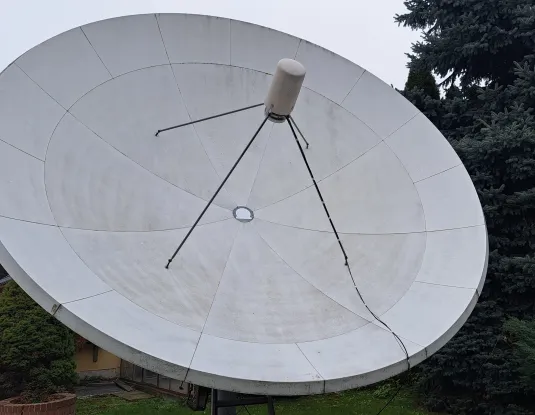
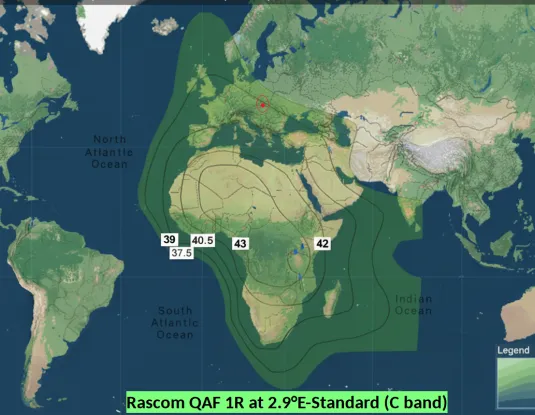
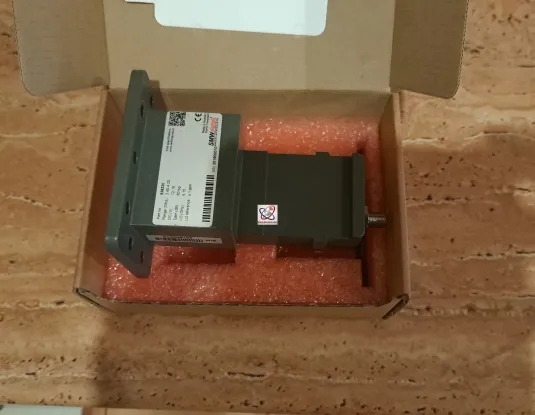
SK:Analýza frekvenčného spektra od 4 068 do 4 070 MHz_R s referenčným analyzátorom Televes Mosaiq-6,SPAN=3-4 MHz :
ENG: Frequency spectrum analysis from 4,068 to 4,070 MHz_R with the reference analyzer Televes Mosaiq-6, SPAN = 3–4 MHz :
4x Radio Maria : SR=128 kSym/s
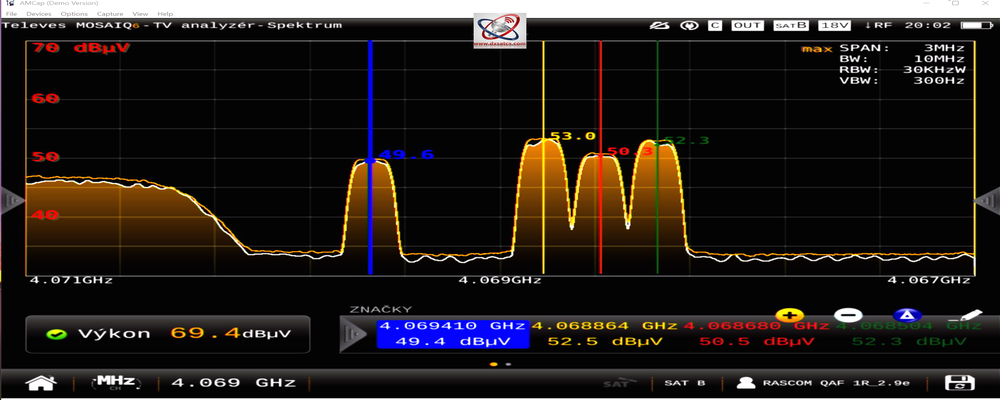
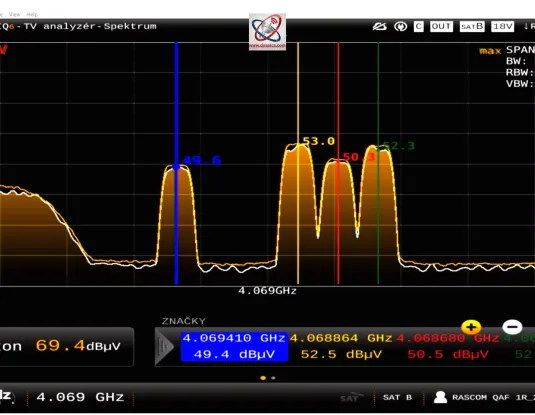
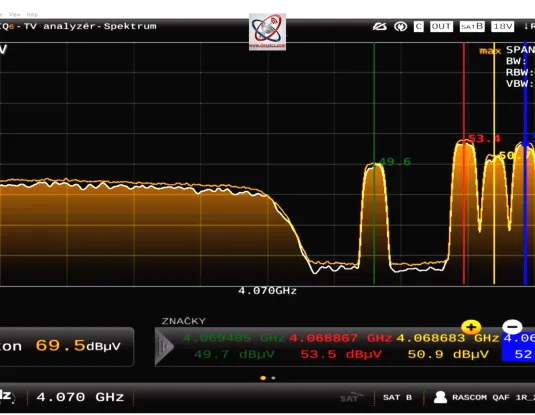
Televes-Mosaiq-6-C-band-spectrum-analysis-rascom-qaf-1r-4x radio-maria-low-SR-symbol-rate-reception
Signálny monitoring štyroch ultra úzkych nosných frekvencií Rádia Mária s SR=128 kSym/s a CW=152 kHz
Signal monitoring of four ultra-narrow carrier frequencies of Radio Maria with SR = 128 kSym/s and CW = 152 kHz
upozornenie :
SK_Všetky tu uverejnené výsledky signálneho monitoringu sú výsledkom prvého, a nie opakovaného, pokusu monitoringu danej frekvencie. Čiže aj potom, čo som zaznamenal výpadok v Locku, som pokračoval v monitoringu a nezačínal som odznova s úmyslom dosiahnutia ideálneho priebehu, lebo inak by som nestihol predpokladaný termín uverejnenia novinky, ktorým má byť, ako vždy, streda, konkrétne 24. 12. 2025. Potom, čo som v piatok 19. 12. 2025 identifikoval samotnú existenciu štyroch nosných Rádia Mária s SR = 128 kSym/s, som začal vykonávať signálny monitoring každej nosnej vo frekvenčnej postupnosti
ENG :All published results of the signal monitoring presented here are the outcome of the first, not a repeated, attempt to monitor the given frequency. Thus, even after observing a lock dropout, I continued the monitoring without restarting with the intention of achieving an ideal signal behavior, because otherwise I would not have met the planned release date of the update, which, as always, is Wednesday, specifically 24 December 2025. After identifying the actual existence of the four Radio Maria carriers with SR = 128 kSym/s on Friday, 19 December 2025, I began to perform signal monitoring of each carrier in frequency sequence
DE_Alle hier veröffentlichten Ergebnisse der Signalüberwachung sind das Ergebnis des ersten, nicht eines wiederholten Versuchs, die betreffende Frequenz zu überwachen. Selbst nachdem ich einen Lock-Ausfall festgestellt hatte, setzte ich die Überwachung fort, ohne mit der Absicht zu beginnen, einen idealen Signalverlauf zu erzielen, da ich sonst den geplanten Veröffentlichungstermin der Neuerung, der wie immer auf einen Mittwoch fällt, konkret auf den 24. Dezember 2025, nicht hätte einhalten können. Nachdem ich am Freitag, den 19. Dezember 2025, die tatsächliche Existenz der vier Träger von Radio Maria mit SR = 128 kSym/s identifiziert hatte, begann ich mit der Signalüberwachung jedes Trägers in Frequenzfolge
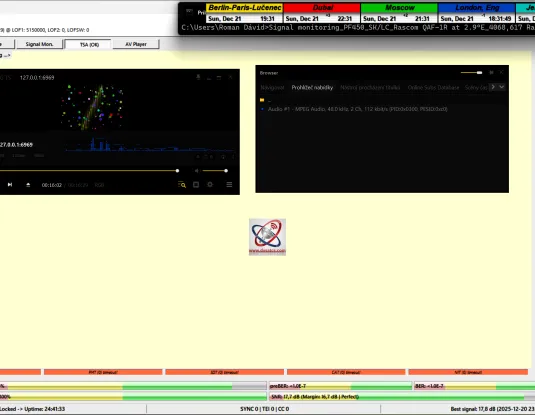
1x- 4068,618 MHz_R- Radio Maria Africa _SR=128 kSym/s
DVBS-S2/QPSK - FEC=1/2 , CW=0,152 MHz
SNR=17,8 dB_Margin=16,8 dB
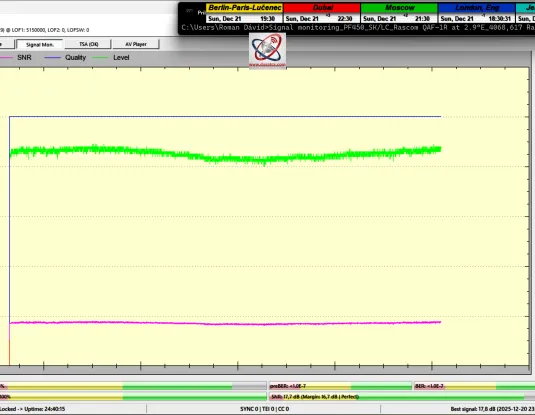
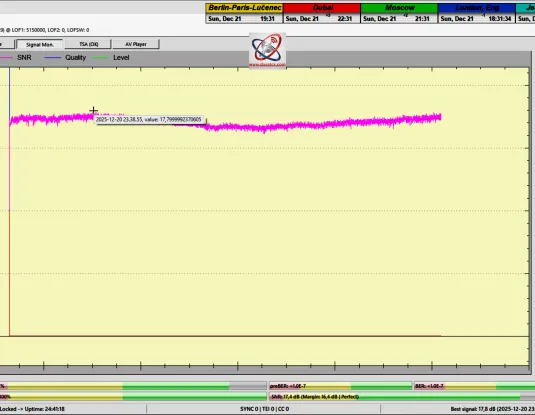
1x Radio-Maria-4068.617-MHz-24H-TBS-signal-monitoring
>Referenčný priebeh a stabilita príjmu na 100%
>Reference behavior and 100% reception stability
>Referenzverlauf und 100 % Empfangsstabilität
>Referenčný priebeh a stabilita príjmu na 100%
>Reference behavior and 100% reception stability
>Referenzverlauf und 100 % Empfangsstabilität
2x- 4068,795 MHz_R- Radio Maria Congo _SR=128 kSym/s
DVBS-S2/QPSK - FEC=1/2 , CW=0,152 MHz
SNR=15,7 dB_Margin=14,7 dB
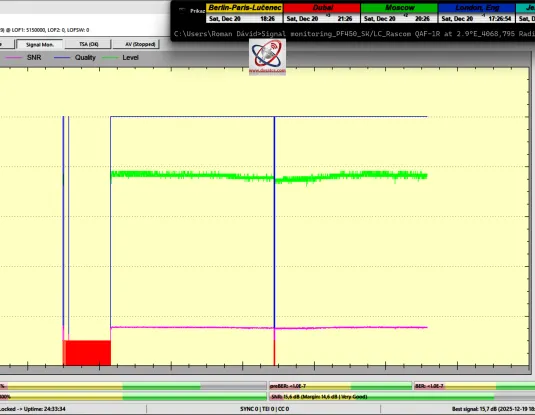
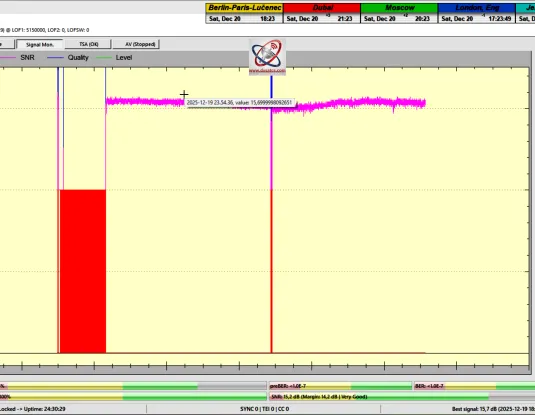
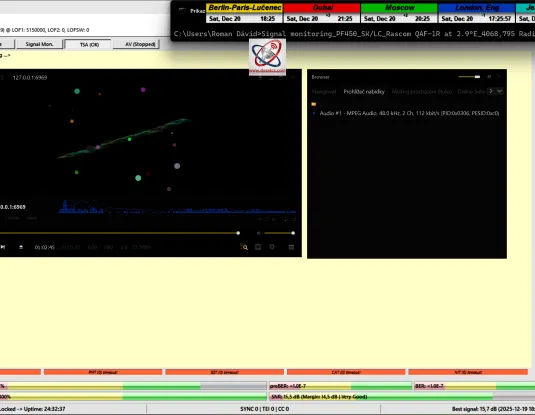
stabilný príjem na 99,988 % s dvoma výpadkami v Locku v trvaní jednotky sekúnd
Stable reception at 99.988% with two lock dropouts lasting several seconds
Stabiler Empfang bei 99,988 % mit zwei Lock-Ausfällen von jeweils wenigen Sekunden Dauer
Stable reception at 99.988% with two lock dropouts lasting several seconds
Stabiler Empfang bei 99,988 % mit zwei Lock-Ausfällen von jeweils wenigen Sekunden Dauer
3x- 4068,977 MHz_R- Radio Maria Africa_SR=128 kSym/s
DVBS-S2/QPSK - FEC=1/2 , CW=0,152 MHz
SNR=18,4 dB_Margin=17,4 dB
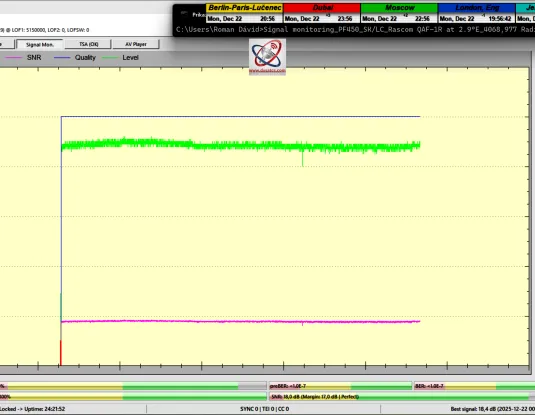
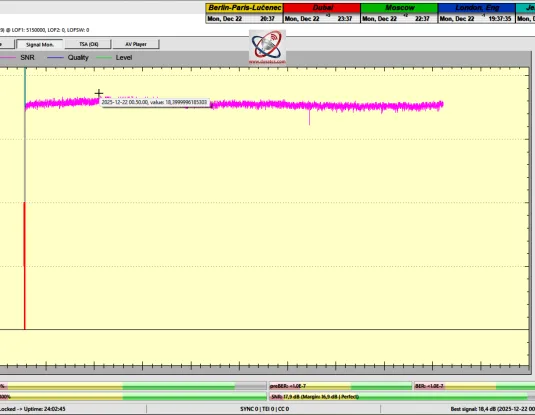
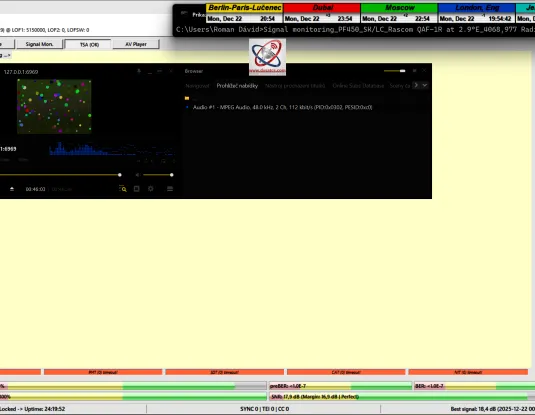
1x Radio-Maria-4068.977-MHz-24H-TBS-signal-monitoring
>Referenčný priebeh a stabilita príjmu na 100%
>Reference behavior and 100% reception stability
>Referenzverlauf und 100 % Empfangsstabilität
>Referenčný priebeh a stabilita príjmu na 100%
>Reference behavior and 100% reception stability
>Referenzverlauf und 100 % Empfangsstabilität
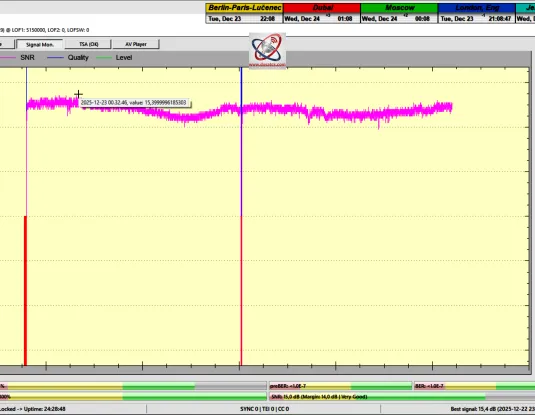
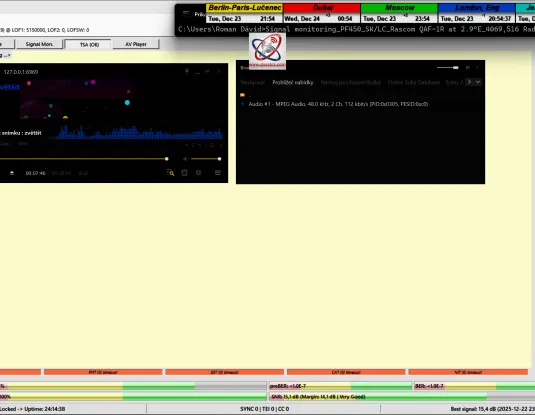
4x- 4069,516 MHz_R- Radio Maria Africa_SR=128 kSym/s
DVBS-S2/QPSK - FEC=1/2 , CW=0,152 MHz
SNR=15,4 dB_Margin=14,4 dB
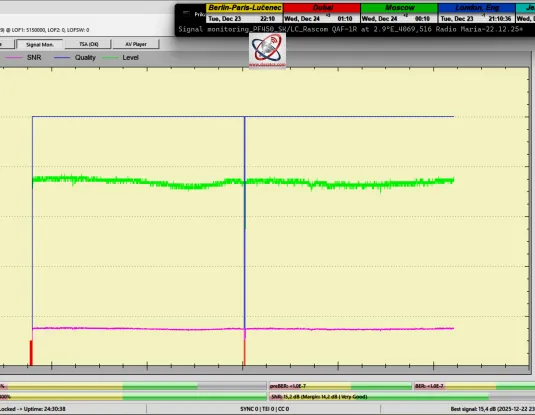
Radio Maria Africa-f=4 069,516 MHz-SR=128 kSym/s
stabilný príjem na 99,9 % s dvoma výpadkami v Locku v trvaní jednotky sekúnd počas dažďových prehánok
Stable reception at 99.9% with two lock dropouts lasting a few seconds during rain showers.
Stabiler Empfang bei 99,9 % mit zwei Lock-Ausfällen von jeweils wenigen Sekunden Dauer während Regenschauern.
stabilný príjem na 99,9 % s dvoma výpadkami v Locku v trvaní jednotky sekúnd počas dažďových prehánok
Stable reception at 99.9% with two lock dropouts lasting a few seconds during rain showers.
Stabiler Empfang bei 99,9 % mit zwei Lock-Ausfällen von jeweils wenigen Sekunden Dauer während Regenschauern.
Radio-Maria-4068,617
Radio-Maria-4068,617
Radio-Maria-4068,617
Radio-Maria-4068,795-MHz
Radio-Maria-4068,795-MHz
Radio-Maria-4068,795 MHz
Radio-Maria-4068,977 MHz
Radio-Maria-4068,977 MHz
Radio-Maria-4068,977-MHz
Radio-Maria-4069,516 MHz
Radio-Maria-4069,516 MHz
Radio Maria-4 069,516 MHz