
>Title of the scientific study and subject of the research...
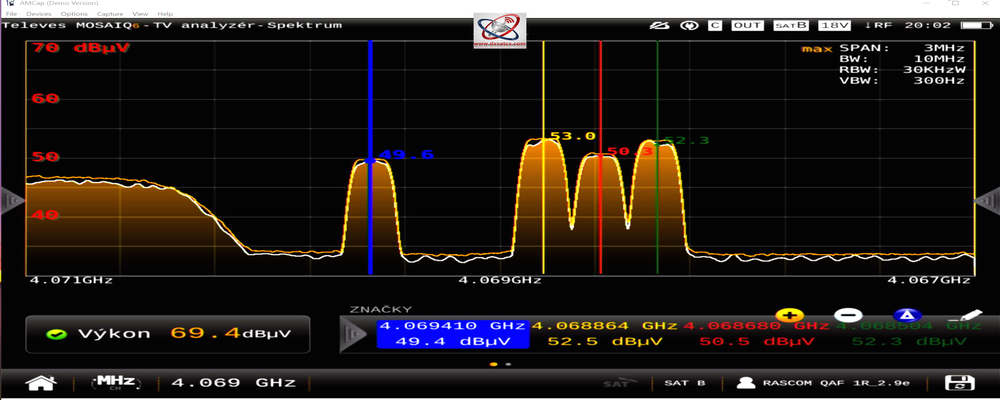
ENG: Slovak scientist and inventor Roman Dávid from Lučenec today publishes, as the very first information source on the global Internet, data on the existence and the possibility of stable reception of the absolute lowest symbol rates SR = 128 kSym/s currently applied in the C-band satellite transmissions worldwide from the Rascom QAF-1R satellite, specifically identifying four Radio Maria carrier frequencies.
>Titel der wissenschaftlichen Studie und Gegenstand der Forschung...
DE:Der slowakische Wissenschaftler und Erfinder Roman Dávid aus Lučenec veröffentlicht heute als weltweit erste Informationsquelle im Internet Daten über die Existenz und die Möglichkeit des stabilen Empfangs der absolut niedrigsten Symbolraten SR = 128 kSym/s, die derzeit in Satellitenübertragungen im C-Band weltweit auf dem Rascom QAF-1R-Satelliten angewendet werden, und zwar konkret vier Trägerfrequenzen von Radio Maria.
>Titre de l’étude scientifique et objet de la recherche...
FR: Le scientifique et inventeur slovaque Roman Dávid de Lučenec publie aujourd’hui, en tant que toute première source d’information sur Internet mondial, des données concernant l’existence et la possibilité de réception stable des taux de symboles SR = 128 kSym/s les plus bas actuellement appliqués dans les transmissions satellitaires en bande C dans le monde, provenant du satellite Rascom QAF-1R, identifiant spécifiquement quatre porteuses de Radio Maria.
Introduction to the Assignment
Slovak scientist and inventor Roman Dávid and his research center hereby become the very first on the global internet to inform the world public about the existence of satellite broadcasting with one of the lowest Symbol Rate (SR) parameters in current global practice of satellite broadcasting in the low-frequency C-band ranging from 3400 to 4200 MHz.
I refer here to the broadcasting of four radio carrier frequencies of Radio Mária with an equally low symbol rate SR = 128 kSym/s, intended for the population of predominantly Central African states, concentrated into a single Standard C radiation pattern of the Rascom QAF-1R satellite. From the perspective of technical categorization of reception, the geographic area of Central Europe falls into the “IN” zone, not the “OUT-of-Footprint reception” zone, for which the provider has set a stable power intensity of approximately 37.5 dBW for most of Central and Western Europe.
The published results of signal monitoring confirm that the Central European reception zone is undoubtedly covered by a stable high EIRP level on the carrier frequencies in the frequency range from 4068 to 4070 MHz, and in terms of day/night comparison, it remains almost constant, showing only minimal intensity oscillation.
The top values of quality in the Signal-to-Noise Ratio (SNR) range of 15–18,4 dB, with a typical and extremely high link margin of 14–17 dB that I recorded, are proof of this. A single monitoring period of t = 24 hours fully suffices as evidence of achieved reception stability of 99–100 % on the carrier frequencies with the applied SR = 128 kSym/s.
Logically, since my reception site is inside the footprint with a clearly defined EIRP value, there is no need to prove reception stability over intervals of t = 48–72 hours (as is usually done in reception zones outside the footprint).
In this case, signal availability is guaranteed by the broadcaster through the Standard C radiation pattern of the Rascom QAF-1R satellite......
link to NEWS : https://www.dxsatcs.com/content/rascom-qaf-1r-c-band-reception-lowest-symbol-rate-sr-radio-maria